| Question | Short Answer |
|---|---|
| What is Echeveria runyonii 'Topsy Turvy'? | It is a stable sport of E. |
| Does 'Topsy Turvy' come true from leaf propagation? | Yes. |
| Is Echeveria runyonii heat tolerant? | Yes. |
| Is Echeveria runyonii cold hardy? | No. |
Echeveria runyonii Rose ex E.Walther was described from material collected along the Rio Grande in Tamaulipas, northeastern Mexico, and extending just into the Texas borderland. Unlike most Echeveria, it is a lowland species, growing below 500 m on rocky outcrops in subtropical thorn scrub. That origin gives it more heat tolerance and more drought tolerance than the classic Mexican highland species.
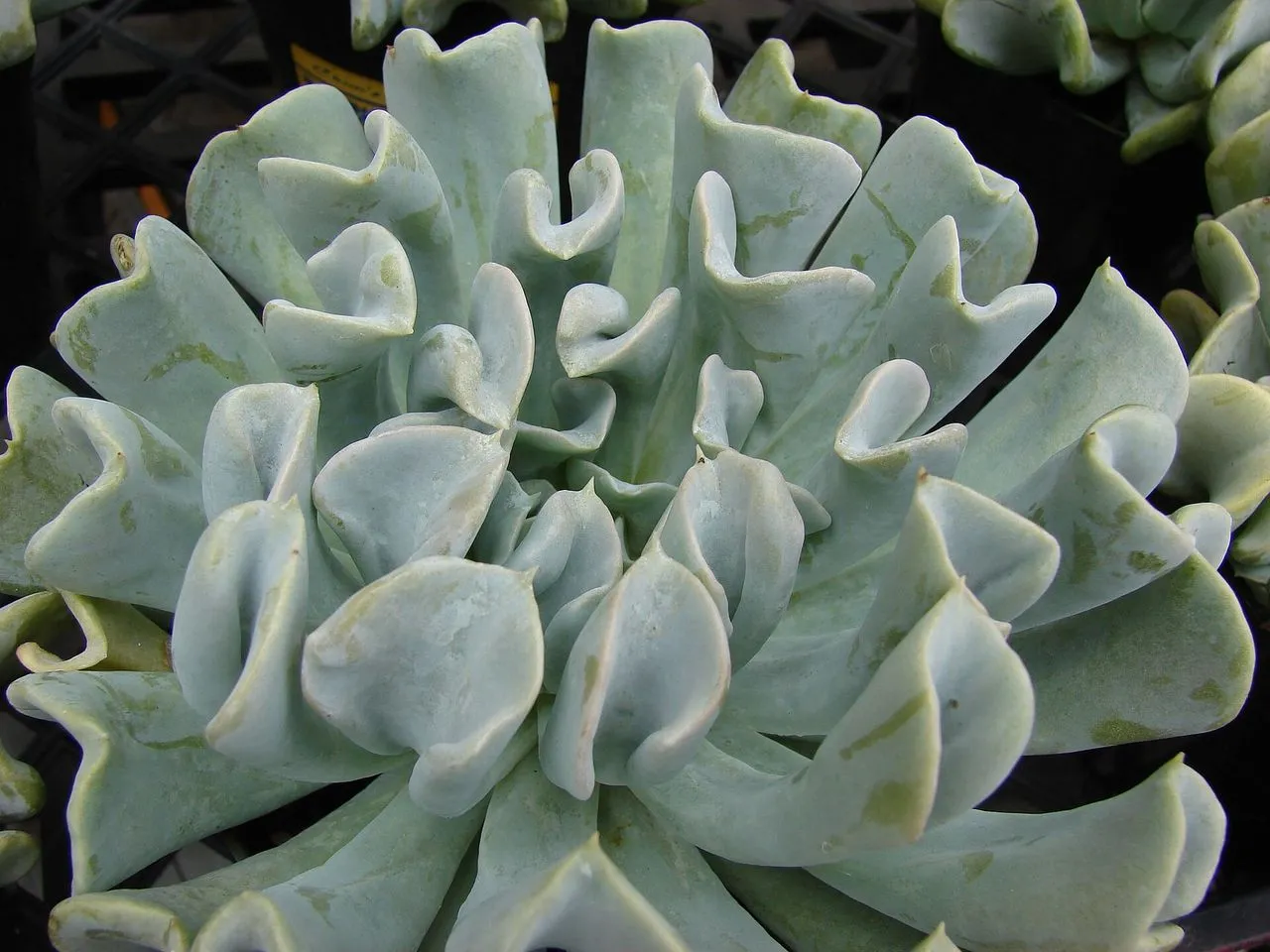
Most plants in cultivation under this name are the sport E. runyonii 'Topsy Turvy', selected decades ago for its strikingly upturned and longitudinally folded leaves.
Part of the Complete Echeveria Guide.
Identification
The species. Rosettes 10 to 15 cm across, 20 to 35 flat, spathulate, pale blue-grey leaves 5 to 8 cm long, faintly farinose. Offsets prolifically. Pink-orange flowers on tall arching scapes in summer.
'Topsy Turvy'. Same species, but the leaves are folded lengthwise into a shallow channel and the leaf tip curves upward and inward toward the centre of the rosette, so the lower leaf surface ends up on top. The result is a rosette that looks as if every leaf has been rotated 180°. It is fully stable — offsets from 'Topsy Turvy' inherit the trait — and it is the form sold at virtually every general garden centre that stocks this species.
The cultivar is a mutation of a single identification character, so the other diagnostic features — leaf colour, farina, flower form, offset habit — are identical to the species. If you are unsure, look at the pedicel and the flower: the flowers are pink-orange, 12 to 15 mm long, tubular, and carried on a scape that can reach 50 cm.
Cultivation
Cultivation matches the pillar defaults with two species-specific notes.
Heat tolerance. E. runyonii tolerates sustained 35 °C plus outdoors, which is more than most collected Echeveria. In a Mediterranean summer it keeps growing through periods when E. lilacina and E. laui pause. This makes it a good outdoor container plant in hot climates.
Cold tolerance. Poor. As a lowland subtropical species, it suffers leaf damage below 2 °C and rot at 0 °C with any substrate moisture. Protect through winter.
Water on the standard genus schedule. The channeled 'Topsy Turvy' leaves collect more water in the rosette than a flat species and must not be allowed to sit wet; water only the substrate, tilt the plant to drain any pooled water in the rosette centre after heavy rain.
Propagation
Leaf propagation is easy at 70 to 90 percent success, equivalent to E. elegans. 'Topsy Turvy' comes true from leaf. Detach a mature lower leaf by a gentle sideways twist, callus three to five days, lay base-down on damp mineral mix, and expect plantlets in three to four weeks.
Offset division is the fastest route. The species produces offsets aggressively; a mature clump yields five to fifteen rooted offsets per year. Cut at the base with a sterile blade, leaving as much stem as possible, callus three to five days, pot into dry mix, water sparingly after a week.
Stem cutting is useful on old leggy plants. Behead, callus a week, root on dry pumice. The remaining stump usually produces a dozen small new rosettes — one of the best methods for bulk propagation of 'Topsy Turvy'.
Notes
'Topsy Turvy' is sometimes confused with E. 'Blue Curls' and E. 'Mauna Loa', both of which have frilled leaf margins rather than a simple fold. The distinguishing feature of 'Topsy Turvy' is that the leaf edge stays entire — no ruffling, just a longitudinal fold and an upturned tip.
The species is not self-compatible. Seed from a single plant will not be viable. If you want to breed from it, source unrelated stock — most commercial 'Topsy Turvy' plants are clonally identical.
See also
- Echeveria elegans — the other easy, prolifically offsetting species.
- Echeveria gibbiflora — large-leaved species with a similarly vigorous habit.
- Echeveria 'Perle von Nürnberg' — hybrid with comparable rosette architecture.
- Echeveria secunda — another compact clumping species for comparison.
Frequently Asked Questions
What is Echeveria runyonii 'Topsy Turvy'?
It is a stable sport of E. runyonii with leaves folded lengthwise so the tips curve upward toward the centre of the rosette.
Does 'Topsy Turvy' come true from leaf propagation?
Yes. The folded-leaf trait is stable, and leaf propagation succeeds at about 70 to 90 percent.
Is Echeveria runyonii heat tolerant?
Yes. Its lowland origin gives it better tolerance of sustained 35 °C conditions than many highland echeverias.
Is Echeveria runyonii cold hardy?
No. It suffers leaf damage below 2 °C and can rot at 0 °C if any substrate moisture is present.