| Question | Short Answer |
|---|---|
| How cold hardy is Echeveria secunda? | Bone-dry plants can survive brief exposure to −7 °C and sometimes −10 °C. |
| How is Echeveria secunda different from Sempervivum? | E. |
| How do you propagate Echeveria secunda? | Offset division is easiest and extremely productive, with 8 to 15 rooted offsets per mature clump each year. |
| How large does Echeveria secunda get? | Single rosettes are usually 5 to 10 cm wide and form dense low cushions through short basal stolons. |
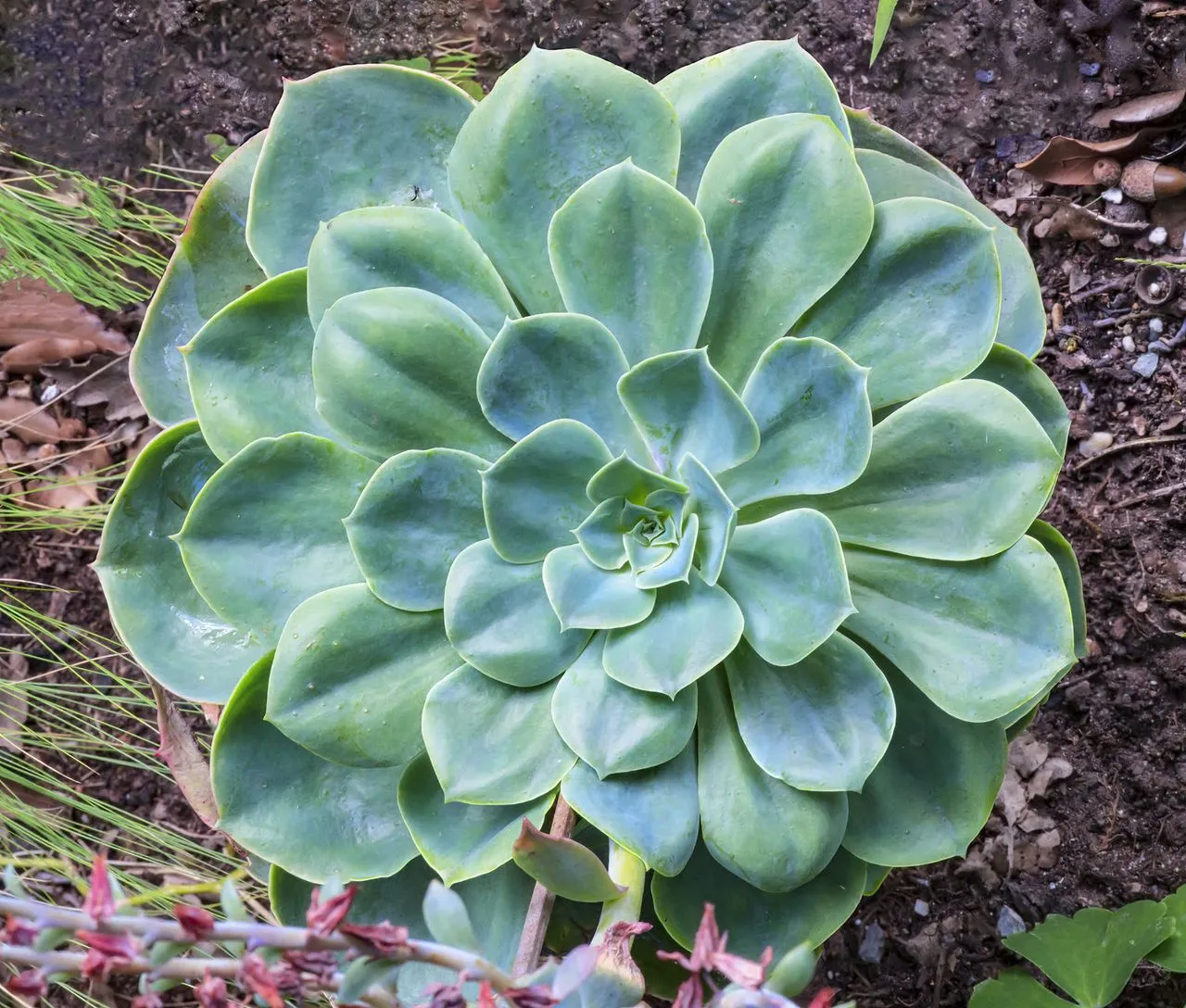
Echeveria secunda Booth ex Lindl., the Mexican hens-and-chicks, was described by Joseph Booth and validated by John Lindley in 1838 from material out of central Mexico. The species holds the widest natural distribution of any Echeveria, occurring across Hidalgo, Puebla, Tlaxcala, Veracruz, and Estado de México at 2,000 m to 3,000 m, where it forms tight pale blue-green rosettes with a sharp red-tipped terminal mucro on each leaf.
In habitat the species clings to volcanic rock and limestone slopes in the Trans-Mexican Volcanic Belt, from cool oak-pine zones at the lower end of its range up to high meseta sites where light frosts are routine in winter. That altitudinal breadth is the reason E. secunda is among the most cold-tolerant soft echeverias in cultivation. Dry plants take brief exposure to minus 7 °C to minus 10 °C without losing the rosette, a tolerance otherwise matched only by E. agavoides among the soft Echeveria. The substrate at habitat is shallow, mineral, and very free-draining, and rainfall arrives mostly in summer with a long dry winter.
Part of the Complete Echeveria Guide.
Identification
A single rosette of E. secunda measures 5 to 10 cm across, sits stemless on the substrate, and is tight enough that the outline reads almost spherical on young plants. The leaves are obovate to spathulate, 2 to 4 cm long, thick and densely packed, pale blue-green under a fine waxy bloom that wears off where you handle it. The diagnostic feature is the leaf tip: each leaf carries a short, sharp, hardened terminal mucro that flushes red, sometimes maroon, in good light and cold weather. Run a fingertip across the apex and you will feel the firm point.
Offsetting is the second key character. E. secunda is one of the most prolific clumping species in the genus, sending out short basal stolons that root and form daughter rosettes within a single growing season. A mature plant becomes a dense low cushion of identical rosettes, which is the source of the hens-and-chicks common name. The habit is superficially similar to Sempervivum, but E. secunda is a true Echeveria and the two are not in the same genus.
The flowers settle the question. A lateral scape rises 15 to 25 cm in spring, bearing a cincinnus of bright red-orange tubular flowers with yellow tips. Flowering is polycarpic: the rosette flowers, sets seed if pollinated, and continues to grow and offset for many seasons. Sempervivum, by contrast, is monocarpic per rosette; each rosette flowers once and then dies, replaced by its previously formed offsets. Watch the parent rosette through the season after flowering and you will see which genus you are holding. Leaf attachment also differs (Sempervivum leaves are thinner and more strap-like), but the inflorescence is the cleanest character.
Distinguishing from related Echeveria:
- E. elegans is purer blue-white, almost chalk-coloured, with rounder leaves and no marked red apex. Its rosette is similar in size, but offsetting is much slower; an E. elegans plant takes several seasons to form the dense cushion that E. secunda makes in one. E. elegans flowers are pink-red with yellow-orange interiors rather than the red-orange-and-yellow bicolour of E. secunda.
- E. agavoides matures at 15 to 20 cm across, several times the size of E. secunda, with narrow agavoid leaves that taper to a sharp point but lack the marked terminal mucro. It rarely forms tight clumps. The two species share a similar cold tolerance, which is the most striking horticultural overlap, but they are easy to tell apart on size and leaf shape.
When in doubt, the working separators are: rosette under 10 cm, dense basal clumping, sharp red-tipped mucro, and a polycarpic red-orange-and-yellow inflorescence.
Cultivation
Light. E. secunda colours best in four to six hours of direct sun after a careful acclimation. Outdoors in temperate Europe or coastal North America, a south or southeast aspect with light afternoon shade in midsummer holds the rosette tight and brings the red apex flush to its full intensity. Indoors, an unobstructed south or east window suits it. Low light flattens the rosette, fades the red tip, and produces longer, paler leaves that the species does not normally carry.
Water. In active growth, water deeply once the top 3 cm of mix reads dry to a probe or finger. For a single rosette in a 9 cm terracotta pot, that usually means every 9 to 14 days in warm weather. In winter, drop to a single light watering every 4 to 6 weeks; if the plant sits below 5 °C, keep it bone-dry. Water around the rosette, never into the crown, since the tight cushion of E. secunda holds water more readily than smoother species and crown rot starts there.
Substrate. Aim for 65% to 75% mineral fraction. A working blend is pumice or 3 to 6 mm lava grit with the remainder a peat-free loam-based compost; small amounts of limestone grit are fine and match the habitat. The pot must dry inside a 48-hour window after a full watering. A 9 to 11 cm terracotta pot suits a single mature rosette; once offsets fill the rim, move the clump up to 13 to 15 cm rather than splitting it, since clumped plants flower more reliably.
Temperature tolerance is where E. secunda separates from most soft echeverias. Steady growth runs from 8 °C to 28 °C. Brief exposure of bone-dry plants to minus 7 °C, and in some collections minus 10 °C, has been documented without loss of the rosette. This is comparable only to E. agavoides among the soft Echeveria and well outside the survival window of E. elegans, E. derenbergii, or most of the genus. The substrate condition is non-negotiable. Wet roots at minus 2 °C will rot a plant that bone-dry roots at minus 8 °C will shrug off. In summer above 32 °C, give afternoon shade and ventilation, especially for plants in small pots that overheat fast.
Feeding is light. One dilute, low-nitrogen feed in mid-spring covers a season for a plant in fresh mix. If you want a baseline watering and feeding habit before tuning to this species, the beginner's guide to succulents sets out the method that the cultivation notes above refine for E. secunda.
Propagation
Three methods all work, and the offset route is so productive that it is the only one most growers ever use.
Offset division is the obvious starting point. Once an offset has put down its own roots and is a third the width of the parent rosette, twist or cut it free with a clean blade. Let the wound dry in shade for 4 to 7 days, set the offset on dry mineral mix, and resume light watering after about two weeks in warm conditions. Success runs above 95% on rooted offsets. From a mature clump you can lift 8 to 15 rooted plants per year without weakening the parent, which is more than most growers know what to do with.
Leaf propagation is straightforward. Detach a healthy, fully expanded leaf with a clean sideways twist; a torn base is the main reason for failure. Callus the leaf for 4 to 6 days, then place it on barely damp pumice in bright shade at 21 °C to 25 °C. Roots and a small plantlet appear within 3 to 5 weeks, with success around 75% to 85% on cleanly removed leaves. The new rosette reaches potting size in 3 to 4 months.
Seed is mainly useful for breeding work or for repopulating habitat, not for keeping a clone. E. secunda crosses readily with neighbouring species in cultivation, and seed-grown plants segregate visibly. For a clean species reference, propagate vegetatively.
Notes
The species is variable across its wide range, and several geographic forms circulate in collections, including E. secunda var. glauca (sometimes treated as a synonym, sometimes as a separate variety) and selected clones such as 'Reglensis' and 'Pumila'. Plants from the eastern, lower-elevation populations in Veracruz and parts of Puebla tend to be slightly larger and less cold-tolerant than plants from the high meseta in Hidalgo and Estado de México. A label that simply reads E. secunda gives no information about which population the plant came from; if cold tolerance matters in your climate, ask the supplier for the provenance.
Pests are conventional for the genus. Mealybugs find the dense crown and the bases of offsets, where they hide until populations are large; pull a clump apart every season or two for inspection. Aphids appear on the flower scape in spring and clear with a hose rinse. Fungal crown rot is rare in well-drained mineral substrate but follows fast if water sits in the rosette during cool weather.
E. secunda is not toxic to humans, dogs, or cats in any meaningful sense, but the apiculate leaf tips are firm enough to scratch a curious animal's nose, which usually ends the experiment without further damage to the plant.
See also
- Complete Echeveria Guide — genus-level substrate, light, and propagation principles.
- Echeveria elegans — the smaller blue-white sibling that is less cold-hardy and slower to clump.
- Echeveria derenbergii — a similar small species with a red apex flush but no comparable cold tolerance.
Frequently Asked Questions
How cold hardy is Echeveria secunda?
Bone-dry plants can survive brief exposure to −7 °C and sometimes −10 °C. Wet roots at −2 °C can still rot the plant.
How is Echeveria secunda different from Sempervivum?
E. secunda is polycarpic, so the parent rosette survives flowering. Sempervivum rosettes flower once and then die.
How do you propagate Echeveria secunda?
Offset division is easiest and extremely productive, with 8 to 15 rooted offsets per mature clump each year.
How large does Echeveria secunda get?
Single rosettes are usually 5 to 10 cm wide and form dense low cushions through short basal stolons.