| Question | Short Answer |
|---|---|
| How large does Echeveria derenbergii grow? | Single rosettes usually measure 5 to 7 cm across and occasionally reach 10 cm. |
| How do you propagate Echeveria derenbergii? | Offsets are fastest and rooted divisions succeed above 95 percent. |
| How do you tell Echeveria derenbergii from Echeveria pulidonis? | E. |
| Is Echeveria derenbergii cold tolerant? | Dry plants can take brief dips around 0 °C and may survive about −2 °C with cosmetic damage. |
Echeveria derenbergii J.A.Purpus, the Painted Lady, was described by Joseph Anton Purpus in 1922 from material out of southern Mexico, and named for Otto Derenberg, a German plant breeder of the period. The species is small, tight, and unusually generous with offsets, and it has been the parent of so many garden hybrids that its leaf shape and colour now show up on shelves under dozens of unrelated names.
In habitat, E. derenbergii grows on andesitic and limestone outcrops in the states of Oaxaca and Puebla at roughly 1,800 m to 2,400 m. The exposure is bright, the substrate is shallow and mineral, and rainfall comes mostly in summer with long dry winters. Those conditions explain the compact rosette, the heavy waxy bloom, and the red flush at the leaf tips, which intensifies under cold nights and strong light.
Part of the Complete Echeveria Guide.
Identification
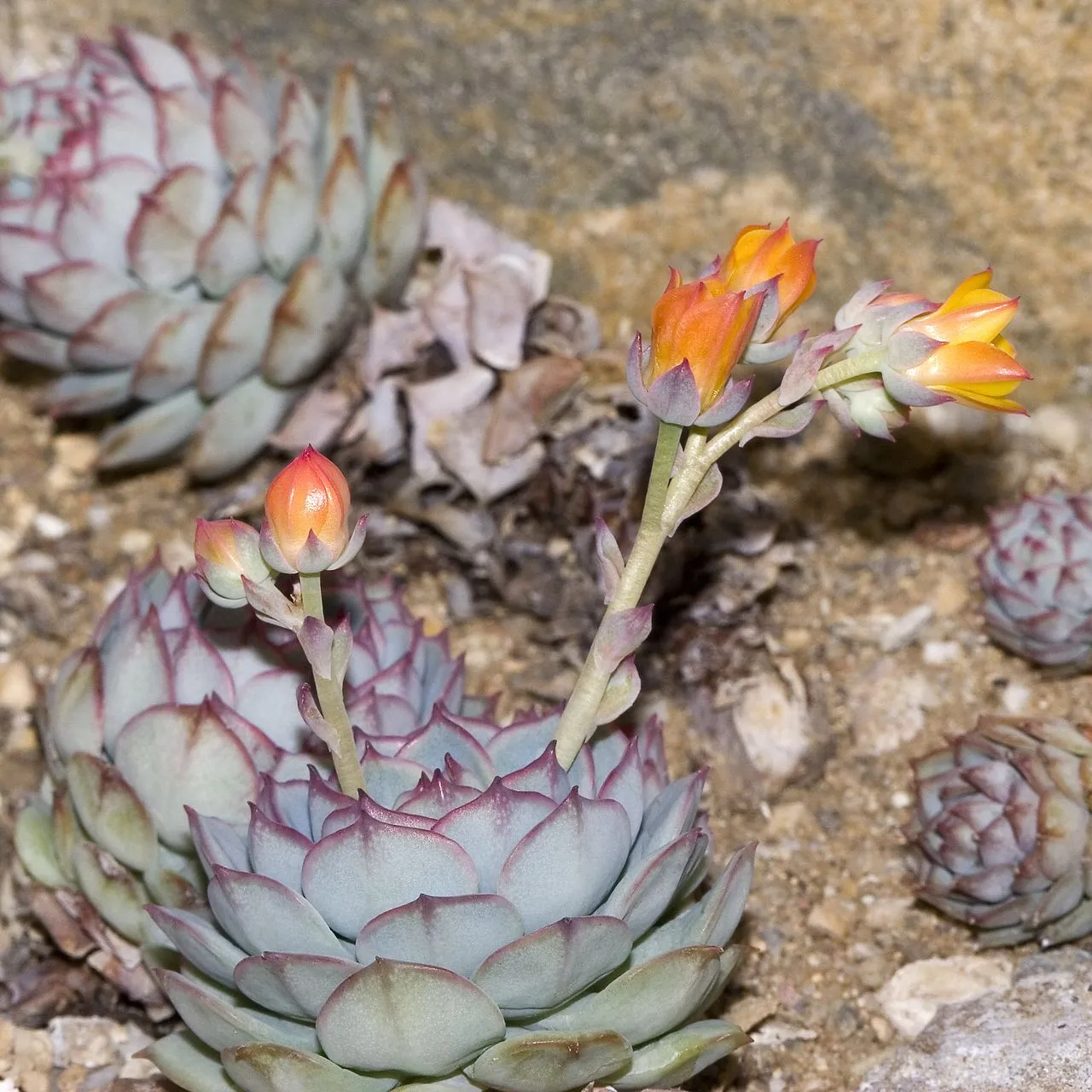
E. derenbergii is among the smaller species in cultivation. A single rosette typically measures 5 to 7 cm across, occasionally reaching 10 cm under generous conditions, and sits stemless or near-stemless on the substrate. The outline is tight and almost ball-shaped on young plants, opening only slightly in mature specimens.
The leaves are obovate, thick, and densely packed, pale grey-green to silvery-blue under a strong waxy bloom. The diagnostic feature is the leaf tip: each leaf carries a clear apiculate terminal mucro (a sharp, hardened point), and the upper third of the leaf flushes red to red-pink in good light, especially in cool weather. Run a fingernail across the apex and you will feel the firm spine; a softer, rounded apex usually points to a hybrid.
Offsetting is heavy. A healthy single rosette will produce 6 to 12 offsets in a year, each developing on a short basal stolon and rooting into the surrounding mix. Within two to three seasons one plant becomes a dense low cushion of identical rosettes. This is one of the most prolific clumping species in the genus, and it is the main reason E. derenbergii is so widely sold as a beginner plant.
The flowers carry the common name. A short scape, usually 10 to 15 cm tall, rises laterally from the rosette in spring and bears a small cincinnus of bell-shaped flowers about 1 cm long. The corolla is bright orange-red on the outside with yellow tips and a yellow throat, and that bicolour pattern is what nineteenth-century English nurseries called "painted". Flowering does not kill the rosette; well-grown plants bloom most years from age two onward.
Distinguishing from lookalikes:
- Echeveria pulidonis has red margins running the full length of each leaf, longer leaves (4 to 6 cm), and a flatter, less ball-shaped rosette. E. derenbergii shows red only at the apex and never along the lateral leaf edges.
- Echeveria elegans is pure blue-white with no red apex flush, and its flowers are pink-red with yellow-orange interiors rather than the orange-and-yellow bicolour of E. derenbergii.
- Echeveria agavoides carries narrow, agavoid, sharply pointed leaves and matures at 15 to 20 cm across; it is several times the size of E. derenbergii and never forms tight clumps.
When in doubt, the combination of small (under 10 cm) rosette, red apex flush only, sharp terminal spine, and dense basal offsetting separates E. derenbergii from almost everything else in trade.
Cultivation
Light is the variable that brings out the species. Give E. derenbergii four to six hours of direct sun after acclimation, ideally morning or late-afternoon sun rather than full midday in hot climates. Outdoors in temperate Europe or coastal North America, a south or southeast exposure with light afternoon shade in summer suits it well. Indoors, an unobstructed east or south window holds the rosette tight and brings the red apex flush to its full intensity. In low light the leaves go flat green, the apex fades, and the rosette starts to open at the centre.
Water on a clear cue. In active growth (spring and early summer, again in early autumn), water deeply once the top 3 cm of the mix is dry and the lower leaves have lost a fraction of their firmness. For a single rosette in an 8 cm terracotta pot, that usually means every 8 to 14 days in warm weather. In winter, drop to a single light watering every 4 to 5 weeks, less if the plant sits below 10 °C. The crown of E. derenbergii catches and holds water more readily than smoother species, so wet the substrate around the rosette and not the leaves themselves.
Substrate should be 60% to 75% mineral. A working blend is pumice or 3 to 6 mm lava grit with the remainder a peat-free loam-based compost; small amounts of limestone grit are fine and match the habitat. The pot must dry inside a 48-hour window after a full watering. If it stays damp longer, the mineral fraction is too low or the pot too deep. A 7 to 9 cm terracotta pot suits a single rosette; once the offsets fill the rim, move the clump up to 10 to 12 cm rather than splitting, since clumped plants flower more reliably.
Temperature tolerance is typical for a highland Mexican species. Steady growth is comfortable between 8 °C and 28 °C. Dry plants take brief dips to 0 °C without damage; brief exposure to about minus 2 °C may cause cosmetic leaf-tip browning but rarely kills the rosette. Keep the substrate bone-dry below 5 °C and provide moving air whenever night temperatures sit close to dew point. In summer above 32 °C, give afternoon shade and ventilation, especially for plants in small pots that overheat fast.
Feeding is light. One dilute, low-nitrogen feed in mid-spring covers a season for a plant in fresh mix. Heavy nitrogen produces large, soft, green leaves and hides the red apex, which defeats the look of the species. If you want a baseline watering and feeding habit before tuning to this species, the beginner's guide to succulents sets out the method that the cultivation notes above refine for E. derenbergii.
Propagation
This is one of the easier echeverias to propagate by any of the three standard methods, and the offset route is so productive that most growers never bother with the others.
Offset division is the obvious starting point. Once an offset has put down its own roots and is a third the width of the parent rosette, twist or cut it free with a clean blade, leaving a small heel of tissue if possible. Let the wound dry in shade for 4 to 7 days, set the offset on dry mineral mix, and resume light watering after about two weeks in warm conditions. Success runs above 95% on rooted offsets. From a mature clump you can easily lift 6 to 10 rooted plants per year without weakening the parent.
Leaf propagation also works. Detach a healthy, fully expanded leaf with a clean sideways twist; a torn base is the main reason for failure. Callus the leaf for 4 to 6 days, then place it on barely damp pumice in bright shade at 21 °C to 25 °C. Roots and a small plantlet appear within 3 to 5 weeks, with success around 75% to 85% on cleanly removed leaves. The new rosette reaches potting size in 3 to 4 months. Keep the propagation tray dry from above and water only at the edge.
Seed is technically possible and can be useful for breeding work, but it is not the right method for keeping the species or any selected clone. E. derenbergii crosses readily with neighbouring species and most cultivated material is grown near other echeverias, so seed-grown plants segregate visibly. For a clean species reference, propagate vegetatively.
Notes
The most important fact about E. derenbergii in horticulture is its role as a parent. It contributed to a long list of hybrids and selections, including 'Painted Lady' (often confused with the species itself), 'Worfield Wonder', and 'Set-Oliver'. Many other widely sold hybrids carry its compact size, red apex, and bell-shaped bicolour flowers. If a plant labelled E. derenbergii has rosettes consistently larger than 10 cm, soft rounded apices, or unicolour flowers, it is almost certainly a hybrid sold under the species name.
Pests on this species are conventional. Mealybugs find the dense crown and the bases of offsets, where they are easy to miss until populations are large; inspect new plants and pull apart clumps every season or two for a quick check. Aphids appear on flower scapes and clear easily with a hose rinse or a fingertip wipe. Fungal crown rot is not common in well-drained mineral substrate but follows quickly if water sits in the rosette in cool weather.
E. derenbergii is not toxic to humans, dogs, or cats in any meaningful sense, but the apiculate leaf tips are firm enough to scratch a curious animal's nose, which usually ends the experiment without further damage to the plant.
See also
- Complete Echeveria Guide — genus-level substrate, light, and propagation principles.
- Echeveria pulidonis — a sibling small species with red leaf margins running the whole edge.
- Echeveria elegans — a smooth blue-white rosette useful for size and colour comparison.
Frequently Asked Questions
How large does Echeveria derenbergii grow?
Single rosettes usually measure 5 to 7 cm across and occasionally reach 10 cm. Healthy plants then form dense clumps through offsets.
How do you propagate Echeveria derenbergii?
Offsets are fastest and rooted divisions succeed above 95 percent. Leaf propagation also works well, with about 75 to 85 percent success.
How do you tell Echeveria derenbergii from Echeveria pulidonis?
E. derenbergii shows red only at the leaf apex, while E. pulidonis carries a continuous red margin along each leaf.
Is Echeveria derenbergii cold tolerant?
Dry plants can take brief dips around 0 °C and may survive about −2 °C with cosmetic damage. Keep substrate bone-dry below 5 °C.