| Question | Short Answer |
|---|---|
| How long does it take for an Echeveria to colour up? | Two to three weeks under overlapping triggers (bright light, cool nights, drought, low nitrogen). |
| Is stress coloring bad for the plant? | No. |
| Why won't my Echeveria turn pink? | The most common reasons are residual nitrogen from summer fertilising, insufficient light (below ~800 µmol/m²/s), or a cultivar that simply doesn't colour heavily. |
| How do I tell stress colour from sunburn? | Stress colour is uniform across the lit surface, tissue feels normal, and the rosette continues to grow. |
The rosy, lavender, peach, or coral hues that Echeveria take on in autumn are not the plant's true colour. They are a stress response, produced by pigments the rosette builds when conditions push it into mild discomfort. The bottom-line answer: bright light, cool nights, and a measured dry spell will turn most cultivars from green to coloured within two to three weeks, and the change reverses cleanly when conditions return to mild. Here is the rest of the picture.
Part of the Complete Echeveria Guide.
What stress coloring actually is
Stress coloring in Echeveria is the visible outcome of a biochemical defence. Two pigment families are involved. Anthocyanins are the larger contributor: water-soluble flavonoids stored in the vacuole that absorb in the green and blue-green band and reflect red, pink, purple, and copper. Carotenoids, mostly accessory pigments already present in chloroplasts, contribute yellow to orange tones and become more visible when chlorophyll levels drop.
Anthocyanin biosynthesis runs through the phenylpropanoid pathway. When the plant senses stress, transcription factors (the MYB-bHLH-WD40 complex in most studied species) up-regulate the enzymes that convert phenylalanine through cinnamic acid, coumaroyl-CoA, naringenin, and on to the cyanidin and pelargonidin glycosides that produce the visible flush. These same compounds appear in autumn maples and red apple skin; the chemistry is shared across higher plants, only the trigger conditions differ.
The function is screening, not decoration. Anthocyanins absorb in the band where chlorophyll is most efficient at converting light to charge separation. By intercepting some of that incoming flux before it reaches the chloroplasts, the pigment limits photo-oxidative damage to Photosystem II. This complements the xanthophyll-cycle quenching the same plant uses to dump excess energy as heat, and the cuticular wax and leaf-angle changes that further reduce surface absorption.
The signalling chain is well studied. Cool temperatures and high light independently raise jasmonate and abscisic acid levels, which activate the relevant MYB transcription factors. Drought adds a third input through ABA. The pathways are partly redundant, which is why any one of the triggers can colour a plant on its own and why colour fades as soon as the inputs relax.
The four triggers
Four environmental conditions push Echeveria into stress coloring. They stack: any one will produce some flush, two together will move the plant most of the way, and all four combined will produce the depth seen on staged display benches at autumn shows.
High light. PPFD above roughly 800 µmol/m²/s sustained over several weeks is the threshold below which most cultivars stay green. A south-facing window in winter sun, an east or west exposure with morning or afternoon direct light through summer, or an outdoor position with bright shade at midday will all move the plant past the threshold for long enough to express anthocyanin. Below that band, even with the other triggers in place, colour stays muted.
Cold nights. Overnight lows of 5 to 10 °C with daytime highs of 18 to 22 °C are the canonical autumn window. Cold nights raise anthocyanin synthesis sharply on their own, which is why colour often appears suddenly in late September or October as the diurnal swing widens. The day-night gap matters more than the absolute low; a 13 °C night following a 14 °C day produces less colour than a 7 °C night following a 20 °C day, because the plant has more daytime photosynthate to convert.
Drought stress. Substrate dry-cycling over 7 to 14 days, where the medium fully dries between waterings, raises ABA and concentrates cell sap. The concentrated vacuolar contents make existing pigment more visible, and the ABA signal up-regulates further pigment synthesis. Drought alone produces a less satisfying colour than light or cold, but combined with either it sharpens the result and improves the contrast between leaf base (greener) and leaf tip (most coloured).
Nutrient balance. A slight nitrogen deficit, with adequate phosphorus and potassium still available, increases pigment expression. Plants pushed with nitrogen-rich fertiliser stay green even under bright cold conditions because abundant amino acids favour chlorophyll synthesis. Cutting nitrogen in the eight weeks before the colour window, while keeping a low-N feed available, gives the cleanest expression. This is why nursery plants pulled from a heavily fertilised production cycle often need a season in your conditions before they colour properly.
Why it is reversible, and sunburn is not
The clearest source of confusion in this topic is that "stress" reads like injury. It is not, in this case. Anthocyanin flushing is a regulated, energy-dependent process. The plant builds the pigment, stores it in living vacuoles, and tears it down again when the screen is no longer needed. Move a coloured Echeveria to mild light, warm nights, and regular watering for three to four weeks and the rosette greens out from the base upward as anthocyanin is degraded and chlorophyll is restored. The leaf is unharmed.
Sunburn behaves nothing like this. Sunburn is photodamage: cells on the exposed surface die, and the bronze-tan necrotic patch that results is fixed in place. No subsequent change in conditions returns that tissue to green. A sunburn mark is dry, papery, locally bounded, and 24 to 72 hours behind the damaging exposure. Stress colour is uniform across the lit surface, tissue is normal in texture, and the rosette as a whole still grows and flowers normally.
The practical consequence: pushing an Echeveria through the four triggers carries no permanent risk, provided the light step is reached through gradual acclimation rather than a sudden move. The rosette will flush, hold colour through the trigger window, then green out when the inputs relax. You can repeat the cycle annually without cumulative damage. What you cannot do is jump an unhardened plant straight from a north window into 1,500 µmol/m²/s outdoor sun and expect the result to be colour rather than scorch.
Cultivar response
Cultivars do not respond identically to the same triggers.
Echeveria agavoides 'Lipstick' shows the cleanest tip-only response. Under cold nights and bright light the leaf tips turn deep red against a green leaf body, producing the eponymous lipstick edge. The pigment is concentrated near the apex where light strikes most directly. Drought sharpens the contrast.
Echeveria 'Black Prince' deepens from its baseline brown-purple to near-black under the same conditions. The cultivar already carries elevated anthocyanin in its standard state, so the flush thickens existing pigment rather than recolouring green tissue. Cold response is the strongest of the four triggers for this cultivar; without cool nights the rosette tends to stay milk-chocolate brown rather than reaching black.
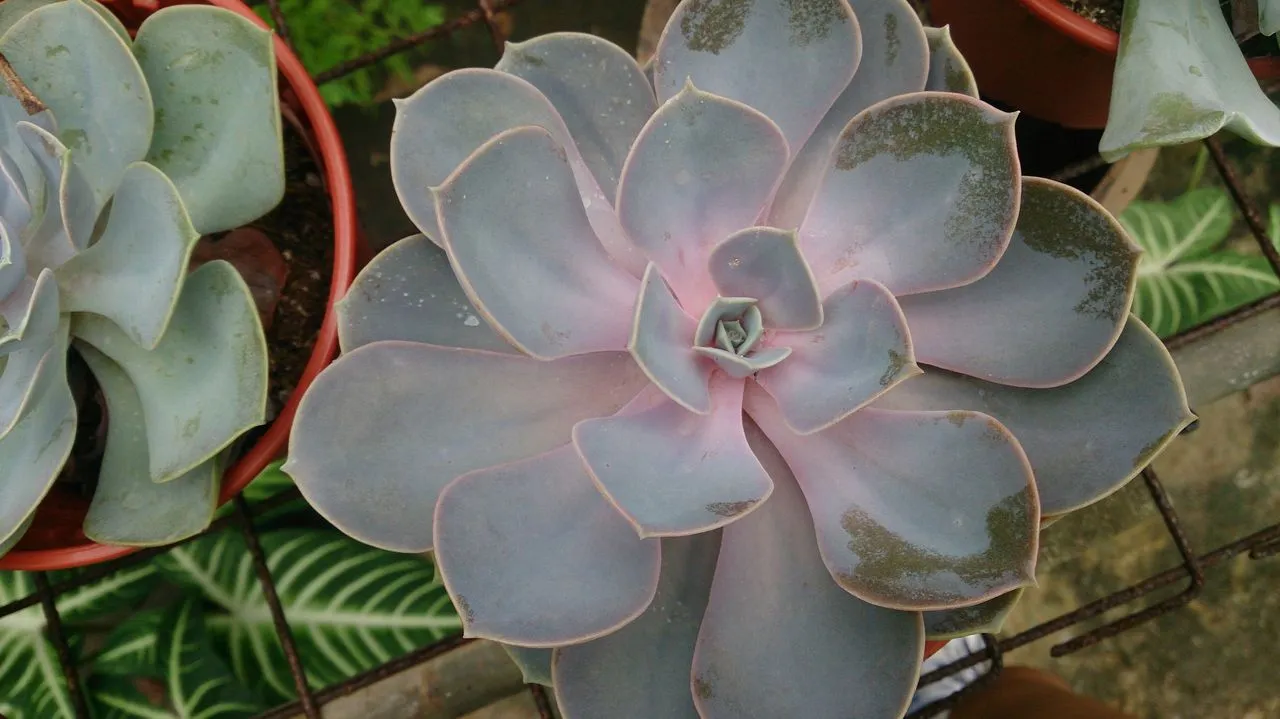
Echeveria 'Perle von Nürnberg' produces the widest gradient of any commonly grown cultivar. Under stress the rosette moves through grey-blue at the leaf base, lavender across the middle, and pink-purple at the tips, with a faint farina bloom over the whole surface. Light is the dominant trigger here; the cultivar colours weakly without sustained PPFD above the 800 µmol/m²/s threshold even when nights are cold.
Echeveria shaviana shows a softer lavender-grey response, more silvery than rosy, with strong frill on the leaf margins. The cultivar tolerates more cold than most before damage, so it can be pushed harder on the night-temperature trigger. Hybrids of Echeveria pulidonis with E. agavoides often produce the cleanest red rim under the four-trigger combination.
A few cultivars colour minimally regardless of conditions. Echeveria elegans, Echeveria laui, and similar species with thick farina and a near-white baseline shift only slightly toward pink under stress. The white wax screens out so much incoming light that the underlying tissue does not need to build heavy anthocyanin protection. Pushing harder will cost the bloom before it produces dramatic colour.
How to push for colour before display
A reliable protocol for autumn or early-winter display uses two to three weeks of overlapping triggers.
Start the schedule when nights begin to drop below 12 °C and daytimes still reach 18 to 22 °C. In a Mediterranean or temperate climate that is typically late September into October. In a glasshouse or cold frame, vent aggressively at night to let the temperature drop. Place the plant in the brightest position available where PPFD reaches the >800 µmol/m²/s window for at least four hours per day.
Reduce watering to a 7 to 14 day dry cycle. Let the substrate go fully dry between waterings, then wet through and let drain. Stop nitrogen fertilising entirely. If you have been feeding through summer, residual nitrogen in the substrate will continue to favour chlorophyll for two to three weeks; that overlap is normal and is part of why the colour deepens slowly rather than appearing overnight.
Watch for the colour gradient to walk inward across the rosette. Echeveria colour from leaf tips down toward the centre over 10 to 21 days. Once the gradient reaches the middle of each leaf and the centre of the rosette is still showing fresh growth, the plant is at peak display. Hold conditions there until the display is over. Do not water heavily, fertilise, or move the plant to lower light during the display window. Any of those will start reversion within days.
How to restore green for plant health
Coloured Echeveria are visibly more eye-catching, but a green rosette photosynthesises more efficiently and grows faster. For plants kept primarily for cultivation rather than display, restoring green between flush periods is sensible.
The reverse protocol is the same triggers relaxed. Move the plant to moderate light around 400 to 600 µmol/m²/s, water on a normal weekly to ten-day cycle once the substrate is dry, restore mild nitrogen feeding at a quarter to a half of full-strength rates, and accept warm room temperatures with no enforced cold drop. Anthocyanin breaks down quickly in living tissue once it is no longer being synthesised, and chlorophyll synthesis resumes within days of the nitrogen returning. Most cultivars green fully within three to four weeks.
A middle-ground approach works for many growers: hold plants at moderate light through spring and summer to push fast growth and propagation, then move them into the four-trigger window from late September for autumn colour, and restore moderate conditions once display is over. Annual cycling does not damage the plant and produces a larger, more colourful rosette over several seasons than continuous high-stress conditions.
For broader context on light handling, water timing, and seasonal adjustment that supports both phases of this cycle, see the Beginner's Guide to Succulents.
See also
- The Complete Echeveria Guide — genus framework, species selection, and core cultivation.
- Echeveria spots on leaves — separating reversible stress colour from permanent sunburn and pest damage.
- Beginner's guide to succulents — light, watering, and seasonal care fundamentals that underpin successful stress colouring.
Frequently Asked Questions
How long does it take for an Echeveria to colour up?
Two to three weeks under overlapping triggers (bright light, cool nights, drought, low nitrogen). The pigment gradient walks from leaf tips inward over 10 to 21 days.
Is stress coloring bad for the plant?
No. Anthocyanin flushing is a regulated, energy-dependent screening response and is fully reversible. Photosynthesis runs slightly slower under stress, so plants kept for growth rather than display are best returned to mild conditions between flush cycles.
Why won't my Echeveria turn pink?
The most common reasons are residual nitrogen from summer fertilising, insufficient light (below ~800 µmol/m²/s), or a cultivar that simply doesn't colour heavily. E. elegans and E. laui stay near-white because their thick farina screens light before pigment is needed.
How do I tell stress colour from sunburn?
Stress colour is uniform across the lit surface, tissue feels normal, and the rosette continues to grow. Sunburn is dry, papery, locally bounded, lags 24 to 72 hours behind the damaging exposure, and never reverses to green.