| Question | Short Answer |
|---|---|
| What is the first step for crested (cristate) cacti and succulents: genetics & care? | Start by matching the symptom to the plant, substrate, light, and season before changing watering or treatment. |
| What should be avoided? | Avoid changing several variables at once; correct the limiting factor and observe the plant before escalating. |
| Which care factor matters most? | Match the plant to its light, substrate, pot size, and season. |
| When should the plant be checked again? | Recheck after one to two weeks unless tissue is actively collapsing. |
Quick Answer
The short answer: A crested/cristate plant has a line-shaped growing point instead of a single point, creating wavy, fan-shaped, or brain-like growth. It's a genetic mutation, not a disease.
Best first step: Cut off any reverted normal shoots within 2-4 weeks, or they'll overtake the crest. Check monthly for pests hiding in the folds.
Avoid: Overwatering - crested forms have weaker root systems and slower growth, so they need smaller pots and less water.
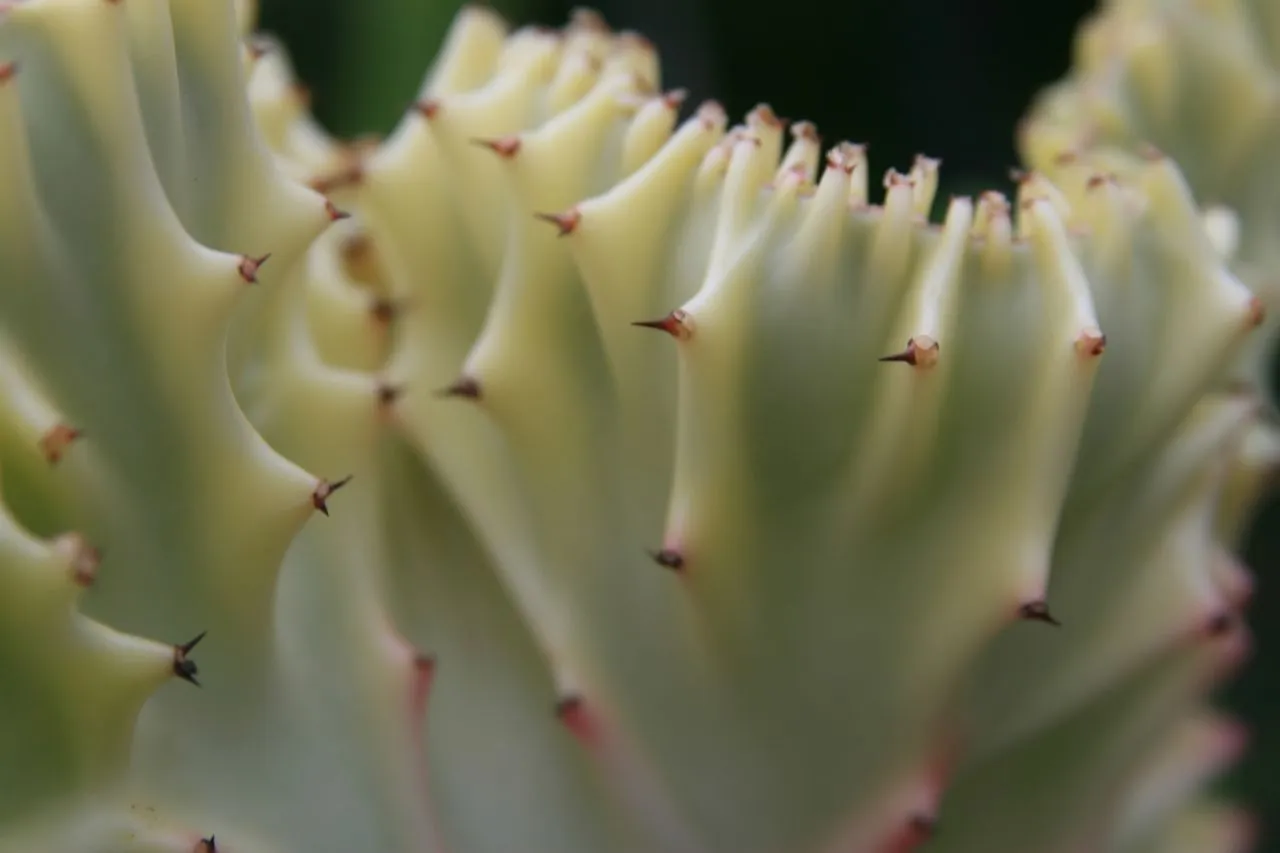
A "crested" or "cristate" cactus or succulent is a plant whose growing point has stopped behaving as a single, dot-sized cell cluster and instead behaves as a long, drawing line. The result is the wavy, brain-like, or fan-shaped growth seen in supermarket "coral cactus" and high-end collector pieces. Cresting is not a disease in the way pests or rot are, and a stable crest can outlive its owner. The catch is that the trait is not always stable, the growth rate is markedly slower than the typical form, and roughly one in ten crests throws a normal-form shoot at some point that, left alone, will overtake the crest. Here is the rest of the picture.
Part of the Beginner's Guide to Succulents.
What "crested" means biologically
A normal cactus or succulent grows from an apical meristem, a small dome of dividing cells at the tip of each stem or branch. Cell division at the dome is roughly radial: the dome stays roughly circular, and the stem behind it stays roughly cylindrical or globular. In a crested plant, that single dome stretches into a line. The actively dividing zone becomes a band of meristematic tissue, sometimes a few millimetres long, sometimes more than a hand-span wide on a mature Cereus or Trichocereus.
Botanists separate two related deformations. Fasciation strictly describes the flattened, fan-shaped form: the growing zone runs as a straight line, and the resulting tissue looks like a flat, ribbon-shaped extension of the stem. Cresting is the broader trade and amateur term, often used for the irregular, convoluted, brain-coral shapes that arise when the meristematic line itself folds and bends as it grows. In practice, the words are used interchangeably outside formal botany, and most plants sold as "f. cristata" or "cristate" sit somewhere along that spectrum.
The mechanism behind both is abnormal cellular proliferation along the apical region. The genes that normally restrict the meristem to a small dome lose their tight regulation, and the dome stretches into a line. The resulting tissue still produces real, functional stem with vascular bundles, areoles, spines or leaves, and (sometimes) flowers. It is laid out along a fan or wave instead of around a column.
Genetic vs viral causes
Four causes account for almost every crested plant in cultivation, but they are not equally likely.
Genetic mutation is by far the most common. A spontaneous mutation in the regulatory genes that control meristem geometry produces a stable cresting trait. The mutation is somatic, meaning it sits in the body cells of one branch or one seedling rather than in seed-line DNA, but it propagates faithfully from cuttings of the crested tissue itself. A cutting of a crested Mammillaria or Echeveria, if it roots, grows back as a crest. Most named cristate cultivars belong to this category, and once stabilised they behave like any other clonally propagated cultivar.
Phytoplasma infection is the second cause, far less frequent in cacti and succulents than in herbaceous perennials but documented. Phytoplasmas are wall-less bacteria that live in phloem tissue and disrupt plant hormone signalling, including the cytokinin and auxin balance that holds a meristem to its normal geometry. Infection-driven cresting is sometimes reversible: if the pathogen load drops or the plant clears the infection, new growth can return to typical form. Crests of viral or phytoplasma origin do not propagate the trait reliably from cuttings, because the cause lives in the phloem rather than the genome.
Physical injury during early apical development can also produce a temporary crest. A spike of cold, a herbivore bite, or mechanical damage that nicks the meristem at the right moment can shift its geometry. These crests rarely propagate, often revert in a year or two, and are not what most cultivar names refer to.
Chemical or hormonal disruption, especially overdoses of cytokinin from misapplied growth regulators, can induce cresting in some genera. These are the least stable of all and almost always revert. Plants where cresting was triggered chemically tend to weaken and decline over a few seasons, and the trait does not survive into cuttings.
Common cristate cultivars in the trade
Several crested forms appear regularly at garden centres, succulent shows, and collector sales. Knowing which is which helps you predict how it will behave on your windowsill.
- Euphorbia lactea f. cristata, the "coral cactus", is probably the most-sold cristate succulent in the world. The fan-shaped, scalloped grey-green or variegated crown is almost always grafted onto a green Euphorbia neriifolia trunk because the crested top has a weak root system. It is technically a Euphorbia, not a cactus, despite the trade name.
- Cereus peruvianus 'Monstrose' (more correctly referable to Cereus repandus) is sold as "monstrose apple cactus". Strictly this is a monstrose mutation rather than a true crest, meaning the deformation lies in the offsetting and areole pattern rather than along a single fan, but the underlying genetics are similar and the trade groups them together.
- Lophocereus schottii 'Monstrose', the totem pole cactus from Sonora, has a smooth columnar form covered in irregular knobs and bumps where areoles would normally sit. Like Cereus 'Monstrose', it is a monstrose mutation rather than a fasciation.
- Trichocereus pachanoi f. cristata, the crested San Pedro, produces broad fan-shaped greyish columns that can reach more than a metre wide in mature specimens. It is one of the more vigorous cristate cacti and circulates widely in collector circles.
- Mammillaria spinosissima 'Un Pico' f. cristata is a small-bodied Mexican mammillaria with single-spined areoles, popular in dish gardens because the crest stays compact and slow.
- Echeveria 'Topsy Turvy' cristata forms appear sporadically as one or two heads on otherwise normal Echeveria runyonii 'Topsy Turvy' clumps. The crested rosettes are denser and more compact than typical Echeveria fans and command a premium when stable.
The pattern across all of these: the cresting trait propagates only from crested tissue, and the most stable named cultivars are decades old in cultivation.
Why they're slower-growing
Crested forms grow roughly 30 to 60% slower than the typical form of the same species under identical conditions. Three biological factors drive this.
The first is hormonal. The apical meristem of a normal plant produces auxin in a concentrated way, and that hormone gradient drives strong, directional growth. A line-shaped meristem produces a more diffuse hormone signal across its length, and downstream growth is correspondingly less vigorous.
The second is geometric. A fan-shaped or convoluted body has more surface area per unit of vascular tissue than a cylinder. The same root system has to push water and sugars through a more sprawling conduction network, and the per-unit growth rate drops.
The third is photosynthetic. The convoluted surface of a cristate plant catches less direct light per gram of tissue than the smooth surface of a column or globe, because parts of the body shade other parts. A cristate Mammillaria sitting next to its normal sibling under the same window will have lower net daily carbon gain.
The practical consequence is that a 10 cm cristate seedling can take 8 to 12 years to reach the size a normal seedling reaches in 5. Plan accordingly when you buy small.
Care differences from the typical form
Crested plants tolerate the same general conditions as their normal form (substrate, light intensity, temperature range), but several specific care points matter more than for the typical form.
Airflow. The convoluted surface of a crest traps moisture in its folds and creases. After watering or after high-humidity periods, water can pool in crevices for hours longer than it would on a smooth column. Move the plant to a position with steady airflow, or run a small fan during the wettest months. Stagnant humid air against a crested surface is the most common cause of fungal lesions on collector specimens.
Pest checks. The same crevices that trap moisture also harbour mealybug colonies. Mealybugs that would be visible on a smooth Echinopsis can hide for months in the seams of a Trichocereus crest. Inspect crests with a hand lens monthly, and pay attention to the inner folds where the brain-coral pattern doubles back on itself.
Pot size. Crested plants typically have weaker, smaller root systems than the typical form (a consequence of the same hormonal weakness). A standard terracotta pot sized for the equivalent normal plant will be too large; the substrate stays wet too long around an undersized root system. Drop one pot size from what you would use for a non-crested specimen of the same diameter.
Watering rhythm. Watering frequency stays similar, but quantity drops. The slower growth rate and weaker roots mean less daily transpiration, so the substrate dries more slowly. Wait until the substrate reads clearly dry to a wooden skewer (no darkening, no resistance) before watering again.
Light. Bright but indirect light tends to suit crests better than the harshest summer sun. Folds in the body can scorch where hot direct sun catches them at an angle that the typical cylindrical form would not see, and scorched cristate tissue does not regrow cleanly.
Reverting to typical: when and how to manage
Spontaneous reversion is real and common. Roughly 5 to 15% of crested plants throw at least one shoot of typical, normal-form growth at some point in their lives. The dynamics closely parallel chimeric reversion in variegation: stable vs unstable cultivars, where a single reverted sector similarly threatens the patterned tissue if not removed promptly. The reverted tissue sits on the genetics of the plant beneath it, but its meristem is back to the unmutated state, and reverted shoots almost always grow faster than the surrounding crest. Left alone, a single typical shoot will dominate the plant within a year or two, draining water and sugars away from the crest and eventually reducing the cristate portion to a small surviving wedge or killing it outright.
Manage reversion proactively.
- Inspect the plant monthly. A reverted shoot is easy to spot: it grows perpendicular to the crest's plane, looks like a normal small column or rosette emerging from the fan, and is usually visibly more vigorous within two or three weeks.
- Cut the reverted shoot off cleanly at its base, flush with the cristate tissue, within 2 to 4 weeks of first appearance. Use a sterilised blade. The longer you wait, the deeper the vascular connection, and the harder the cut becomes.
- Dust the wound with sulphur or cinnamon and keep it dry for 7 to 10 days while it calluses.
- If you want to keep the typical-form plant as well, treat the cut shoot as a stem cutting and root it separately. The typical form will grow back as typical and behave as the species normally does.
If the cresting was caused by physical injury or chemical disruption rather than genetic mutation, reversion is often impossible to stop: every new growing point reverts, and the plant returns to typical form within a couple of seasons. This is not a fault you can fix; the trait was never stable to begin with.
Pricing and ethics
Pricing of cristate forms varies enormously and tells you something about the plant's stability.
Common species (Euphorbia lactea, Cereus repandus 'Monstrose', Trichocereus pachanoi) typically sit at €15 to €50 in European garden centres and online specialist nurseries. These are well-established cultivars, propagated for decades, and a moderate-quality specimen at the lower end of that range is a reasonable buy.
Rarer crested forms (true Astrophytum asterias f. cristata, Ariocarpus crests, Lophophora williamsii crests, named Aztekium crests) run €100 to €500 and occasionally far higher at specialist auctions. The price reflects both the rarity of the species and the genuine difficulty of producing a stable, large cristate specimen of a slow-growing genus.
Two ethical points are worth keeping in mind.
The first is that crests induced by chemical or hormonal treatment, sold as if they were genetic, are unstable, decline over a few seasons, and amount to a form of deception. A reputable seller will tell you whether a crest is propagated from a long-established mother plant or whether it appeared spontaneously in their stock. If a vendor cannot say where the crest came from, treat the plant as unstable and price it accordingly.
The second is that cristate forms of CITES-listed genera (Ariocarpus, Lophophora, Turbinicarpus, certain Aztekium) are subject to the same trade rules as the typical form. Buy only from sellers who can produce CITES paperwork or evidence of artificial propagation. The crest does not change the legal status of the plant.
See also
- A Beginner's Guide to Succulents: the underlying light, water, substrate, and pot-size decisions that apply to crested forms as well as typical ones, with the small modifications above
- Variegation: stable vs unstable cultivars: another morphological variant with a parallel reversion-management problem
- Indoor succulent care: the light, watering, and container decisions that apply to crested forms indoors
- Pot size selection: choosing the smaller pot size that crested root systems need
FAQ
Are crested plants more expensive?
Yes. Common crests like Euphorbia lactea f. cristata (coral cactus) cost €15-50. Rare collector crests (crested Astrophytum, Lophophora) cost €100-500+.
How fast do crested cacti grow?
30-60% slower than normal forms. A 10cm cristate seedling takes 8-12 years to reach what a normal one reaches in 5 years.
Will my crest revert to normal growth?
Possibly. About 5-15% of crests throw a normal shoot at some point. Cut it out promptly - if left alone, it will dominate and kill the crest.
Why are crested forms grafted onto a trunk?
The crested top has a weak root system. Grafting onto a vigorous rootstock (like Euphorbia neriifolia for coral cactus) gives it stability and strength.
Frequently Asked Questions
What is the first step for crested (cristate) cacti and succulents: genetics & care?
Start by matching the symptom to the plant, substrate, light, and season before changing watering or treatment.
What should be avoided?
Avoid changing several variables at once; correct the limiting factor and observe the plant before escalating.
Which care factor matters most?
Match the plant to its light, substrate, pot size, and season. Most succulent failures trace to a mismatch between drying speed and the plant's current growth rate.
When should the plant be checked again?
Recheck after one to two weeks unless tissue is actively collapsing. Stable firmness and new growth are better signs than a fixed calendar interval.