| Question | Short Answer |
|---|---|
| What is fasciation in haworthias? | A normal single apical meristem becomes elongated into a line, so leaves emerge along a ridge rather than around a point. |
| Are fasciated haworthias grown differently? | They follow the care of the underlying species, but watering restraint is more important because the enlarged meristem line is more susceptible to rot. |
| How do you propagate cristate haworthias? | Vegetative propagation is the reliable route. |
| Can fasciated haworthias revert to normal rosettes? | Yes. |
Fasciated haworthias are plants in which the normal single growth point has been replaced by a linear meristem, producing a flattened, fan-shaped or convoluted crest instead of a rosette. The phenomenon is called fasciation (from Latin fascia, a band or ribbon) or cristation, and the resulting plants are sold as "crested" or "cristate" forms. They are some of the most collectable mutations in the genus.
This article covers fasciation across the whole haworthia group rather than any single species; cristate forms are known from Haworthia cooperi, H. cymbiformis, Haworthiopsis fasciata, H. attenuata, H. limifolia and many others.
Part of the Complete Haworthia Guide.
What fasciation is
A normal Haworthia rosette grows from a single apical meristem that produces leaves spirally around a central point. In a fasciated plant the meristem has become elongated into a line rather than a point, so new leaves emerge along a ridge instead of around a centre. The visible result is a fan, a wave, or a brain-like series of folds, sometimes several centimetres wide.
The causes are not always well characterised. Fasciation can arise from somatic mutation, hormonal disturbance, injury to the growing point, viral or bacterial infection, or genetic predisposition. In haworthias the trait is usually somatic and partially heritable through vegetative propagation; seed rarely reproduces cristate character faithfully.
Fasciation is distinct from monstrose growth, in which multiple meristems proliferate chaotically rather than forming a clean crest. Monstrose haworthias exist but are less often seen in the trade.
Identification
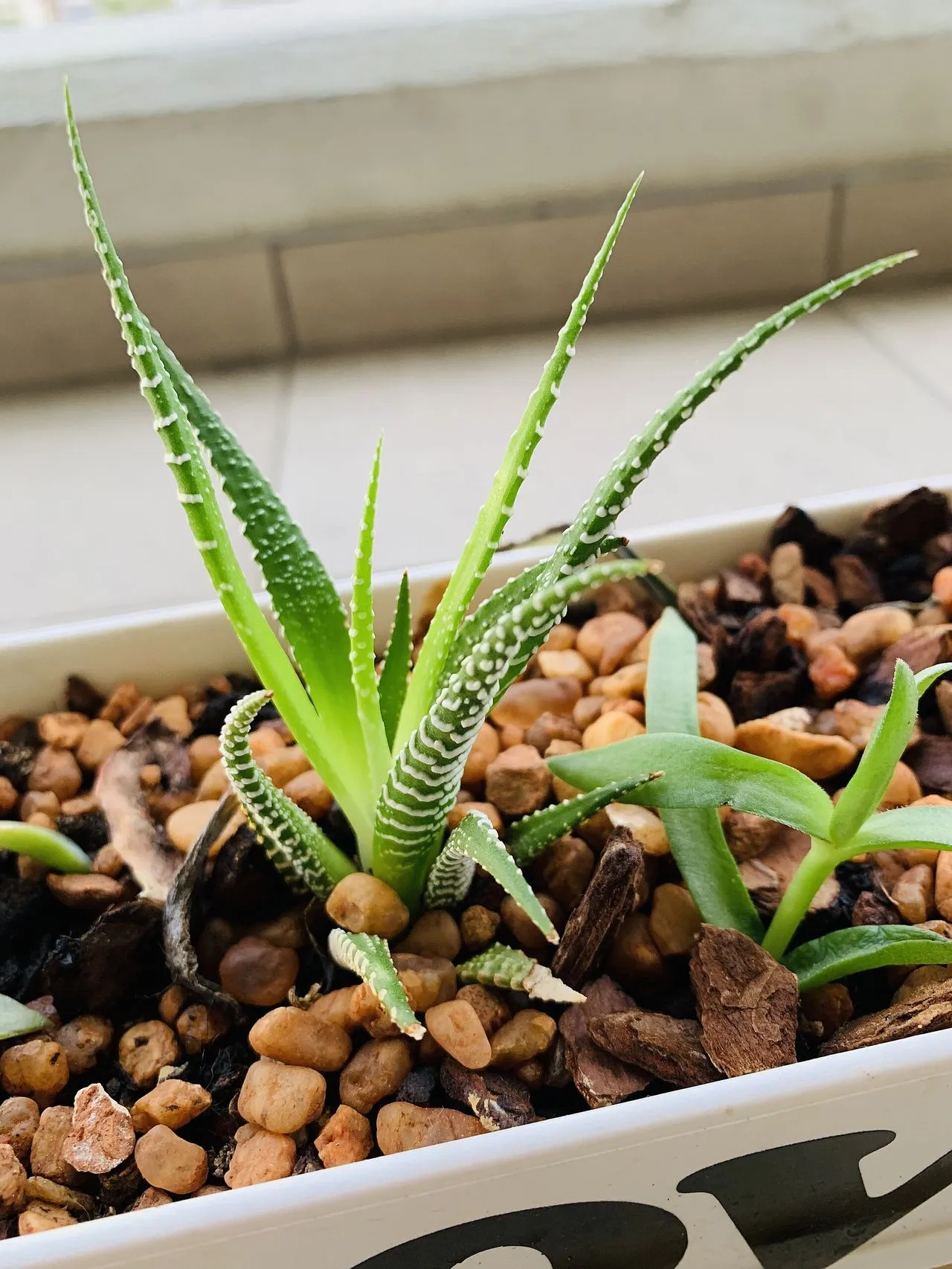
A fasciated haworthia looks wrong at first glance. Instead of a circular rosette, the plant forms a narrow wavy fan of leaves rising from a broadened stem. Individual leaves are often reduced or distorted; windows on soft-leaf species may be patchy. Crest width varies from 1 cm on young offshoots to 15 cm or more on decades-old specimens.
Most fasciated haworthias in circulation are clones propagated from a single original mutant. The most famous is probably the cristate H. limifolia 'Fairy Washboard', but similar selections exist across the commonly-cultivated species.
Cultivation
Cultivation of a fasciated plant follows the care for the underlying species. A cristate H. cooperi wants the same bright indirect light and gritty substrate as a normal H. cooperi, no more and no less. Growth rates are generally slower than the species form, and the crest is more susceptible to rot at the enlarged meristem line, so the water restraint discussed in the pillar guide is even more important here. Water the substrate, never the crest.
Bright but not harsh light helps preserve the cristate character. Under very low light the meristem can revert to normal point growth, producing ordinary rosettes on the ends of the crest; once reverted, those rosettes almost never go back to crested form on their own.
Propagation
Vegetative propagation is the only reliable route for keeping the cristate trait. Cut off pieces of the crest with a sharp sterile blade, callus 5-10 days, and pot in dry grit. Rooting is slower than for normal tissue; expect four to eight weeks.
Offsets from a cristate parent are mixed. A fraction will grow as cristate; the rest will revert to normal rosette form. Select and retain only the crested pups, label the reverts clearly, and either discard them or grow them on as the species form.
Seed from a fasciated parent is not worth sowing for crest propagation. The trait is typically somatic and not passed through meiosis.
Notes and Quirks
Fasciated plants are usually priced far above species forms of the same haworthia, sometimes by an order of magnitude for old specimens. Counterfeits and mislabelled young plants are common in online sales; look for a clear continuous crest, not just a double-headed rosette (which is usually transient and not true cristation).
Old cristate haworthias in long-term cultivation can reach remarkable sizes. A H. cymbiformis cristate in continuous cultivation for twenty years can form a convoluted mound 30 cm across and is among the most architecturally striking plants in the genus.
If part of a cristate plant reverts and you want to encourage crest re-formation, one technique is to gently injure the growing point of the reverted rosette, which can occasionally restimulate linear meristem growth. The success rate is low and I would not rely on it.
See also
Frequently Asked Questions
What is fasciation in haworthias?
A normal single apical meristem becomes elongated into a line, so leaves emerge along a ridge rather than around a point. The result is a fan, wave, or brain-like crest.
Are fasciated haworthias grown differently?
They follow the care of the underlying species, but watering restraint is more important because the enlarged meristem line is more susceptible to rot.
How do you propagate cristate haworthias?
Vegetative propagation is the reliable route. Cut crest pieces with a sterile blade, callus 5–10 days, and expect rooting in four to eight weeks.
Can fasciated haworthias revert to normal rosettes?
Yes. Very low light can encourage normal point growth at the crest ends, and those reverted rosettes rarely return to crested form on their own.