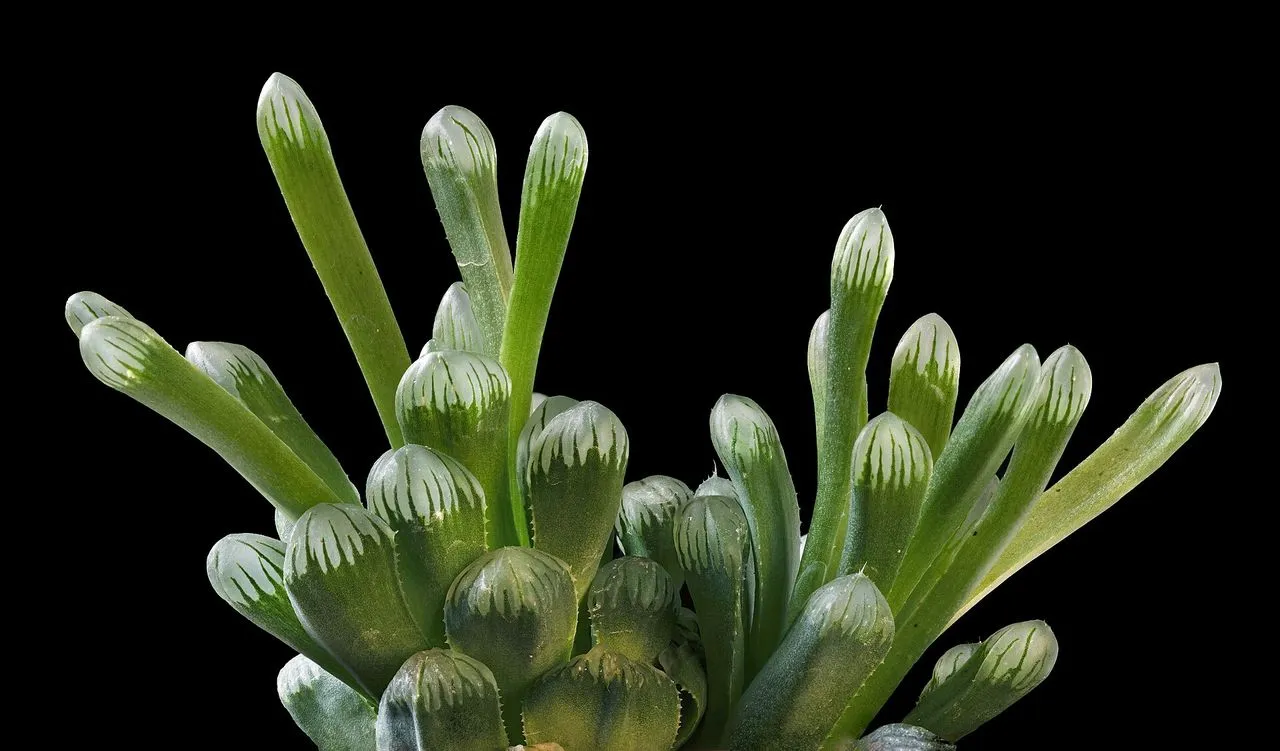
A Haworthia that grows tall, leans toward the window, or opens its rosette is usually asking for more light. It can tolerate shade better than Echeveria or most cacti, but it still needs bright indirect light to stay compact. Once a section has stretched, it will not shrink back; the realistic goal is to make the next leaves grow tight again.
Part of the Complete Haworthia Guide.
Quick answer: why is my Haworthia stretching?
Most stretching comes from low light. Look for a rosette that opens up, leans toward the brightest side of the room, or makes paler, narrower new leaves. Give it brighter indirect light gradually. Do not move a shade-grown plant straight into hot sun; that fixes one problem by creating another.
Etiolation from insufficient light
Etiolation in plants is a physiological response to light deprivation. When photoreceptors in the leaf and stem tissue detect insufficient red-wavelength light, the plant increases production of the growth hormone auxin, which promotes cell elongation in the stem and internodes. In Haworthia, the internode is the short section of stem between each leaf or pair of leaves. In good light, these internodes are so compressed that the rosette appears stemless. In insufficient light, they lengthen, and the plant visibly stretches.
The earliest sign is not the stretch itself but the direction of growth. A haworthia in marginally insufficient light starts leaning toward the brightest point in the room — a window, a ceiling light, the reflection off a pale wall. The rosette becomes asymmetric before the elongation is obvious. Over the following weeks, leaves are produced with slightly wider spacing between them. Eventually, a section of bare or sparsely-leaved stem becomes visible beneath the crown. New leaves are thinner and paler than older ones. This is the full etiolation pattern.
Indoor positions that consistently produce etiolation include: north-facing windowsills in winter, positions more than 1.5 m from a window without artificial supplementation, shelves below other plants that intercept the available light, and bathrooms or utility rooms with frosted glass or no window. A Haworthia that was compact at purchase and is now spreading open has almost certainly been in insufficient light since arriving in its new position.
Natural columnar growth — not all elongation is etiolation
Before diagnosing a problem, confirm the species. Most rosette-forming Haworthia species (H. cooperi, H. cymbiformis, H. retusa, H. fasciata, H. obtusa) should remain compact and stemless throughout their growth. If they elongate visibly, it is etiolation.
However, Haworthiopsis coarctata and Haworthiopsis reinwardtii — both still sold under the Haworthia label in many nurseries — naturally grow as tall, columnar stems with tightly packed spiralled leaves, sometimes reaching 30 cm or more. This is their correct growth form. The leaves remain firm, compact against the stem, and correctly proportioned. Compare with etiolation, where the leaves are spread apart and the internodes are visibly stretched.
Examine the spacing between individual leaves. Natural columnar species maintain very tight leaf-to-leaf contact with virtually no visible stem between leaves. Etiolated rosette species show a gap of 5 mm or more between leaf insertions, and the spacing widens as the condition progresses.
Heat and low light combined
Elevated temperatures in combination with low light accelerate the etiolation rate. A plant on a warm, north-facing windowsill in summer — or next to a radiator in winter — receives more heat signal to grow but less light signal to stay compact. The result is faster elongation than low light alone would produce. Warm temperatures increase metabolic rate and auxin activity; without adequate light to direct that growth into compact leaf production, the plant channels it into internodal extension.
This is particularly relevant for indoor growers who maintain heated rooms year-round. In the natural habitat, haworthias experience cool, low-light winters that slow them to near dormancy. A warm, poorly lit indoor winter accelerates the problem — the plant is metabolically active but light-starved, and etiolation progresses faster than in a cooler, darker rest period.
Seasonal variation in light availability
Even a plant in a position that provided adequate light in summer can etiolate over winter as day length shortens and the sun's angle drops. A south-facing window that was adequate in June may provide insufficient photosynthetically active radiation in December. The plant continues growing — driven by warm room temperature — but in progressively weaker light. By March, the rosette may have noticeably elongated compared to the previous autumn.
Monitoring light levels with a lux meter or a smartphone light-measurement app gives a concrete basis for decisions. Haworthia needs roughly 2,000–10,000 lux for compact growth; below 1,000 lux sustained for more than a few weeks, etiolation becomes likely. A supplemental grow light during winter months maintains compact growth without requiring the plant to be repositioned.
How to diagnose etiolation
| Observation | Likely explanation |
|---|---|
| Rosette leaning toward light source | Early etiolation |
| Leaves more widely spaced than before, rosette opening up | Active etiolation |
| Visible stem section below the crown | Moderate etiolation |
| New leaves thinner and paler than old ones | Etiolation combined with possible light-related chlorosis |
| Plant is columnar with tightly packed leaves | Normal species morphology — not etiolation |
| All leaves compact but plant leans | Directional light — rotate pot, not a pathology |
Risk and severity
Etiolation in Haworthia is not life-threatening in the short term. A stretched plant is structurally weaker and more vulnerable to crown rot if water collects in the widened leaf axils, but it can live in a stretched state for years. The concern is practical: a severely etiolated rosette loses its compact, attractive form and becomes harder to manage. Arresting the problem early — at the leaning and slight-opening stage — is easier than correcting severe elongation with a metre of bare stem below the crown.
Solutions
Move to brighter indirect light
The primary fix is immediate repositioning to a bright indirect position. An east-facing window receives 2–4 hours of direct morning sun and bright indirect light for the remainder of the day — ideal for most haworthia species. A south-facing window set back 60–100 cm from the glass provides bright diffuse light without the midday UV intensity that burns soft-leaf species. If windows are not adequate, a full-spectrum LED grow light placed 20–30 cm above the plant for 12–14 hours per day is a reliable alternative.
The transition from a dim to a bright position should be gradual. Leaves adapted to low light will sunburn in direct sun within a few hours. Step the plant from its current dim position to a moderate indirect position for one week, then to its target bright position over the following week. This prevents the common outcome of solving etiolation and causing sunburn simultaneously.
Beheading and re-rooting
If elongation is severe — the stem is 5 cm or more, the rosette is unattractively sparse, or the base of the plant is becoming woody and unhealthy — the plant can be beheaded. Cut the compact top rosette off with a sterile blade, leaving 1–2 cm of stem below the leaves. Allow the cut face to callus for 5–7 days in dry shade. Pot the cutting into a small container of dry mineral mix and place in bright indirect light. New roots form within 3–6 weeks. The remaining stub often produces new offsets from the base.
Rotating the plant
If the elongation is primarily directional rather than uniform — the rosette leaning to one side — quarter-turn rotations of the pot every 7–10 days distribute light evenly around the rosette and prevent asymmetric stretching without needing to change position.
Prevention
Position Haworthia in bright indirect light from the start. An east window or supplemented indoor position maintains compact growth year-round. In winter, supplement with a grow light if day length drops below 10 hours of meaningful indoor light. Rotate the pot quarterly. Measure light periodically rather than estimating — the human eye is a poor judge of absolute light intensity, and a moisture meter guide explains how to track substrate conditions alongside light, and what appears bright to the eye may be well below the threshold for compact succulent growth.
See also
- Cactus etiolation fix — beheading and re-rooting the stretched top section; the procedure applies equally to haworthia.
- Indoor succulent care — managing light levels, grow lights, and seasonal variation for houseplant succulents.
- Haworthia fasciata — one of the more shade-tolerant Haworthiopsis species; a benchmark for what compact growth looks like under typical indoor conditions.
Quick answer: an elongating Haworthia wants brighter light
A Haworthia that grows tall, pale, or widely spaced is usually stretching toward light. Move it gradually into brighter indirect light or gentle morning sun, rotate the pot weekly, and avoid sudden full sun, which can scorch windowed leaves before the plant adapts.
Do not fertilize your way out of stretching
Extra fertilizer cannot fix etiolation; it often makes weak, fast growth worse. Once the plant is in better light, feed lightly in the growing season with a low-nitrogen cactus and succulent fertilizer at diluted strength. If the stem is already permanently stretched, keep the healthier top growth and propagate offsets when they are large enough to handle.
As an Amazon Associate, we earn from qualifying purchases, at no extra cost to you.
When a grow light is the cleaner fix
If every window is dim, a grow light is safer than chasing the plant from sill to sill. Start with the light high enough that the leaves do not bleach, then lower it gradually while watching the new center leaves. A simple full-spectrum fixture such as the SANSI LED Grow Light is more useful than extra fertilizer. Feeding a light-starved Haworthia usually makes the stretched growth softer, not sturdier.
As an Amazon Associate, we earn from qualifying purchases, at no extra cost to you.
Frequently Asked Questions
Can a stretched Haworthia go back to normal?
No. Stretched leaves and stem sections do not shrink back. Better light will make new growth compact, while old elongated growth remains until it ages out or you cut and re-root the top.
Why is my Haworthia growing tall?
The usual cause is low light. Some species naturally grow in columns, but a rosette Haworthia that leans, opens up, and makes pale narrow leaves is usually etiolating.
How much light does Haworthia need indoors?
Most Haworthia stay compact in bright indirect light, an east window, or a full-spectrum grow light run for about 12–14 hours a day. Avoid sudden hot midday sun.
Should I cut the top off a stretched Haworthia?
Only if the stretch is severe or ugly enough that you do not want to wait for new compact growth. Let the cut callus before re-rooting it in dry, gritty mix.