| Question | Short Answer |
|---|---|
| How do you identify true Haworthiopsis fasciata? | The outer leaf surface carries transverse white tubercle bands, while the inner surface is smooth. |
| How large does Haworthiopsis fasciata grow? | Rosettes are usually 5–10 cm across and clump freely into tight colonies. |
| Can Haworthiopsis fasciata handle brighter light? | Yes, it tolerates brighter light than soft-leaf haworthias. |
| What is the best way to propagate Haworthiopsis fasciata? | Offset division is the primary method. |
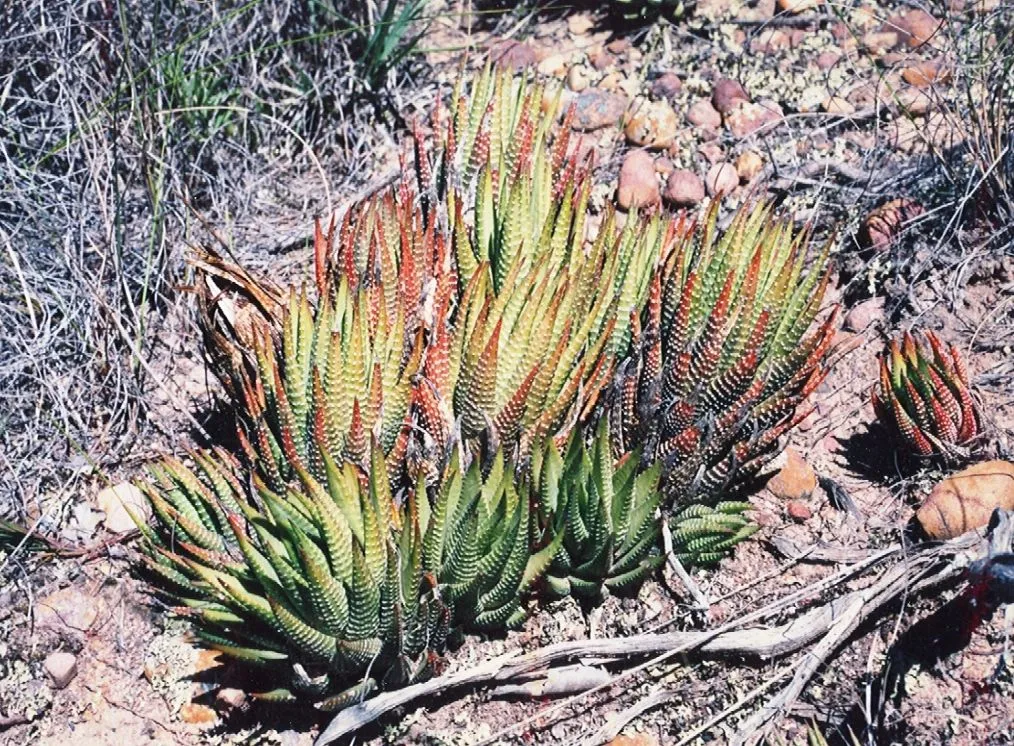
Haworthiopsis fasciata (Willd.) G.D.Rowley (Zebra Plant, Zebra Haworthia), formerly Haworthia fasciata, is a small hard-leaf rosette succulent from the Eastern Cape of South Africa. It was reclassified from Haworthia into the segregate genus Haworthiopsis in the 2013 generic split based on molecular phylogeny and flower morphology. Most horticultural labels and retail stock still use the older name; the plant is the same.
In habitat it occupies low shrub and grass cover in rocky, well-drained ground around the Humansdorp and Port Elizabeth districts, where it tolerates more sun than its soft-leaf cousins.
Part of the Complete Haworthia Guide.
Identification
Rosettes are 5-10 cm across, stemless, and clump freely into tight colonies. Leaves are stiff, dark green, triangular in cross-section and curved inward at the tip. The outer (abaxial) surface carries transverse bands of raised white pearl-like tubercles; the inner (adaxial) surface is smooth and unmarked. That asymmetry is the single most reliable way to distinguish it from the very similar Haworthiopsis attenuata, which has tubercles on both leaf surfaces.
Inflorescence is a slender raceme 25-40 cm tall with small two-lipped whitish flowers with pink-brown venation, arising usually in late spring.
Cultivation
H. fasciata tolerates brighter light than soft-leaf haworthias. An east, west or lightly shaded south-facing windowsill all work. Under good bright indirect light the leaves develop a reddish-bronze flush, which is normal and desirable; bleached white patches indicate sunburn and are permanent.
Substrate is the standard gritty mineral mix, 60% pumice or perlite plus 20% coarse sand and 20% peat-free loam-based compost. This species is among the most forgiving of watering errors in the group, tolerating brief neglect better than brief overwatering. Water when the top 3-4 cm reads dry, usually every 2-3 weeks in winter and 7-10 days in active growth.
Temperature tolerance is wider than the soft-leaves, down to around 2°C if bone dry.
Propagation
Offset division is the primary method. Mature plants produce a ring of three to eight offsets annually. Wait until each has its own two or three roots, then separate at the stolon with a sterile blade, callus three to five days, and pot in dry grit. Establishment is reliable within three to four weeks.
Leaf propagation works poorly here compared with soft-leaf species; success rates under 10% are typical. The firm, silica-rich leaf base rarely differentiates new meristem. Stick with offsets.
Seed is viable but slow and largely of collector interest. The species is self-incompatible.
Notes and Quirks
H. fasciata is the most commonly mislabelled plant in the genus. Almost every plant sold in supermarkets and generic garden centres as "Haworthia fasciata", "Zebra Cactus" or "Zebra Plant" is actually Haworthiopsis attenuata or one of its cultivars. True H. fasciata is less common in the trade. The reliable diagnostic: feel the inner surface of the leaf. If it is smooth, you have H. fasciata; if it has raised tubercles matching the outer surface, it is H. attenuata.
Several cultivars are offered, including 'Big Band' with broader white bands, 'Alba' with pale yellow-green leaves, and variegated forms that slow growth considerably and need more shade.
This species is also widely sold as a pet-friendly houseplant and is on the ASPCA's non-toxic list for cats and dogs, though as with any plant, ingestion in quantity is not recommended.
See also
Frequently Asked Questions
How do you identify true Haworthiopsis fasciata?
The outer leaf surface carries transverse white tubercle bands, while the inner surface is smooth. H. attenuata has tubercles on both surfaces.
How large does Haworthiopsis fasciata grow?
Rosettes are usually 5–10 cm across and clump freely into tight colonies. Flower racemes reach 25–40 cm.
Can Haworthiopsis fasciata handle brighter light?
Yes, it tolerates brighter light than soft-leaf haworthias. Bright indirect light can produce a reddish-bronze flush, while bleached white patches indicate permanent sunburn.
What is the best way to propagate Haworthiopsis fasciata?
Offset division is the primary method. Mature plants produce three to eight offsets annually, while leaf propagation usually succeeds under 10%.