| Question | Short Answer |
|---|---|
| Is Haworthiopsis attenuata the same as Haworthia fasciata? | No. |
| How big does Haworthiopsis attenuata get? | Rosettes typically reach 8–12 cm across. |
| How should Haworthiopsis attenuata be propagated? | Offset division is overwhelmingly best. |
| Is Haworthiopsis attenuata tolerant of indoor neglect? | Yes. |
Haworthiopsis attenuata (Haw.) G.D.Rowley, formerly Haworthia attenuata, is a small rosette hard-leaf succulent from the Eastern Cape of South Africa, reclassified from Haworthia into Haworthiopsis in the 2013 split. It is by a comfortable margin the most widely grown species in the group, despite being routinely sold under the label H. fasciata.
Its habitat is grass and shrub-covered slopes of the Uitenhage and Humansdorp districts, where it grows in partial shade among rocks and low vegetation.
Part of the Complete Haworthia Guide.
Identification
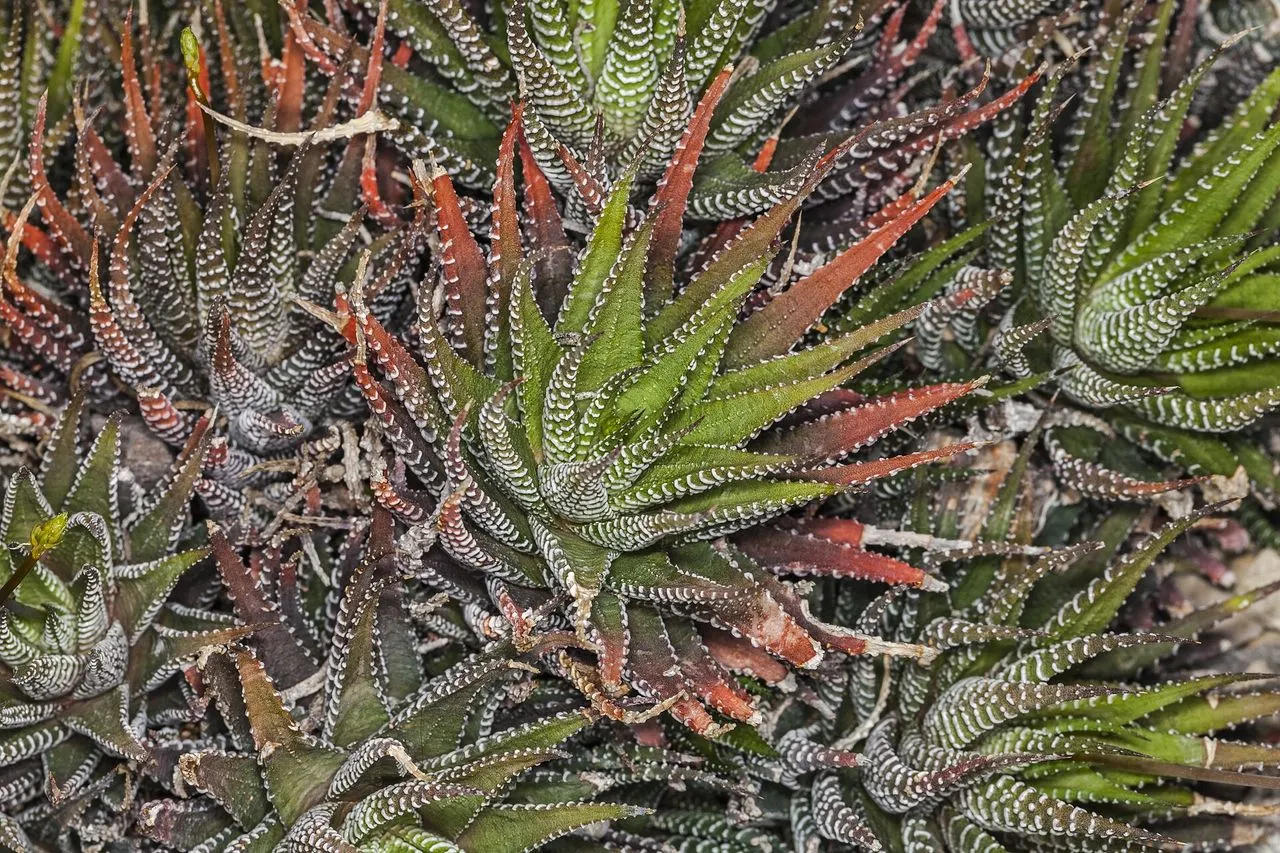
Rosettes reach 8-12 cm across, stemless, and offset prolifically into clumps. Leaves are triangular, 5-7 cm long, dark green, tapering to a point (the specific epithet attenuata means "tapering"). Both the upper and lower surfaces of each leaf carry raised white pearly tubercles, usually in irregular bands but sometimes scattered.
That two-sided tuberculation is the single diagnostic feature that separates H. attenuata from the genuinely similar H. fasciata, on which tubercles appear only on the outer leaf surface. Slide a thumb over the upper side of a leaf: if you feel bumps, it is H. attenuata; if it is smooth, you have H. fasciata.
Inflorescence is a slender raceme 25-40 cm tall with small two-lipped whitish flowers veined in pink-brown. Several cultivars are common in the trade: 'Clariperla' with heavier white banding, 'Enon' with sparser tubercles, var. radula with very fine tubercles, and 'Super White' with dense coverage.
Cultivation
Standard Haworthiopsis care applies. H. attenuata tolerates a wide range of light from bright indirect to a few hours of gentle direct sun per day. Leaves flush red-brown under stronger light, which is a health indicator rather than a problem. Indoors, almost any bright windowsill works.
Substrate is the standard gritty 60% mineral mix. Water when the top 3-4 cm reads dry. This species is the most tolerant of watering mistakes of any haworthia I know; it survives both forgetful owners and mildly over-enthusiastic ones better than the soft-leaves or Tulista.
Temperature range is generous, from 2°C to 35°C. Frost at or below 0°C damages tissue but is survivable if the plant is dry.
Propagation
Offset division is overwhelmingly the best method. Adult plants produce six to fifteen offsets per year, and a pot-bound specimen may be half offsets by volume. Separate offsets with a sterile blade at the stolon, callus 3-5 days, and pot in dry grit. Establishment is reliable within three weeks.
Leaf propagation is unreliable, with success rates typically under 10%. The hardened silica-rich leaf base does not readily form new meristem.
Seed is viable but slow. The species is self-incompatible and hybridises readily with H. fasciata and related species.
Notes and Quirks
The commercial confusion with Haworthiopsis fasciata is so pervasive that I regard "Zebra Plant" at a mainstream garden centre as meaning H. attenuata by default. If the label matters for your collection, buy from a specialist.
Variegated cultivars ('Variegata', 'Akatsuki', and various Japanese-origin chimeras) are common and attractive but grow considerably more slowly and sunburn more readily than the species. Treat them as the soft-leaf haworthias are treated for light.
This species is the one I recommend for anyone wanting a first succulent for an office or shaded home. It survives fluorescent light, erratic watering, and weeks of complete neglect, and the only practical way to kill it is to leave it sitting in a saucer of water.
See also
Frequently Asked Questions
Is Haworthiopsis attenuata the same as Haworthia fasciata?
No. H. attenuata has raised tubercles on both upper and lower leaf surfaces, while true H. fasciata has a smooth upper surface.
How big does Haworthiopsis attenuata get?
Rosettes typically reach 8–12 cm across. Mature plants offset prolifically and can become dense clumps.
How should Haworthiopsis attenuata be propagated?
Offset division is overwhelmingly best. Adult plants can produce six to fifteen offsets per year, while leaf propagation usually succeeds under 10%.
Is Haworthiopsis attenuata tolerant of indoor neglect?
Yes. The post identifies it as one of the best first succulents for an office or shaded home because it tolerates fluorescent light, erratic watering, and weeks of neglect.