| Question | Short Answer |
|---|---|
| How tall does Haworthiopsis coarctata grow? | Over many years columns can reach 20–30 cm tall and form branched thickets. |
| How is Haworthiopsis coarctata different from Haworthiopsis reinwardtii? | H. |
| Can Haworthiopsis coarctata be grown from stem cuttings? | Yes. |
| Does Haworthiopsis coarctata need more light than soft haworthias? | Yes. |
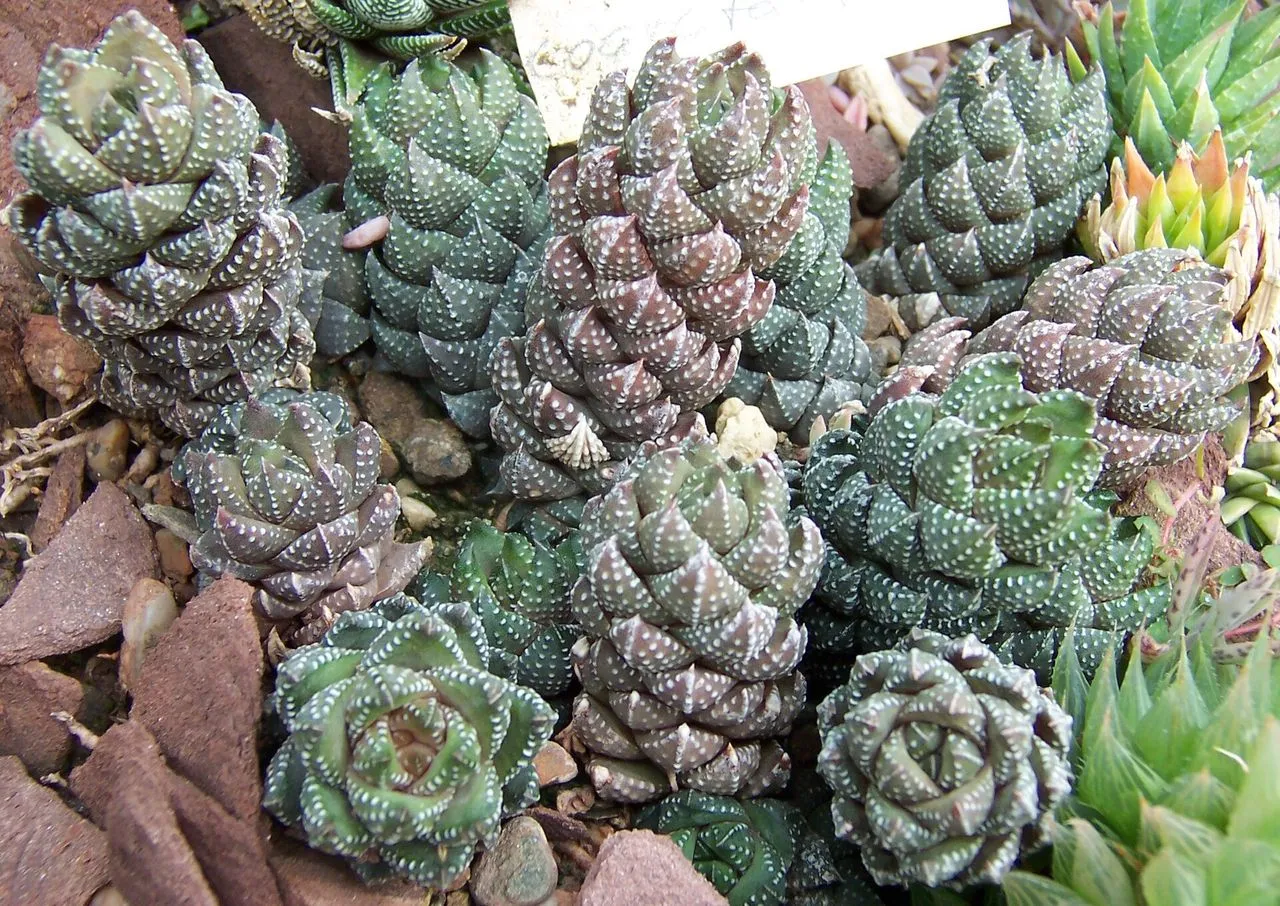
Haworthiopsis coarctata (Haw.) G.D.Rowley, formerly Haworthia coarctata, is a hard-leaf columnar succulent from the Eastern Cape of South Africa, moved to Haworthiopsis in the 2013 split. It is one of the few haworthias whose adult form is decisively vertical rather than rosette-flat, producing upright stacked columns of tightly spiralled leaves that can reach 20-30 cm tall over many years.
Native to rocky slopes and river-valley cliffs in the Albany and Alexandria districts, it grows among grasses and small shrubs in bright but broken light. The vertical habit is an adaptation to competition for light in fynbos understorey.
Part of the Complete Haworthia Guide.
Identification
Stems are upright, unbranched at first, becoming branched with age, 2-4 cm thick and densely packed with leaves in a tight spiral. Leaves are triangular, 2-4 cm long, dark green, curving inward at the tip. Both leaf surfaces carry raised white tubercles arranged in irregular transverse bands. Under bright light the leaves flush bronze, purple or deep red-brown, which is the strongest colour response of any species in the genus.
Inflorescence is a slender raceme 30-50 cm tall with typical small zygomorphic whitish flowers. Mature specimens flower almost annually.
H. coarctata is most often confused with Haworthiopsis reinwardtii, which shares the columnar habit. H. coarctata has broader, shorter leaves and coarser tubercles; H. reinwardtii is taller, slimmer, with finer more regular tubercle rows. Several forms and varieties are grown, including var. adelaidensis with pale tubercles and f. greenii (sometimes treated as a separate species) with larger leaves and sparser tubercles.
Cultivation
H. coarctata takes more light than soft-leaf haworthias and rewards it with intense colour. A bright south- or west-facing window, or an outdoor position in dappled light in summer, is ideal. Full direct midsummer sun can still scar the leaves; acclimate gradually.
Substrate is the standard gritty 60% mineral mix. Use a deeper pot than you would for rosette species, because the columnar habit makes tall plants top-heavy and the root system is correspondingly deeper. Water when the top 3-4 cm reads dry; this species tolerates drought better than most and can go several weeks without water in winter.
Temperature tolerance is relatively wide; brief exposure to near 0°C is survived if the plant is dry.
Propagation
Offset division is the primary method. Columns branch at the base and produce side shoots, which can be cut off with a sharp sterile blade once they have their own roots. Callus 5-7 days in shade before potting. An older plant can be cut near the base to force multiple new branches from the remaining stump.
Whole-stem cuttings also root easily. A column decapitated at any point will callus and root within two to three weeks if laid on dry grit, and the remaining stump will push multiple new shoots.
Leaf propagation is unreliable and seldom worth attempting on this species.
Notes and Quirks
Old specimens of H. coarctata develop considerable character. Columns lean, split, and branch to form thickets 30 cm or more across over a decade or two. A well-grown clump is as ornamental as any architectural succulent and far more cold-tolerant than most.
The species is closely related to Haworthiopsis reinwardtii and the two hybridise readily where their ranges overlap. Many plants sold as one species are actually natural hybrids or form intermediates; if absolute identity matters, source from a specialist nursery.
See also
Frequently Asked Questions
How tall does Haworthiopsis coarctata grow?
Over many years columns can reach 20–30 cm tall and form branched thickets. Old specimens may become 30 cm or more across.
How is Haworthiopsis coarctata different from Haworthiopsis reinwardtii?
H. coarctata has broader, shorter leaves and coarser irregular tubercles. H. reinwardtii is taller, slimmer, and more finely tubercled.
Can Haworthiopsis coarctata be grown from stem cuttings?
Yes. Whole-stem cuttings root within two to three weeks after callusing, and the remaining stump can push multiple new shoots.
Does Haworthiopsis coarctata need more light than soft haworthias?
Yes. It rewards brighter light with strong bronze, purple, or red-brown colour, though full midsummer sun still requires gradual acclimation.