| Question | Short Answer |
|---|---|
| How tall does Haworthiopsis reinwardtii grow? | Mature columns reach about 15–20 cm tall while remaining only 2–3 cm thick. |
| How is Haworthiopsis reinwardtii different from Haworthiopsis coarctata? | H. |
| Can Haworthiopsis reinwardtii be propagated from stem cuttings? | Yes. |
| How much water does Haworthiopsis reinwardtii need? | Water when the top 3–4 cm reads dry. |
Haworthiopsis reinwardtii (Salm-Dyck) G.D.Rowley (Zebra Wart, Reinwardt's Haworthia), formerly Haworthia reinwardtii, is a slender hard-leaf columnar succulent from the Eastern Cape of South Africa, reclassified into Haworthiopsis in the 2013 generic split. The species epithet honours the Dutch botanist Caspar Georg Carl Reinwardt.
In habitat it grows on bush-covered slopes around the Bathurst and Albany districts, forming dense vertical colonies in partial shade among grasses and small shrubs.
Part of the Complete Haworthia Guide.
Identification
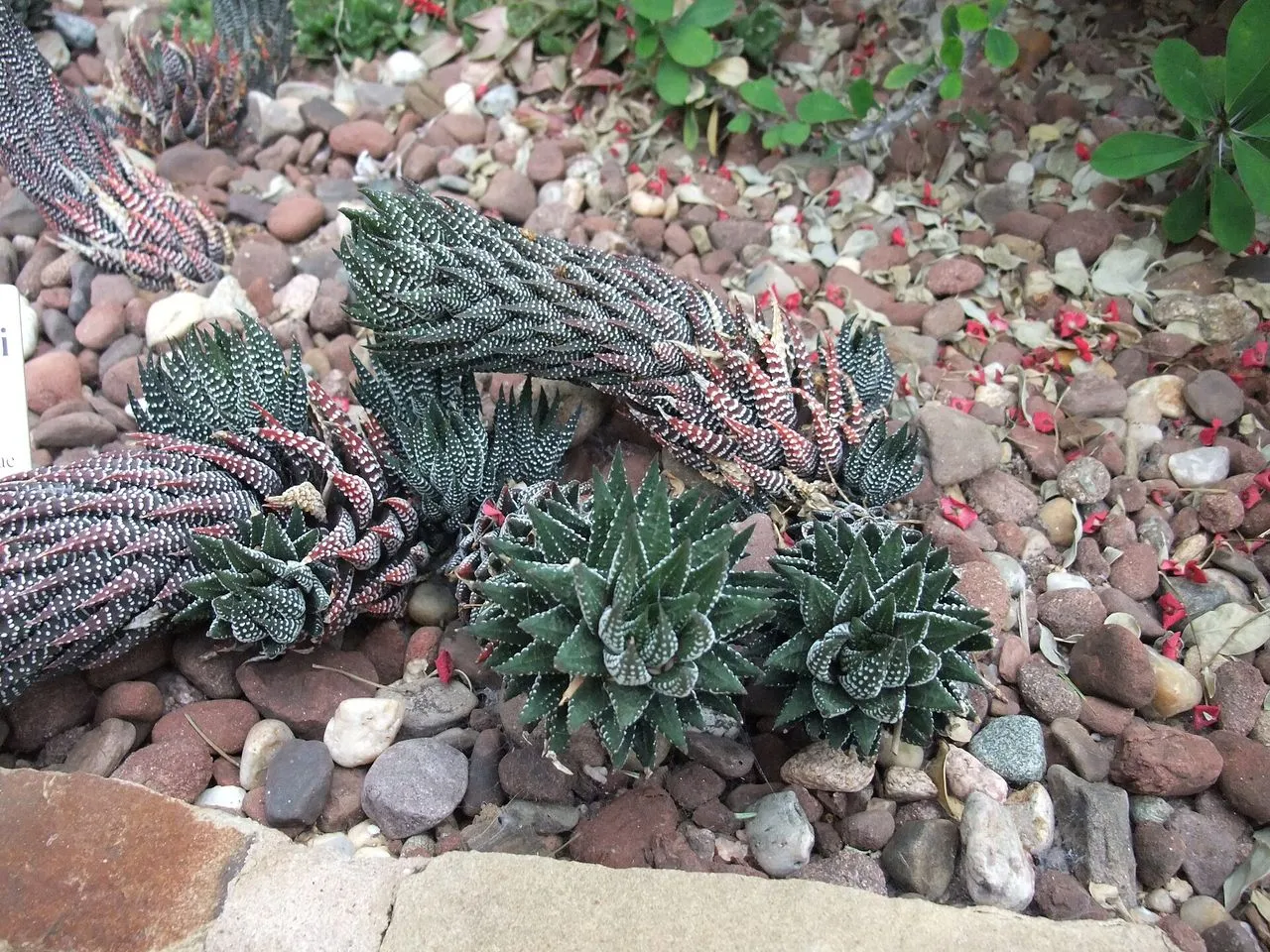
Columns are upright, 15-20 cm tall when mature, and only 2-3 cm thick, distinctly slimmer than the closely related H. coarctata. Leaves are tightly spiralled up the stem, triangular, 2-3 cm long, dark green. Both surfaces carry small white tubercles arranged in neat transverse rows, finer and more regular than the blotchier tubercles of H. coarctata.
Inflorescence is a wiry unbranched raceme 30-50 cm tall with typical small haworthiopsis flowers, white with faint brown-pink venation.
Several varieties are in cultivation, including var. brevicula with shorter, stubbier columns and var. chalumnensis with reddish leaves under bright light. The trade is inconsistent; plants sold as H. reinwardtii are often H. coarctata or hybrids between the two.
Cultivation
Standard hard-leaf Haworthiopsis care applies. H. reinwardtii takes more light than the soft-leaf species and colours deep red-brown under bright indirect exposure. A bright east, west, or lightly shaded south window in the northern hemisphere is correct. Direct midday summer sun without acclimation will scar the leaves.
Use the standard gritty 60% mineral substrate mix described in the pillar guide. Deep pots suit the columnar habit better than shallow bowls; the plant grows fairly aggressive downward roots compared to rosette haworthias, and a cramped pot tips over under the weight of a mature column.
Water when the top 3-4 cm reads dry. The species is drought-tolerant even by haworthia standards and easily tolerates two to three weeks between waterings in winter.
Propagation
Offset division is the easiest route. Mature columns produce basal offsets freely and, with age, side branches along the length of the stem. Separate offsets with a sterile blade at the stolon, callus 5-7 days, and pot in dry grit.
Whole-stem cuttings also work. Cut a column at any internode with a clean sterile blade, callus the cut end a full week in shade, then lay or stand the cutting in dry grit. Roots appear within two to three weeks. The remaining stump usually pushes two to four new shoots within the same season.
Leaf propagation is unreliable for this species, as with most Haworthiopsis.
Notes and Quirks
The classic telltale for distinguishing H. reinwardtii from Haworthiopsis coarctata is slenderness and tubercle pattern. H. reinwardtii is thinner and its tubercles are finer and run in clean transverse rows; H. coarctata is broader and its tubercles are chunkier and more irregular. That said, the two hybridise where their ranges meet, and many garden-centre plants are somewhere in between.
A well-grown clump eventually leans, splits, and climbs across its pot surface like a small slow-motion thicket. This is normal. If the leaning becomes unstable, top-cut the tallest stems and re-root them vertically alongside the originals.
See also
Frequently Asked Questions
How tall does Haworthiopsis reinwardtii grow?
Mature columns reach about 15–20 cm tall while remaining only 2–3 cm thick. The habit is distinctly slimmer than H. coarctata.
How is Haworthiopsis reinwardtii different from Haworthiopsis coarctata?
H. reinwardtii is thinner and carries finer tubercles in clean transverse rows. H. coarctata is broader with chunkier, more irregular tubercles.
Can Haworthiopsis reinwardtii be propagated from stem cuttings?
Yes. Whole-stem cuttings callused for a week can root within two to three weeks, and the remaining stump usually produces two to four new shoots.
How much water does Haworthiopsis reinwardtii need?
Water when the top 3–4 cm reads dry. The species is drought-tolerant and can easily tolerate two to three weeks between winter waterings.