| Question | Short Answer |
|---|---|
| What makes Haworthia pygmaea distinctive? | The terminal window is densely pebbled with raised papillae, giving it a mossy or velvety appearance. |
| How large does Haworthia pygmaea get? | Rosettes are small, usually 4–6 cm across with 2–3 cm leaves. |
| Is Haworthia pygmaea easy to propagate? | No. |
| Why is my Haworthia pygmaea window surface dull? | Under-lit plants lose papillae definition and the window becomes flat and dull. |
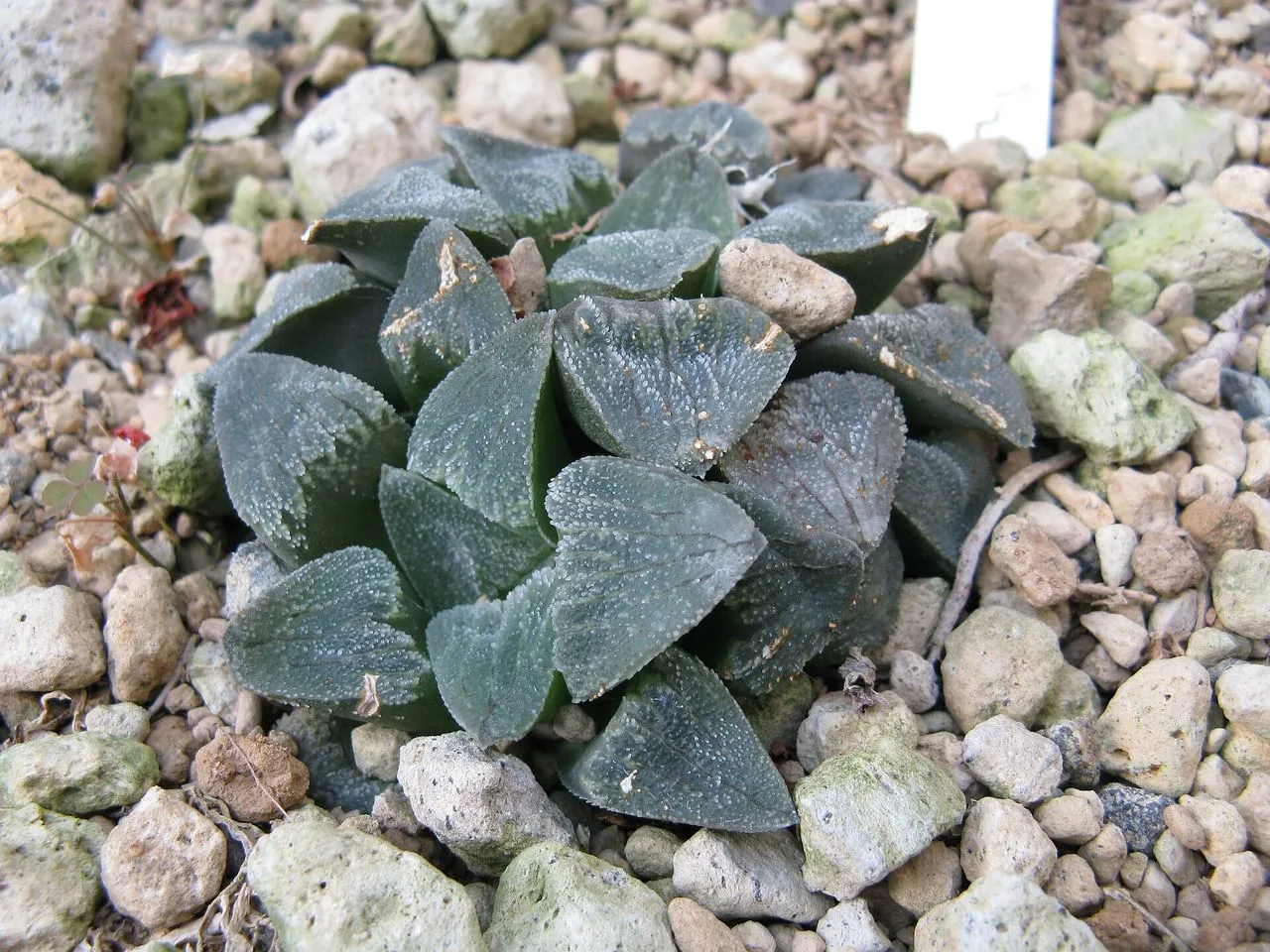
Haworthia pygmaea V.Poelln. is a small soft-leaf South African succulent from the southern coast of the Western Cape. Its specific epithet means "dwarf", reflecting its compact rosette size. The defining feature is the texture of the terminal window on each leaf: rather than smooth and glassy, the window is densely pebbled with fine raised papillae, giving it a mossy or velvety appearance.
In habitat the species grows in quartz gravel around Mossel Bay and Great Brak River, largely buried with just the textured window tops at soil level.
Part of the Complete Haworthia Guide.
Identification
Rosettes are 4-6 cm across, usually solitary or clumping slowly. Leaves are 2-3 cm long, triangular, dark greyish-green to bronze, with a flattened or slightly domed terminal window. The window surface is covered with fine raised papillae that refract light and give a matte rather than glassy appearance. Colour deepens strongly under bright light.
Inflorescence is a slender raceme 20-30 cm tall with typical small two-lipped whitish flowers.
Several varieties and forms are cultivated. Var. argenteo-maculosa has pronounced silvery spots on the window. Var. crystallina has an exceptionally densely papillate window, almost frosted in appearance. Selections from different locality populations differ subtly and are tracked by serious collectors.
H. pygmaea is most often confused with H. bayeri and H. emelyae. The pebbled (papillate) window surface is diagnostic; the others have smoother, more reticulate windows.
Cultivation
Standard soft-leaf Haworthia care applies, with the same caution as for other collector species of the retusa complex. Bright indirect light is essential; direct summer sun bleaches the papillate window irreversibly. An east-facing window or a south-facing position behind a sheer curtain is correct.
Substrate is the standard gritty 60% mineral mix, or a more mineral version (70% pumice and perlite) if conditions run humid. Use a tight pot, barely wider than the rosette; excess substrate stays wet and invites rot in this small-rooted species.
Water when the top 3-4 cm reads dry, typically every 2-3 weeks in active growth and less often in peak summer dormancy.
Temperature range 10-28°C. Protect from frost.
Propagation
Offsetting is slow; a mature plant may produce one or two offsets per year at best. Separate with a sterile blade when an offset has its own roots, callus five to seven days, and pot in dry grit.
Leaf propagation is unreliable. Rates of 10-20% are typical for clean-twisted mature leaves.
Seed is a realistic alternative. Two unrelated flowering plants are required, since the species is self-incompatible. Germination under humidity takes 2-4 weeks; seedlings flower at 4-6 years. Progeny vary, and raising seed from the most heavily papillate parents can produce interesting selections.
Notes and Quirks
The papillate window surface is the whole aesthetic appeal of this species, and it is maintained only under appropriate light. Under-lit plants lose the papillae definition and the window becomes flat and dull. Over-lit plants bleach and scar. The correct position produces a velvety, almost moss-like surface texture that sets the species apart.
H. pygmaea hybridises readily in collection settings with Haworthia bayeri, H. emelyae, H. mirabilis and H. retusa. Many plants in the trade labelled as H. pygmaea are actually hybrids; source from specialist nurseries with documented provenance if species identity matters.
The Japanese succulent trade has produced heavily selected cultivars with extreme papillation and window pattern, sold at significant premiums. These are striking but demand precise light and substrate management to maintain their character.
See also
Frequently Asked Questions
What makes Haworthia pygmaea distinctive?
The terminal window is densely pebbled with raised papillae, giving it a mossy or velvety appearance. That texture separates it from smoother H. bayeri and H. emelyae.
How large does Haworthia pygmaea get?
Rosettes are small, usually 4–6 cm across with 2–3 cm leaves. Mature plants are usually solitary or slow to clump.
Is Haworthia pygmaea easy to propagate?
No. Offsetting is slow, leaf propagation usually succeeds only 10–20%, and seed takes 4–6 years to reach flowering.
Why is my Haworthia pygmaea window surface dull?
Under-lit plants lose papillae definition and the window becomes flat and dull. The post recommends bright indirect light that preserves the velvety surface without bleaching.