| Question | Short Answer |
|---|---|
| What does Haworthia emelyae look like? | It forms 5–8 cm rosettes with triangular grey-green to bronze leaves. |
| Is Haworthia emelyae the same as Haworthia comptoniana? | The post treats var. |
| How fast does Haworthia emelyae offset? | Slowly. |
| Can Haworthia emelyae be grown from seed? | Yes, if two unrelated flowering plants are available. |
Haworthia emelyae V.Poelln. is a soft-leaf South African succulent from the southern Little Karoo, named for Emily Ferguson who first collected it. It is a close relative of H. bayeri, H. pygmaea and H. mirabilis, and the boundaries between these species are actively debated; collectors typically distinguish them by habitat and window pattern.
In habitat it grows pressed into the ground in pockets of quartz gravel around Calitzdorp, Ladismith and Oudtshoorn, with only the window tips showing above the soil surface.
Part of the Complete Haworthia Guide.
Identification
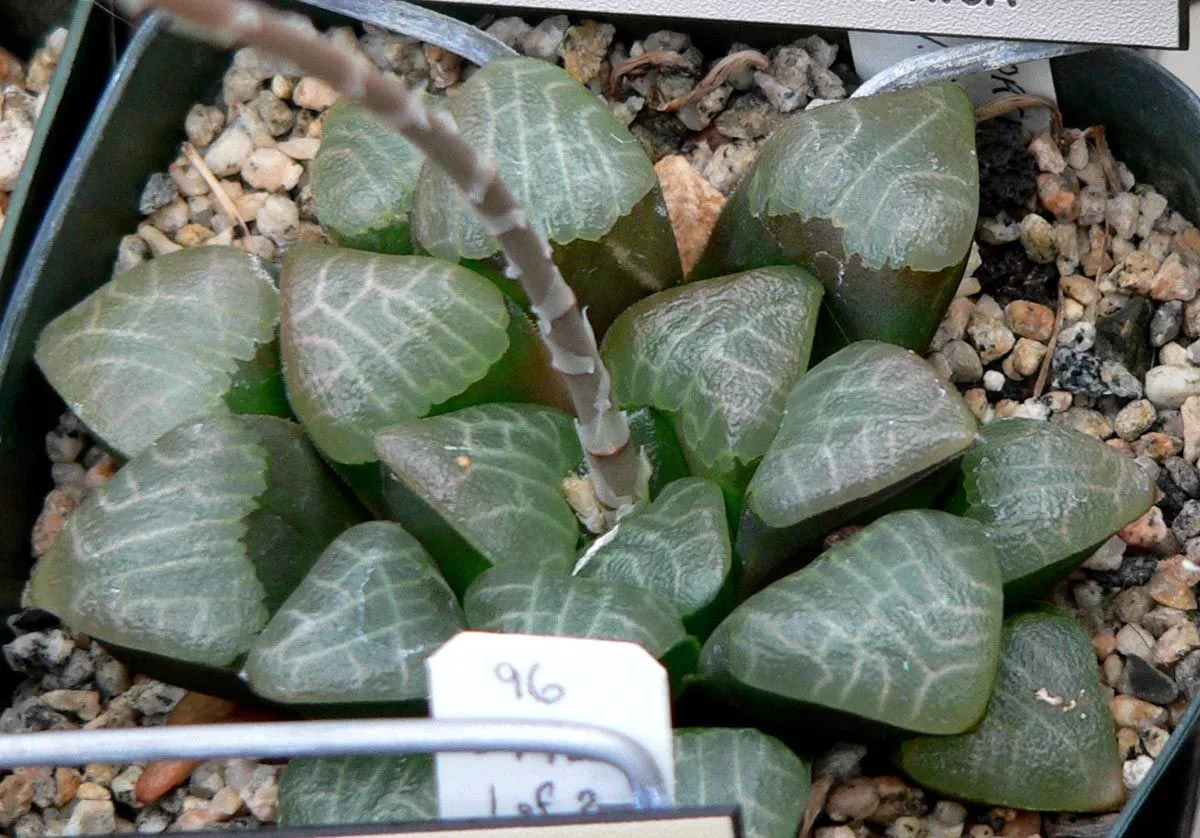
Rosettes are 5-8 cm across, usually solitary or slowly offsetting. Leaves are 3-5 cm long, triangular, grey-green to bronze under strong light, with a flattened or slightly domed terminal window decorated with fine pale flecks, dashes and broken lines. The pattern is less formally reticulate than H. bayeri but more complex than a plain window, and varies substantially between individuals and populations.
Inflorescence is a wiry raceme 25-40 cm tall with typical small two-lipped whitish flowers.
Several varieties are recognised. Var. major (also called H. picta in some treatments) has larger rosettes and bolder pale spots. Var. multifolia has more numerous, narrower leaves. Var. comptoniana, sometimes treated as a separate species H. comptoniana, has the largest rosettes in the group (to 12 cm) with strongly reticulate, almost mossy window patterns.
Cultivation
Standard soft-leaf Haworthia care applies with the same adjustments discussed for H. bayeri. Light must be bright indirect, never direct midday sun. The dark leaf surface warms quickly in sun and scars easily; an east-facing window or a position set well back behind a sheer curtain is correct.
Use the standard gritty 60% mineral substrate mix, or a slightly more mineral version (70% pumice and perlite) if your conditions run humid. Water sparingly, when the top 3-4 cm of substrate reads dry; in cool indoor conditions that is every 2-3 weeks in active growth and every 4-6 weeks in peak summer when the plant semi-dormants.
Temperature range 10-28°C suits it best. Protect from frost.
Propagation
Offsetting is slow; mature plants produce one or two pups per year at most. Separate with a sterile blade when an offset has its own roots, callus five to seven days in shade, and pot in dry grit.
Leaf propagation is unreliable here, as with most of the window-flat soft-leaves in the retusa complex. Rates of 10-20% are typical.
Seed is a real option and produces visibly variable offspring, which is part of the collecting appeal. The species is self-incompatible; two unrelated flowering plants are required. Germination under humidity takes 2-4 weeks; seedlings flower at 4-5 years.
Notes and Quirks
Provenance matters for H. emelyae. Named locality forms from populations around Calitzdorp, Muiskraal and Prince Albert are collector staples and command a premium. Plants from these areas differ subtly but consistently in window pattern, leaf form and growth rate, and they are maintained as clones through offset division.
Var. comptoniana is arguably the most visually dramatic member of the whole retusa complex and is often treated as a distinct species in the horticultural trade. Whether you regard it as a variety or a species, its care is identical.
H. emelyae hybridises freely in collection settings with Haworthia bayeri, H. mirabilis, H. pygmaea and H. retusa. If seed fidelity matters, bag the inflorescences.
See also
Frequently Asked Questions
What does Haworthia emelyae look like?
It forms 5–8 cm rosettes with triangular grey-green to bronze leaves. The window tops carry pale flecks, dashes, and broken lines rather than a plain or regular mesh.
Is Haworthia emelyae the same as Haworthia comptoniana?
The post treats var. comptoniana as sometimes recognised separately in horticulture. Its care is identical whether treated as a variety or species.
How fast does Haworthia emelyae offset?
Slowly. Mature plants produce one or two pups per year at most, and leaf propagation is typically only 10–20% successful.
Can Haworthia emelyae be grown from seed?
Yes, if two unrelated flowering plants are available. Germination takes 2–4 weeks and seedlings flower at about 4–5 years.