| Question | Short Answer |
|---|---|
| What makes Haworthia mirabilis recognisable? | Mature leaves recurve so the outer tips point outward or downward. |
| How large does Haworthia mirabilis get? | Rosettes are usually 5–9 cm across and are solitary or slowly clumping. |
| Why does Haworthia mirabilis turn copper or burgundy? | Strong bright indirect light and cooler autumn-to-winter conditions bring out its natural colour response. |
| Are Haworthia mirabilis labels reliable? | Not always. |
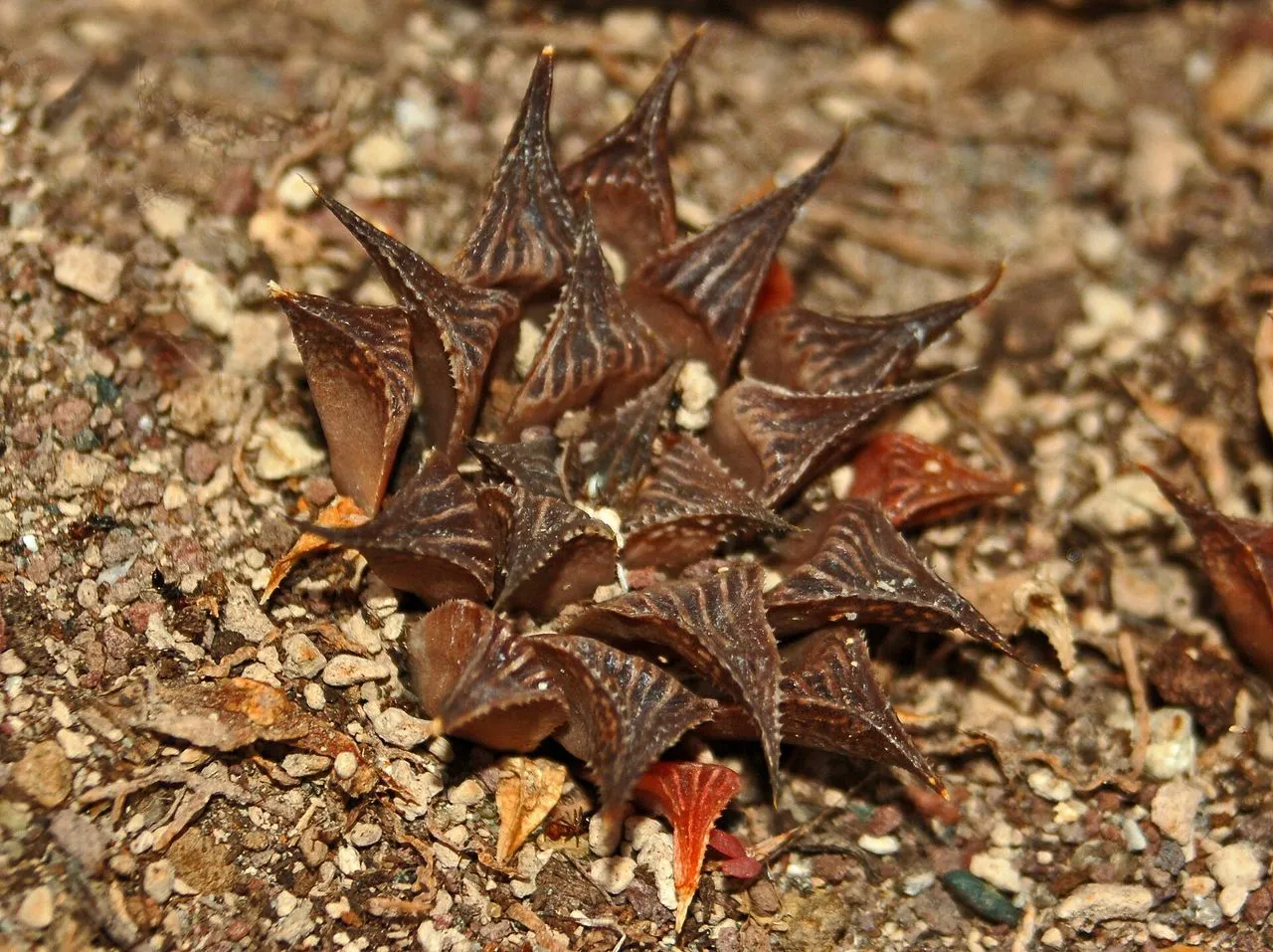
Haworthia mirabilis (Haw.) Haw. is a soft-leaf South African succulent from the Western Cape, one of the most variable species in the genus. Its specific epithet means "wonderful" or "remarkable", a nineteenth-century flourish that gives no actual diagnostic hint. What makes the species recognisable is the characteristic recurvature of mature leaves, which bend back on themselves as the rosette matures, and the strong seasonal colour shifts from green to copper to purple under changing light.
Distribution is broad, covering the Overberg region and extending into the Little Karoo, with populations on rocky shale outcrops and among low vegetation. The species is often buried partly in substrate, with leaf tips above the surface.
Part of the Complete Haworthia Guide.
Identification
Rosettes are 5-9 cm across, usually solitary or slowly clumping. Leaves are 3-5 cm long, lanceolate, tapering to a point, with a textured upper surface marked by fine longitudinal veins and sometimes small pale tubercles near the margins. As the rosette matures the outer leaves bend back (recurve) so the tips point outward or downward. Colour ranges from dull green in shade to intense burgundy, copper or near-black under strong light.
Inflorescence is a slender raceme 20-35 cm tall with typical small two-lipped whitish flowers.
Multiple varieties are recognised, including var. mundula, var. triebneriana, var. beukmannii and var. paradoxa. Each has subtle differences in leaf shape, vein pattern, and colour response. The variation is so broad that specimens from different populations can look like different species, and locality labelling matters for collectors.
Cultivation
Standard soft-leaf Haworthia care, with one useful quirk: H. mirabilis colours most intensely under strong bright indirect light, short of burning. A bright east- or west-facing window, or an outdoor position in morning sun with afternoon shade, produces dramatic seasonal colour. In deep shade the plant stays green and flat and much of the visual interest is lost.
Substrate is the standard gritty 60% mineral mix. Water when the top 3-4 cm reads dry, usually every 2-3 weeks in winter growth and less often in peak summer dormancy. The species responds to cooler autumn nights with a surge of colour; do not rush to bring it indoors in early autumn.
Temperature range 5-30°C is tolerated. Brief near-frost is survived if the plant is dry.
Propagation
Offset division is the usual method but slow; mature plants may produce only one or two offsets per year. Separate with a sterile blade at the stolon, callus three to five days, and pot in dry grit.
Leaf propagation works with moderate reliability for this species, with success rates of 20-30% for clean-twisted mature leaves. Plantlets take 6-12 months to reach a potting-on size.
Seed is a real option and yields variable progeny, which can be interesting. Two unrelated flowering plants are needed. Germination takes 2-4 weeks; flowering at 4-5 years.
Notes and Quirks
The strong colour response is the main ornamental appeal of this species, and it is genuinely seasonal. A plant that spends autumn and winter in bright light will typically peak in colour in March-April (northern hemisphere) and return to green under more shaded summer conditions. This is normal cyclical behaviour rather than a health problem.
H. mirabilis is one of the most frequently reclassified species in the genus. Recent taxonomic work suggests that many forms currently called H. mirabilis may belong to other species (H. rossouwii, H. maraisii, H. magnifica) or to undescribed taxa. For gardeners the practical message is: labels attached to plants of this complex are often provisional, and if your plant does not match photographs exactly, that is the complex, not a mistake. The same labelling uncertainty applies to closely related species including Haworthia emelyae, which overlaps with H. mirabilis in both range and collector trade.
See also
Frequently Asked Questions
What makes Haworthia mirabilis recognisable?
Mature leaves recurve so the outer tips point outward or downward. The species also shows strong seasonal colour shifts under changing light.
How large does Haworthia mirabilis get?
Rosettes are usually 5–9 cm across and are solitary or slowly clumping. Flower racemes reach 20–35 cm.
Why does Haworthia mirabilis turn copper or burgundy?
Strong bright indirect light and cooler autumn-to-winter conditions bring out its natural colour response. The plant often peaks in colour around March–April in the northern hemisphere.
Are Haworthia mirabilis labels reliable?
Not always. The post notes that many forms in the complex may belong to other species or undescribed taxa, so labels are often provisional.