| Question | Short Answer |
|---|---|
| Why is Haworthia bayeri collectable? | Each plant has a distinctive reticulated window pattern, effectively a fingerprint. |
| How much light does Haworthia bayeri need? | It needs bright indirect light but no direct sun. |
| Is Haworthia bayeri easy to propagate? | No. |
| Can Haworthia bayeri be raised from seed? | Yes, and seedling variation can be interesting. |
Haworthia bayeri J.D.Venter & S.A.Hammer is a soft-leaf South African succulent named for the haworthia monographer M.B. Bayer. It is among the most collected species in the genus, prized for the intricate reticulate pattern of clear veins running across the dark window surface of each leaf.
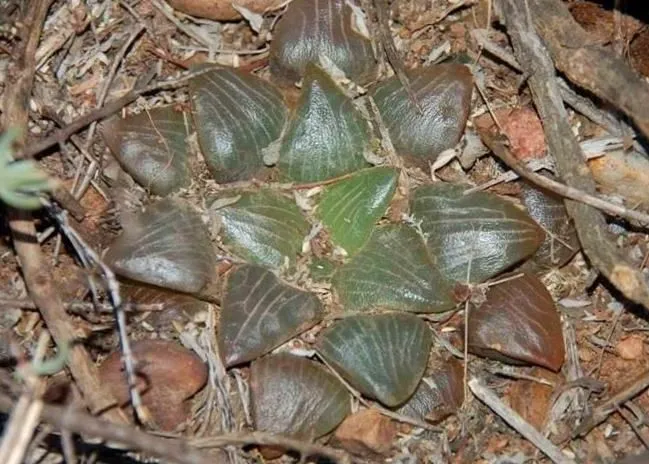
The species grows in the Little Karoo of the Western Cape, particularly in the Oudtshoorn, De Rust and Uniondale districts, where it sits flush with ground level in pockets of quartz grit in partial shade. Contractile roots keep the rosette essentially buried, with only the window tips exposed.
Part of the Complete Haworthia Guide.
Identification
Rosettes are 6-9 cm across, usually solitary or slowly offsetting. Leaves are 3-4 cm long, triangular, dark green to almost black-green, with an abruptly flattened or slightly domed terminal window. The window is the key feature: a dark background is traversed by a network of fine, clear, pale green veins forming an irregular reticulated mesh. No two plants have identical reticulation; it is effectively a fingerprint.
Inflorescence is a wiry unbranched raceme 25-35 cm tall with typical small two-lipped whitish flowers.
H. bayeri closely resembles H. emelyae, H. mirabilis and H. pygmaea, and the boundaries between them are a matter of active taxonomic debate. Specialist collectors usually record provenance by locality code (e.g. Oudtshoorn, Schoemanspoort).
Cultivation
H. bayeri is among the more demanding species in the genus. Follow the standard Haworthia substrate and watering protocol from the pillar guide, with two adjustments. First, light must be bright indirect but never direct; the dark leaf surface absorbs heat rapidly and the plant scars easily. An east-facing window or a well-set-back position behind a sheer curtain is correct. Second, water more sparingly than you would a H. cymbiformis. The thick leaves store significant water and the fine roots rot quickly in persistently damp substrate.
Use the standard gritty 60% mineral mix, but err toward the mineral end: I use 70% pumice and perlite for this species, with minimal organic content. A slightly undersized pot, barely wider than the rosette, reduces the volume of substrate that stays wet.
Temperature range 10-28°C suits it best. Protect from frost and from sustained heat above 30°C.
Propagation
Offset division is the standard route but slow, as H. bayeri produces few offsets, typically one or two per year on a mature plant. Separate with a sterile blade at the stolon, callus five to seven days, and pot in dry grit.
Leaf propagation is unreliable; rates of 10-20% are typical.
Seed is of real interest for this species, because the reticulation pattern varies and raising a batch of seedlings can yield interesting patterns. The species is self-incompatible; two unrelated flowering plants are needed. Germination takes 2-4 weeks under humidity; seedlings flower in 4-6 years.
Notes and Quirks
The intense reticulation that makes H. bayeri desirable depends on light level. Under insufficient light the leaves go flatter, paler, and the reticulation fades into a general greenish tone. Too much light scars the window permanently. The narrow middle band is what the species demands.
Prices for named selections and locality forms can be high. Plants from the Schoemanspoort and Montagu populations, for instance, are collectors' staples and routinely sell at prices well above common haworthias. Source from reputable specialist nurseries rather than generic online sellers; mislabelling is widespread.
H. bayeri hybridises with Haworthia emelyae, H. mirabilis, and H. pygmaea in collection settings. If you grow several of these species, bag the inflorescences to prevent cross-pollination if pure seed matters.
See also
Frequently Asked Questions
Why is Haworthia bayeri collectable?
Each plant has a distinctive reticulated window pattern, effectively a fingerprint. Named selections and locality forms can be expensive.
How much light does Haworthia bayeri need?
It needs bright indirect light but no direct sun. Too little light flattens and fades the reticulation; too much light scars the dark window surface.
Is Haworthia bayeri easy to propagate?
No. Mature plants produce few offsets, usually one or two per year, and leaf propagation is typically only 10–20% successful.
Can Haworthia bayeri be raised from seed?
Yes, and seedling variation can be interesting. Two unrelated flowering plants are needed, and seedlings flower in about 4–6 years.