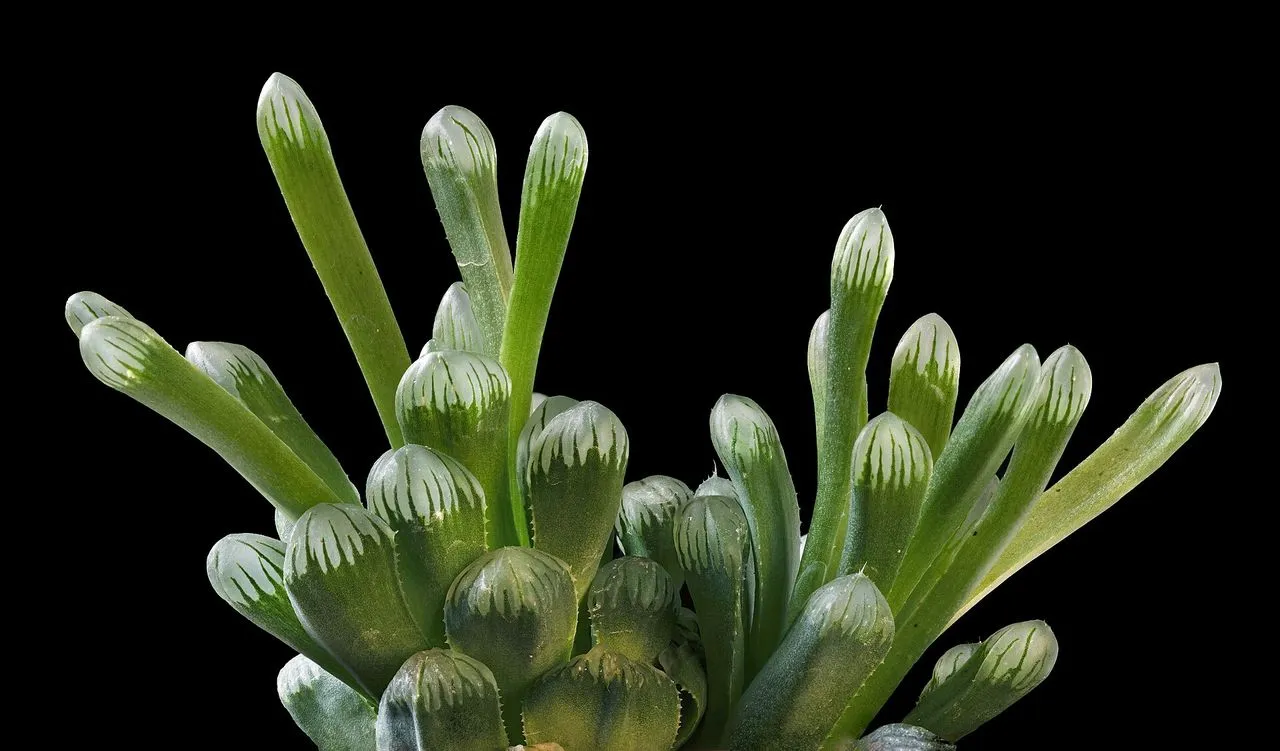
Watching a haworthia sit in its pot, season after season, without producing a single pup is one of the more frustrating experiences for collectors who expected the plant to clump. The frustration is partly a species-expectation problem and partly a care problem, and separating the two is the starting point for any diagnosis. A plant that should not offset by nature is not failing. A plant that should offset freely and is not is telling you something about its light, roots, or substrate.
Part of the Complete Haworthia Guide.
Species genetics: who offsets freely and who does not
The most important variable in haworthia offset production is genetics, not care. The three genera in the horticultural haworthia group differ dramatically in their propensity to produce offsets, and within each genus there is substantial species-level variation.
Prolific offsetters: Haworthia cymbiformis, H. cuspidata, H. cooperi, Haworthiopsis attenuata, Haworthiopsis fasciata — these species are vigorous clumpers that will fill a pot with offsets in 2–3 growing seasons under good conditions. If any of these species is not producing pups, the cause is almost certainly cultural rather than biological.
Moderate offsetters: Haworthia retusa, H. emelyae, Haworthiopsis coarctata, H. reinwardtii — these produce offsets but more slowly and erratically. Expect pups on an irregular schedule rather than continuously through the growing season.
Rare or non-offsetting species: Haworthia truncata, H. maughanii, H. bayeri, H. pygmaea, Tulista pumila — these are inherently solitary or near-solitary species. Waiting for pups from H. bayeri can mean years of patience even under optimal conditions. This is species biology, not failure. Propagation for these species is primarily via seed or, rarely, leaf propagation.
Before assuming something is wrong, confirm the species identity. Labels in the nursery trade are unreliable — a plant sold as Haworthia fasciata may be Haworthiopsis attenuata (typically similar but distinct), a nursery hybrid, or mislabelled entirely. Compare plant form against Haworthia fasciata (Haworthiopsis fasciata) and Haworthia cooperi to narrow down what you are working with.
Insufficient light
After species identity, light is the single strongest predictor of offset production in species that should be clumping. Pup production is the haworthia's investment in vegetative reproduction, and it happens only when the plant has surplus energy beyond its maintenance requirements. Energy production depends on photosynthesis, which depends on light. A haworthia in deep shade — a north-facing windowsill in winter, a corner shelf, an interior room without natural light — operates at near-maintenance levels. New leaf production slows, and vegetative reproduction is one of the first processes suspended.
Minimum light for active pup production in prolific species: approximately 150–250 µmol/m²/s PAR at the leaf surface for 12–14 hours per day. In practical terms, this means an east-facing window that receives 3–4 hours of morning sun, a south-facing window set back 60–100 cm from the glass, or a grow light positioned 15–25 cm above the rosette. A plant receiving substantially less than this will remain alive but vegetatively static — surviving, not thriving.
The correction is to increase light gradually over 10–14 days to avoid sunburn on leaves calibrated for shade conditions. Results take time: expect a 4–8 week lag between improved light and the appearance of a visible new pup bud at the base of the rosette. For the broader picture of how light affects vegetative growth across the genus, see Haworthia not growing.
Root health and substrate condition
Offset formation requires an active, functional root system. A plant with root rot, root mealybug, or an exhausted substrate cannot sustain the energy-intensive process of producing new rosettes from stolon tissue at its base. The primary rosette may appear healthy — it is drawing on stored reserves — while root capacity is too low to support vegetative expansion beyond maintenance.
If a prolific-offsetting species has shown no pup activity for a full active growing season (spring through early summer, then autumn), unpotting for root inspection is warranted. Healthy roots supporting active pup production are white to pale tan, firm, and numerous — a dense network of fine roots indicates the absorptive capacity needed to sustain vegetative expansion. A sparse, thin, or damaged root system cannot. After treating any root problems and repotting into fresh substrate, allow 4–8 weeks for root re-establishment before expecting renewed offset activity. Substrate that has been in the pot for more than two or three years may be structurally sound but nutritionally exhausted — repotting into fresh mineral mix restores both structural drainage and available nutrients.
Pot size and root zone density
There is a persistent grower belief that haworthias need a large pot to produce pups — that the plant needs room to expand. The opposite is closer to correct. Haworthia roots in a pot sized close to the root ball establish efficient contact with the substrate and maintain a faster, more regular dry-down cycle. An oversized pot retains excess moisture relative to the root mass, extends the wet period, reduces root zone oxygenation, and paradoxically suppresses the root activity that supports offset production. Prolific-offsetting Haworthia species in the wild grow in tight rock crevices and narrow soil pockets — not in open, expanded growing beds.
A correct pot diameter is 1–2 cm wider than the current root ball. When a haworthia has filled its pot with offsets and produced a dense clump that is visibly pushing against the pot wall, that is the correct signal to size up — not before. Repotting too early, into too large a container, resets the process. See pot size selection for the cross-genus sizing rationale.
Age of the plant
Young haworthias do not offset. A small offset purchased from a nursery at 3–4 cm diameter will typically require 2–4 years to reach the maturity at which it begins producing its own pups. This is one of the most common sources of frustration for new growers: a small haworthia that produces no pups for its first two years is behaving completely normally. Maturity indicators include reaching near-adult rosette size for the species (which ranges from 5 cm for H. pygmaea to 15 cm for large Haworthiopsis forms), developing a visible basal clustering habit, and producing its first flower stalk. The stalk is a reliable indicator that the plant has crossed into reproductive maturity — offsetting often follows within one to two growing seasons of the first bloom.
Seasonal dormancy and growth pauses
Haworthia produces most of its offsets during active growth windows: late winter through spring, and again in early autumn. During summer dormancy (July–August in the Northern Hemisphere) and during mid-winter cold, offset formation pauses. A plant that was pushing visible pup buds in May but appears to have stalled in August is most likely dormant rather than declining. The pups that were forming continue to develop slowly and become more visible as active growth resumes in September. Do not repot or disturb a dormant plant — disrupting root contact during dormancy delays the resumption of pup development further. See Haworthia not growing for a full discussion of the haworthia seasonal rhythm.
Fertilisation and substrate nutrition
Haworthia is not a heavy feeder, but a plant in substrate that has been nutritionally depleted over several years may have insufficient phosphorus for stolon and root development. Phosphorus is particularly relevant to vegetative reproduction. A modest application of a low-nitrogen, higher-phosphorus fertiliser (such as a bloom-formula product at one-quarter the label rate) applied once in spring can support offset development in plants in otherwise adequate light and substrate conditions. Do not fertilise during dormancy, during root recovery from rot, or when the substrate is bone dry. Fertilise only into moist substrate and water through afterward to prevent salt accumulation at the root zone.
How to assess the situation
| Observation | Most likely cause |
|---|---|
| Species is inherently solitary (H. truncata, H. bayeri, H. maughanii) | Species genetics — no intervention will change this |
| Prolific species, deep shade or north-facing window | Insufficient light — primary correctable cause |
| Prolific species, correct light, no pups for more than one full growing season | Root damage or substrate exhaustion |
| Plant less than 2 years old from a small offset | Too young — normal |
| Pup buds present in spring but stalled July–August | Summer dormancy — wait |
| Pot diameter more than 4 cm wider than rosette | Oversized pot — correct sizing at next repotting |
Risk and severity
Failure to produce offsets is almost never a health emergency. A haworthia that does not pup is not dying — it is simply not investing in vegetative reproduction. The only elevated risk is when the absence of pups accompanies other symptoms: no new leaf growth, shriveling, or yellowing. In those cases, the root system is likely compromised and the offsetting suppression is a secondary effect. Treat the presenting symptom — shriveling or yellowing — and offsetting will resume as root function is restored.
Solutions
Improve light
Move to an east-facing window or a south-facing position set back 60–100 cm. Supplement with a grow light if natural light is inadequate. Expect 4–8 weeks before new pup buds become visible.
Treat roots and refresh substrate
Unpot, inspect for rot or mealybug, treat as appropriate, and repot into fresh mineral-dominant substrate (60% pumice or perlite minimum). Allow 4–8 weeks for root re-establishment before expecting offset activity to resume.
Right-size the pot
If the pot is more than 2 cm wider than the root ball, move into a correctly sized container at the next repotting opportunity. Do not repot during summer dormancy — spring or autumn are the effective windows.
Accept species limits
For inherently solitary species, accept that the plant does not offset and explore seed propagation if multiplication is the goal.
Prevention
Match pot size to root ball from the outset. Maintain bright indirect light year-round at an east or south-set-back window. Repot into fresh mineral-dominant substrate every 2–3 years. Inspect for root mealybug during each repotting, even without above-ground symptoms. Accept the summer dormancy pause as a part of the plant's biology rather than a signal to increase water or fertiliser. Take monthly photographs of the rosette base — offset buds are often visible weeks before they become large enough to notice without looking carefully.
See also
- Haworthia not growing — general vegetative stalling, including the seasonal and root-health factors that suppress both leaf production and offsetting simultaneously.
- Haworthia cymbiformis — the benchmark prolific-offsetting soft-leaf species and the standard for what active clumping looks like.
- Haworthia cooperi — another vigorous clumper that should produce regular pups under correct light and root conditions.
Frequently Asked Questions
At what age does a Haworthia start producing offsets?
Most species require 2–4 years of growth before producing their first offsets. Some collector species (H. bayeri, H. maughanii) may take 5–7 years. A small offset purchased from a nursery will rarely pup until it has reached near-adult size, which takes several growing seasons.
Will removing the flower stalk encourage Haworthia to produce more pups?
There is no strong horticultural evidence that stalk removal reliably increases offset production in Haworthia. Seed setting does consume resources, so removing an inflorescence before seed set may marginally benefit vegetative growth, but the effect is small compared to light and root health.
My Haworthia cymbiformis is not producing pups — is something wrong?
H. cymbiformis is one of the most prolific offsetters in the genus. If it is not producing pups, the most likely causes are insufficient light, root damage, or a pot that is too large and staying wet too long. Check all three before assuming a species-level issue.
How do I encourage a Haworthia to offset?
Provide bright indirect light at an east or south-set-back window, use a pot sized close to the root ball, maintain an active watering dry-cycle, and repot into fresh substrate every 2–3 years. These conditions together maximise available energy for vegetative reproduction.