| Question | Short Answer |
|---|---|
| Why is Haworthia cymbiformis called boat-leaf haworthia? | The epithet cymbiformis means boat-shaped, matching the keel and concave upper surface of each leaf. |
| Is Haworthia cymbiformis good for beginners? | Yes. |
| How fast does Haworthia cymbiformis offset? | A three-year-old plant typically produces six to ten offsets per season. |
| Can Haworthia cymbiformis be propagated from leaves? | Yes. |
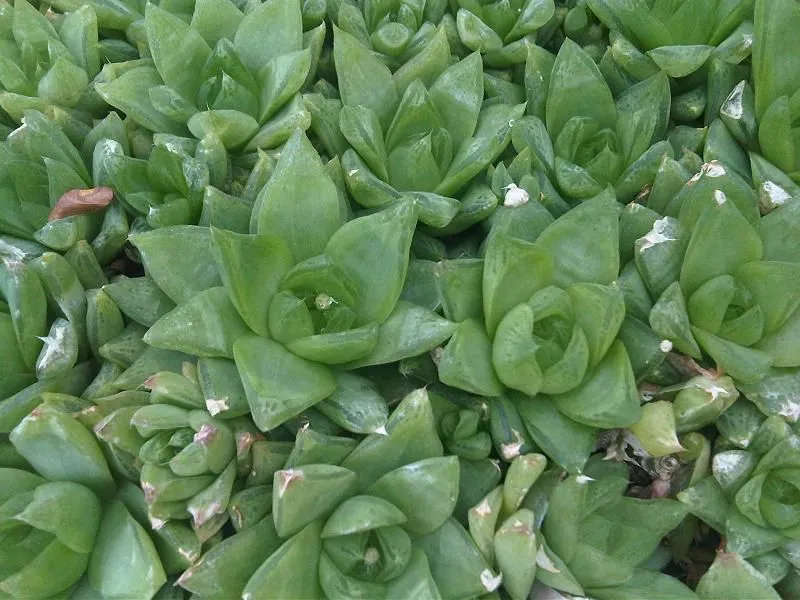
Haworthia cymbiformis (Haw.) Duval (cathedral window haworthia, boat-leaf haworthia) is a soft-leaf South African succulent whose specific epithet means "boat-shaped", describing the keel and concave upper surface of each leaf. It is, along with Haworthiopsis fasciata, the species I most often recommend to someone starting out: cheap, forgiving, and representative of everything that makes the genus what it is.
Its natural range runs along cliffs and rocky outcrops of the Eastern Cape, particularly the Great Fish and Sundays River valleys, where it roots into shallow pockets of mineral grit in partial shade. In habitat it forms wide mats by offsetting freely from stolons.
Part of the Complete Haworthia Guide.
Identification
Rosettes reach 6-10 cm across, stemless, and clump aggressively. Leaves are 3-5 cm long, light green, curving upward into a distinct boat or scoop shape, with translucent longitudinal lines running toward the tip rather than a single terminal window. The upper leaf surface carries fine soft teeth on the margins. Inflorescence is a slender raceme 20-35 cm tall, with typical small two-lipped whitish flowers.
The boat-shaped leaf and the cluster of translucent lines rather than a clean window separate this species from H. cooperi, which has swollen cylindrical leaves and a single clear apical window.
Cultivation
Standard Haworthia substrate and watering apply without modification. H. cymbiformis is the most tolerant of handling errors of any soft-leaf haworthia I know. It accepts light from deep shade to bright indirect; the leaves will flush reddish-brown if the position gets too much direct sun but rarely scar irreversibly. It recovers from mild over-watering in a way most of its relatives do not, though chronic waterlogging still rots the roots.
The gritty 60% mineral mix described in the pillar guide is correct for this species. Pot it tight; a rosette overflowing the pot edge is normal and the plant will offset harder for it.
Propagation
Offset division is the default and is almost ridiculously easy for this species. A three-year-old plant will typically produce six to ten offsets per season. Lift the clump in autumn, tease apart by hand, and pot offsets with any roots they carry. Callus cut surfaces for three to five days before replanting dry, then water lightly after a week.
Leaf propagation works too. Success rates of 40-50% are achievable with clean-twisted mature leaves laid on damp grit at 20-25°C. This is unusually high for the genus.
Notes and Quirks
H. cymbiformis has several named varieties worth knowing. Var. obtusa (not to be confused with H. obtusa) has blunter, less pointed leaves. Var. incurvula is smaller and more tightly incurved. Variegated cultivars with cream longitudinal stripes exist and command a premium, though they grow more slowly and sunburn more readily than the species.
The species crosses readily with other soft-leaf haworthias in cultivation. Many plants sold as Haworthia cuspidata are hybrids of H. cymbiformis with H. retusa or similar. If you see flowers on two neighbouring haworthias at the same time, expect insect-mediated hybrid seed unless you bag the inflorescences.
One last useful trait: H. cymbiformis is the haworthia most likely to survive a genuinely neglectful owner. If yours has spent a winter forgotten on the back of a shelf, water it lightly and it will almost certainly come back.
See also
Frequently Asked Questions
Why is Haworthia cymbiformis called boat-leaf haworthia?
The epithet cymbiformis means boat-shaped, matching the keel and concave upper surface of each leaf.
Is Haworthia cymbiformis good for beginners?
Yes. The post calls it one of the best starter haworthias because it is cheap, forgiving, and representative of the genus.
How fast does Haworthia cymbiformis offset?
A three-year-old plant typically produces six to ten offsets per season. Tight pots encourage the clumping habit.
Can Haworthia cymbiformis be propagated from leaves?
Yes. Leaf propagation can reach 40–50% success with clean-twisted mature leaves on damp grit at 20–25 °C.