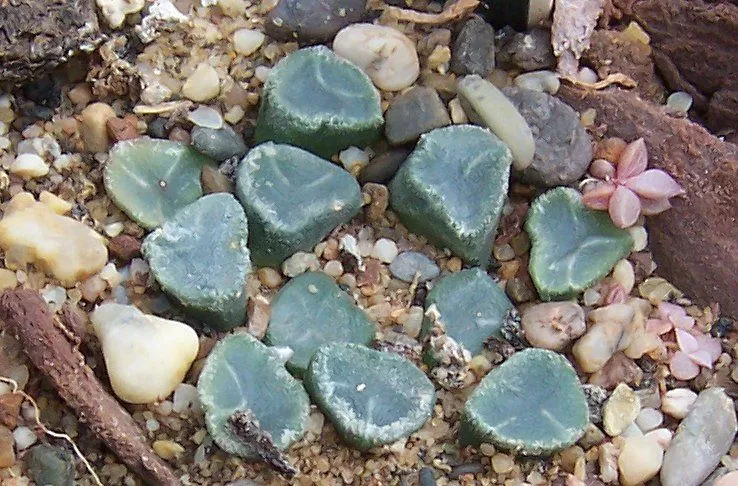
Transparency in Haworthia leaves generates more unnecessary worry than almost any other observation in the genus, because the word "transparent" describes two completely different conditions. One is a remarkable evolutionary adaptation that defines the soft-leaf Haworthia group. The other is a pathological symptom of overwatering. Getting them confused leads to exactly the wrong intervention.
Part of the Complete Haworthia Guide.
Normal leaf windows — the defining feature of soft-leaf Haworthia
The transparent or translucent patch at the tip of a Haworthia cooperi, H. cymbiformis, H. retusa, H. truncata, H. obtusa, or H. maughanii leaf is not a symptom of anything. It is a leaf window — one of the most specialised structures in the succulent world. In the wild, these plants grow mostly buried in sandy or rocky soil, with only the leaf tips exposed above the surface. The silica-rich, transparent apical tissue admits light to photosynthetic cells deep inside the leaf body, where chlorenchyma can operate safely, shielded from the harsh South African sun and desiccating dry-season winds.
Hold a Haworthia cooperi leaf to the light and you can see straight through it at the tip. The window may cover just the final 3–5 mm of the leaf tip, or in species like H. truncata, nearly the entire flattened leaf face. Translucent lines that follow the main leaf veins are part of the same window tissue network. None of this is pathological. A plant with clear, well-defined windows is well-grown and correctly hydrated.
The window colour can vary. Well-lit plants often have more vivid windows with green or blue-green tissue visible through the translucent tip. In very low light the windows appear milky or opaque as the chlorenchyma inside densifies. In higher light the windows may take on a russet or bronze tint as protective pigmentation (related to anthocyanin production) develops in the outer epidermis.
What normal windows look like versus pathological transparency
Normal window transparency is:
- Confined to the leaf tip and vein lines, not the whole leaf
- Present only in soft-leaf Haworthia species, not in hard-leaf Haworthiopsis
- Consistent across most leaves of the plant simultaneously
- Not accompanied by mushiness, yellowing, or leaf collapse
- Not spreading or worsening over days
Pathological transparency is:
- Uniform across the full leaf surface, making the whole leaf look glassy or water-filled
- Often accompanied by yellowing, softening, or collapse
- Spreading from older leaves upward toward the centre
- Accompanied by a wet or sour smell from the root zone
- Associated with recent overwatering, a wet substrate, or cold exposure
Overwatering and waterlogged leaf cells
When Haworthia roots are functioning but the plant is receiving more water than it can manage, the cells in the leaf tissue become overloaded with water. The internal pressure (turgor) increases past the normal range, and the mesophyll cells swell, giving the leaf a glassy, almost translucent appearance — the texture changes from firm and matte to wet-looking and slightly inflated. This is distinct from the normal leaf window: it affects the full leaf body rather than just the tip, and the leaf does not feel firm — it feels soft or even mushy.
This condition precedes root rot in many cases. The root zone is saturated, anaerobic conditions are developing, and fine roots are beginning to die. The waterlogged transparency across multiple leaves is an early warning that the plant needs to dry out immediately. Stop watering, check that the drainage hole is clear, remove any saucer with standing water, and move the plant to a position with better airflow. If the transparency does not resolve within 5–7 days and the plant continues to soften, unpot and inspect the roots.
Cold damage and tissue collapse
Frost or temperature below 3–4 °C collapses the cell walls in Haworthia leaf tissue, releasing their water content into the intercellular spaces. Immediately after a cold event, affected leaves may appear glassy or translucent in a way that resembles waterlogging — but the history of the plant makes the diagnosis clear. Cold-damaged transparency typically appears 12–48 hours after exposure and is associated with a specific cold event (frost, a cold windowsill overnight, outdoor exposure in winter).
Cold-damaged leaves turn from glassy to brown-grey and collapsed over 2–7 days. Soft-leaf species with high water content — H. cooperi, H. bayeri, H. truncata — are particularly vulnerable. The affected leaves cannot recover. Move the plant to above 10 °C, withhold water for at least two weeks, and allow damaged tissue to fully dry before removing it. Evaluate whether the growing centre of the rosette remains firm before assuming the plant is lost.
Sunburn bleaching
Pale, bleached-out areas on the upper leaf surface of soft-leaf Haworthia species can look semi-transparent or papery-white. This differs from leaf windows in location (random upper surface patches rather than the leaf tip) and from waterlogging (dry and papery rather than wet). The cause is direct sun exposure, and the mechanism is photoinhibition and chlorophyll destruction in the sunburn zone. The damaged area becomes paler, almost glassy-white, then dries to a papery scar.
Sunburn bleaching is permanent but the plant survives. Move to bright indirect light. New growth from the centre will be undamaged.
How to tell the causes apart
| Appearance | Location | Texture | Most likely cause |
|---|---|---|---|
| Translucent tip and vein lines, rest of leaf green | Leaf tip only | Firm | Normal leaf window |
| Entire leaf glassy or water-filled | Whole leaf | Soft, inflated | Overwatering |
| Glassy transparency, followed by collapse | Scattered leaves | Soft then collapsed | Cold damage |
| Pale, bleached-white patches | Exposed upper surface | Papery, dry | Sunburn bleaching |
| Milky or opaque windows | Leaf tip | Firm | Low light (reduced window clarity) |
Risk and severity
Normal leaf windows carry no risk. Mild overwatering causing glassy leaves, if caught before roots are damaged, resolves by drying out. Overwatering that has progressed to root rot is more serious and requires unpotting and intervention. Cold damage is cosmetic if the crown is spared. Sunburn bleaching is permanent but rarely fatal.
Monitor the developing situation: a plant with glassy leaves that continues to soften and smell sour within 5 days needs root inspection. A plant with glassy leaves that firms back up after 3–4 days of drying out has self-corrected.
Solutions
Normal leaf windows
No action. Confirm the plant is a soft-leaf Haworthia species and the transparency is confined to the leaf tips and vein network. Enjoy the adaptation for what it is.
Overwatering-caused glassiness
Stop watering immediately. Ensure drainage hole is clear. Remove from saucer. Move to a spot with airflow. If glassiness does not resolve in 5–7 days, unpot and check roots. Any black or slimy roots indicate root rot and should be cut back, the plant dried bare-root, and repotted into dry mineral mix.
Cold damage
Move above 10 °C. Do not water for two weeks. Allow damaged leaves to dry fully before removing. Assess crown firmness to determine whether the rosette centre is recoverable.
Sunburn bleaching
Move to bright indirect light. The pale patches are permanent. Protect from direct sun in future by acclimatising gradually to any increase in light intensity.
Prevention
The most effective prevention for pathological transparency is correct watering — the wet-dry cycle explained guide covers the mechanics in full. Water thoroughly, drain completely, and wait until the top 3–4 cm of substrate is dry before watering again. Use a pot with an open drainage hole and never leave the plant in a saucer of water. Avoid temperatures below 5 °C. Acclimatise to any increase in light over 7–14 days.
For collectors who want to display leaf windows at their best: plant slightly deep so only the leaf tips emerge, use bright indirect light, and allow the substrate to dry thoroughly between waterings — a slightly water-stressed plant shows more vivid windows than an over-watered one.
See also
- Root rot diagnosis — confirming and treating root rot when waterlogged glassiness has progressed.
- Haworthia cooperi — the most window-prominent of the commonly grown species; the benchmark for normal translucency.
- Haworthia truncata — extreme window development across the full flattened leaf face.
Frequently Asked Questions
Are transparent tips on Haworthia normal?
Yes, for soft-leaf species. The translucent or transparent tip is the leaf window — a silica-rich apical area that admits light to chlorenchyma inside the leaf. It is the defining characteristic of Haworthia cooperi, H. cymbiformis, H. retusa, and related species.
Why are my Haworthia leaves turning glassy?
Glassy, water-filled whole leaves indicate the tissue is waterlogged — more water has entered the cells than the plant can manage. This is an overwatering symptom and is often accompanied by yellowing and root rot. Unpot and inspect roots.
Do all Haworthia species have windows?
No. Leaf windows are characteristic of soft-leaf Haworthia (sensu stricto) species. Hard-leaf Haworthiopsis species such as H. fasciata and H. attenuata have opaque, stiff leaves decorated with tubercles, not translucent windows.
Can I increase transparency of the leaf windows?
Burying the plant slightly deeper so only the leaf tips are exposed, as in natural habitat, enhances the window appearance. Brighter indirect light also increases the visible translucency compared to very low-light conditions.