| Symptom | Likely Cause | Risk | First Action |
|---|---|---|---|
| Light | Bright shade is the right setting. | Overhead watering; water pooled on the truncated windows can rot the growth point within 48 hours. | Use a deep 8–10 cm pot with 70% pumice or perlite and water only when the top 3 cm dries. |
| Water | Water thoroughly when the top 3 cm of substrate reads dry on a moisture probe, then withhold completely until it reads dry again. | Overhead watering; water pooled on the truncated windows can rot the growth point within 48 hours. | Use a deep 8–10 cm pot with 70% pumice or perlite and water only when the top 3 cm dries. |
| Pot and temperature | Use a deep pot rather than a shallow one. | Overhead watering; water pooled on the truncated windows can rot the growth point within 48 hours. | Use a deep 8–10 cm pot with 70% pumice or perlite and water only when the top 3 cm dries. |
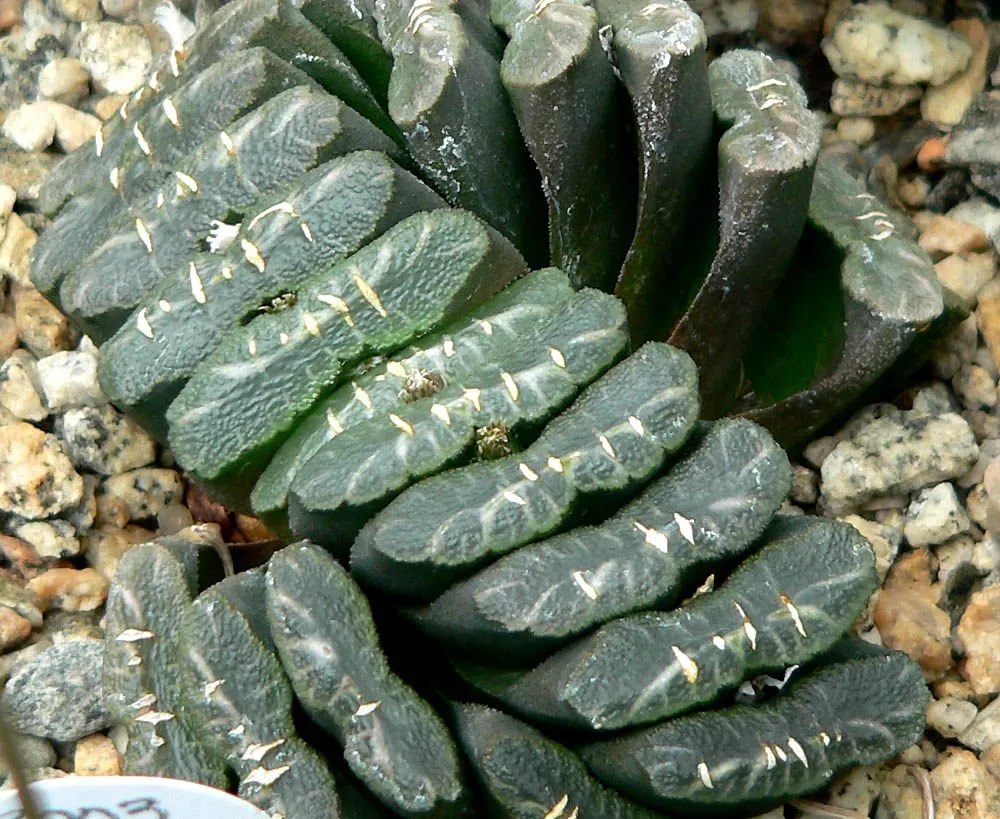
Haworthia truncata was described by Selmar Schönland in 1910 from collections made in the Little Karoo of South Africa's Western Cape. It is the most distinctively shaped species in the entire genus: instead of forming the rosette typical of its relatives, the leaves are arranged in two opposing ranks like the teeth of a horse, each leaf a vertical fleshy column truncated flat at the top into a translucent window. The common name "Horse's Teeth" describes the plant precisely.
In habitat the plant grows almost entirely buried in quartzite gravel and clay flats between 100 and 800 m elevation, with only the flat leaf tips, those polished translucent panels, exposed at ground level. The windows admit diffuse light to chlorenchyma deep inside each leaf, while the underground bulk of the plant is shielded from desiccation, grazers, and the brutal summer surface temperatures of the Little Karoo. Rainfall is bimodal, with reliable winter rain and unpredictable summer thunderstorms; substrate is sharply drained and mineral-poor. Wild populations are scattered, slow-growing, and protected from collectors under South African legislation and CITES Appendix II controls.
Part of the Complete Haworthia Guide.
Identification
Three features taken together separate H. truncata from every other small succulent in cultivation.
- Distichous (two-ranked) leaf arrangement. This is the diagnostic. The leaves emerge in a single plane, alternately to left and right, producing a fan-shaped silhouette viewed from above. No other widely cultivated Haworthia arranges its leaves this way. Even very young seedlings show the trait.
- Truncated, fenestrated leaf tips. Each leaf is a vertical fleshy column 2–4 cm tall and 1–2 cm wide, dark grey-green to brown-green on the outer surface, abruptly cut off flat at the top. The flat face is the window: a smooth or finely reticulated translucent panel through which light penetrates the leaf interior. The cut looks deliberate, as if the plant has been pruned with a blade. It has not.
- Vertical, columnar leaf habit. Leaves stand upright or near-upright, never reflexed back like Haworthia retusa and never recurved like Haworthia cooperi.
A mature plant rarely exceeds 5–10 cm across. Roots are thick and contractile, pulling the rosette deeper into the substrate as it ages. The flower is the standard Haworthia type: small, white with green keels, two-lipped, borne on a slender unbranched raceme 20–35 cm tall in late spring or early summer.
The lookalikes are predictable.
- Haworthia maughanii (often treated as H. truncata var. maughanii) shares the truncated window habit but its leaves are round in cross-section and arranged in a spiral rosette, not a 2-ranked fan. Once you have seen the difference it is unmissable.
- H. retusa has flat, star-window leaf tips, but they spread flat against the soil in a rosette, each leaf curving back on itself. The arrangement is rosulate, not distichous, and the leaves are triangular not columnar.
- H. cooperi has rounded, almost spherical translucent leaf tips and forms a tight rosette of soft leaves clustered in three dimensions. There is no flat truncation and no two-ranked arrangement.
If a vendor sells you a "horse's teeth" plant whose leaves form a circular rosette, you have H. maughanii or a hybrid. If the leaves spread flat against the pot rather than standing vertical, you have H. retusa or a relative.
Cultivation
H. truncata is treated as a slow but unfussy collector's plant. The cultivation goal at home is to mimic, in muted form, the buried-in-gravel habit of habitat: bright but indirect light, very free-draining substrate, and water that arrives in long pulses with hard dry periods between.
Light
Bright shade is the right setting. An east-facing windowsill with morning sun, or a south-facing position one metre back from the glass under a sheer curtain, produces dark green leaves with crisp window faces. Direct unshaded summer sun bleaches the windows opaque grey-white and the damage does not repair. In a greenhouse, 50% white shadecloth from April through September is appropriate at temperate latitudes. If your plant is producing pale lime-green windows, light is correct. Saturated dark green and a flattened, opening fan means too dark; reddish or chalk-grey windows mean too bright.
Water
Water thoroughly when the top 3 cm of substrate reads dry on a moisture probe, then withhold completely until it reads dry again. In typical indoor conditions this is roughly every 10–14 days during the active growth season (autumn through spring) and every 3–4 weeks during summer dormancy. Water the substrate only. Never irrigate from above; pooled water sitting on the truncated window faces will rot the growth point within 48 hours. The species shares the soft-leaf Haworthia quirk of slowing dramatically in midsummer heat. If yours looks dull and slightly sunken in August, water less, not more.
Substrate
Mineral-heavy and free-draining. I use 70% pumice or perlite (2–6 mm grade), 15% coarse sand, and 15% peat-free loam-based compost (John Innes No. 2 or equivalent). pH should sit between 6.0 and 7.0. Top-dress with 1 cm of clean grit; this slows surface evaporation, prevents mossy compaction, and helps the plant settle visually into a habitat-like presentation.
Pot and temperature
Use a deep pot rather than a shallow one. The contractile roots are long and the plant prefers to pull itself down into the substrate column. A pot 2 cm wider than the leaf fan and 8–10 cm deep suits a mature plant. Unglazed terracotta and plastic both work; terracotta dries faster and is the safer default for growers who tend toward overwatering. Comfortable temperature range is 8–28 °C. Bone-dry plants tolerate brief dips to 0 °C without harm; below freezing the leaf-tip windows pit and scar irreversibly. Above 32 °C combined with any substrate moisture triggers root rot. Ventilate well in summer.
Propagation
Slow propagation is one of the things collectors accept about this species. Three methods are used in practice.
Leaf cuttings
The most common method, but not a fast one. Detach a healthy outer leaf with a clean sideways twist that takes the entire leaf base. Callus 7–10 days in shade. Lay the leaf horizontally on damp coarse grit at 20–25 °C in bright shade, with the basal cut barely touching the substrate. Plantlets emerge from the cut surface in 6–12 months; some leaves take longer or fail entirely. Success rates run 30–50% for healthy material. The new plantlet matures to a recognisable miniature horse's-teeth fan in another 12–18 months.
Root cuttings
A method specific to H. truncata and worth knowing. Thick mature roots, severed at repotting, will sprout adventitious plantlets if laid on grit and treated as leaf cuttings. Success is variable but the technique is useful when offsets are unavailable, which they usually are.
Seed
Slow but reliable for documented stock. The species is largely self-incompatible; two unrelated flowering plants are needed for viable seed. Sow on the surface of fine grit, scatter a thin layer of sand on top, mist, and germinate at 20–25 °C under humidity. Germination follows in 2–4 weeks. Seedlings reach a 2 cm fan in roughly three years and flowering size in five to seven. Hybridisation with other Haworthia species in a mixed collection is common, so isolate flowering plants if you want clean seed.
Basal offsets are uncommon on this species. A mature plant may eventually produce one or two pups, but this cannot be relied upon. If you want more plants quickly, leaf and root cuttings are the answer, not division.
Notes
The variety H. truncata var. maughanii (sometimes elevated to H. maughanii) is the round-leafed, rosulate sister of true H. truncata and shares the same cultivation. Numerous Japanese-bred cultivars exist with enlarged or finely reticulated window faces, sold under names like 'Lime Green' and 'Silver Wide'. These are propagated by tissue culture or root cuttings and command high prices in collector circles. The species is not toxic to dogs or cats, but the firm leaves are unappealing to most pets.
Pests are limited to the standard Haworthia problems: foliar mealybug in leaf axils, root mealybug detected at repotting, and aphids on the flower spike. Treat as you would for any soft-leaf Haworthia; the beginner's guide to succulents covers the general pest and watering protocols that apply across the genus.
See also
- The Complete Haworthia Guide
- Beginner's guide to succulents
- Haworthia maughanii — the spiral-rosette sister species with identical flat windows and cultivation requirements.
Frequently Asked Questions
Why is Haworthia truncata called Horse's Teeth?
The leaves stand in two opposing ranks and are cut flat at the top, giving the silhouette of horse teeth. The common name describes the plant's structure precisely.
How is Haworthia truncata different from Haworthia maughanii?
H. truncata is distichous, with leaves in a two-ranked fan. H. maughanii has similar flat windows but arranges its leaves in a spiral rosette.
Can Haworthia truncata tolerate frost?
Bone-dry plants tolerate brief dips to 0 °C. Below freezing, the window faces pit and scar irreversibly.
What is the fastest propagation method for Haworthia truncata?
Offsets are uncommon, so leaf and root cuttings carry most propagation. Leaf plantlets may take 6–12 months to emerge and another 12–18 months to form a recognisable fan.