| Symptom | Likely Cause | Risk | First Action |
|---|---|---|---|
| Light | Bright but filtered light. | Overhead watering on the flat windows; crown rot can develop within 48 hours in warm conditions. | Grow it like H. truncata: deep pot, quartz or pumice top-dressing, and water only at substrate level. |
| Water | Water thoroughly when the top 3 cm of substrate reads below 15% on a moisture probe, then withhold completely until it reads dry again. | Overhead watering on the flat windows; crown rot can develop within 48 hours in warm conditions. | Grow it like H. truncata: deep pot, quartz or pumice top-dressing, and water only at substrate level. |
| Pot and temperature | Use a deep pot. | Overhead watering on the flat windows; crown rot can develop within 48 hours in warm conditions. | Grow it like H. truncata: deep pot, quartz or pumice top-dressing, and water only at substrate level. |
Haworthia maughanii was described by Karl von Poellnitz in 1937 from material collected near Riversdale in South Africa's Western Cape, and named in honour of the botanist R. C. R. Maughan, who first brought the plant to wider attention. The species shares the trademark window-top construction of Haworthia truncata: vertical fleshy leaves cut off flat at the apex into translucent fenestrations. What sets it apart, and the single feature that resolves almost every nursery confusion, is the leaf arrangement: a tight spiral rosette rather than the two-ranked fan of its better-known relative.
In the wild H. maughanii occupies a tightly restricted range on rocky clay flats north and east of Riversdale, between roughly 100 and 300 m elevation. The substrate is mineral-poor: quartzite gravel and surface litter over a heavy clay base. The climate sits at the transition between winter-rainfall and bimodal-rainfall regimes typical of the southern Western Cape. As in H. truncata, the bulk of each plant grows below ground level; only the polished window faces sit flush with the surrounding gravel, admitting light to the leaf interior while the body avoids surface heat, herbivores, and dehydration. The Riversdale populations are small and slow-recovering, and the species is treated as conservation-sensitive under South African legislation and regulated under CITES Appendix II along with the rest of the genus.
Part of the Complete Haworthia Guide.
Identification
A mature H. maughanii sits 4-7 cm across, carrying 8-15 leaves arranged in a tight spiral around a central growth point. Three features anchor the identification.
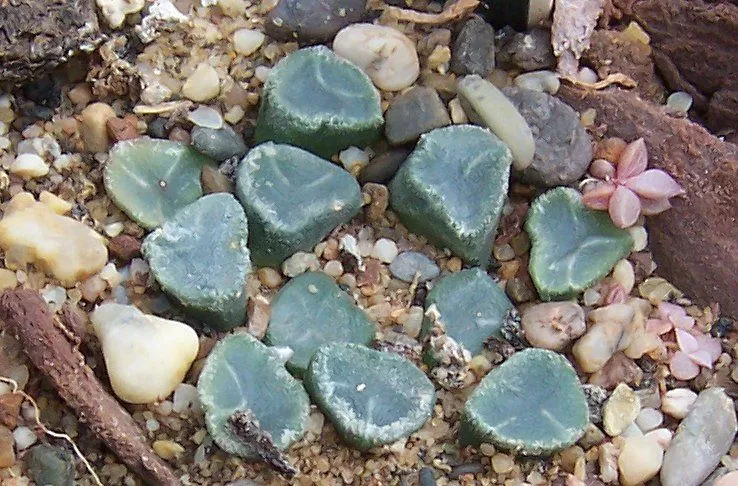
- Spiral rosette of vertical columnar leaves. Leaves emerge in a continuous spiral, not in two opposing ranks. Viewed from above the rosette is roughly circular, with leaf tips packed into a tessellated mosaic. From the side the leaves stand upright, blunt-ended like cut sections of dowel.
- Flat truncated window at each leaf apex. Each leaf is cylindrical to broadly conical, 1.5-3 cm wide at the apex and 2-4 cm tall, with the top abruptly cut off horizontally. The cut face is the window: a smooth, translucent panel, sometimes finely reticulated, that lets diffuse light into the chlorenchyma layer deeper inside the leaf. Body colour is dark brown-green to grey-green, with the windows lighter and slightly luminous in oblique light.
- Habit of sinking into the substrate. Contractile roots gradually pull the rosette downward; mature plants in deep pots can sit with their bodies almost entirely buried, only the windows visible at the gravel surface. Top-dressing with quartz grit reinforces this presentation.
The flower spike is the standard Haworthia type: 20-30 cm tall, unbranched, carrying small two-lipped white flowers with green keels in late spring to early summer. Flowering is unremarkable and not useful for identification.
The two species you most need to separate from H. maughanii are predictable.
- H. truncata. Same vertical columnar leaves, same flat truncated windows, same buried-in-gravel habit. The only structural difference is leaf arrangement: H. truncata produces leaves in two opposing ranks (distichous), giving a fan-shaped silhouette from above. H. maughanii produces them in a spiral, circular from above. Once you have a specimen of each side by side the difference is unmissable, but in trade, where plants are sold individually and often mislabelled, the confusion is constant. If your "horse's teeth" plant has a circular rosette, it is H. maughanii or a hybrid, not H. truncata.
- H. cooperi. Forms a rosette and has translucent leaf tips, so beginners sometimes group it with H. maughanii. The separator is window shape. H. cooperi leaves have rounded, almost spherical translucent tips, often with bristly hairs along the leaf edge, and no flat truncation. H. maughanii leaves are cut off cleanly horizontally, the window face geometric and matte rather than glassy and bulbous. Body texture also differs: H. cooperi is soft and yielding, H. maughanii firm and dense.
Hybrids of H. maughanii with H. truncata, H. retusa, and other rosette species circulate in collector trade, sometimes with intermediate leaf arrangements that look neither cleanly distichous nor cleanly spiral. Treat such plants as hybrids.
Cultivation
Cultivation principles for H. maughanii are those of H. truncata: the plant evolved buried in clay and quartz, and resents the conditions that suit a typical houseplant rosette. Bright shade, lean mineral substrate, infrequent thorough watering, and good ventilation produce healthy specimens. Saturated, shaded, or stagnant conditions kill them, slowly or quickly depending on temperature.
Light
Bright but filtered light. An east-facing window with morning sun, or a south-facing position one metre back from the glass behind a sheer curtain, suits the species at temperate latitudes. In a greenhouse, 50% white shadecloth from April through September is the safe default. Direct unshaded summer sun bleaches the window faces opaque grey-white, and the damage is permanent; the affected leaf has to be replaced from the centre over the following year. Healthy windows are pale to mid green, faintly luminous in raking light. Saturated dark green plus a flattening, opening rosette indicates too little light.
Water
Water thoroughly when the top 3 cm of substrate reads below 15% on a moisture probe, then withhold completely until it reads dry again. Indoors that schedule typically runs every 10-14 days during the autumn-to-spring active season and every 3-4 weeks in summer dormancy. Never irrigate over the rosette: water pooled on the truncated window faces drains into the apical growth point and rots the crown within 48 hours at warm temperatures. Apply water to the substrate only, ideally by partially submerging the pot for 10 minutes and letting it drain. The plant slows visibly in midsummer; if the rosette looks dull and slightly sunken in August, reduce water rather than add it.
Substrate
Mineral-heavy, free-draining, slightly acidic to neutral. A working blend is 70% pumice or perlite (2-6 mm grade), 15% coarse sand, and 15% peat-free loam-based compost (John Innes No. 2 or equivalent). pH between 6.0 and 7.0 suits the species. Top-dress with 1 cm of clean quartzite or pumice grit; this stabilises the rosette, slows surface evaporation, and approximates the gravel mulch of habitat.
Pot and temperature
Use a deep pot. The contractile roots are long and the plant prefers to sink into the substrate column over time. A pot 2 cm wider than the rosette and 8-10 cm deep suits a mature plant. Unglazed terracotta is the safer default for growers who tend toward overwatering; plastic works for those who read substrate moisture confidently. Comfortable temperature range is 8-28 °C. Bone-dry plants tolerate brief dips to about 0 °C without lasting harm. Below freezing, even by a degree or two, the window faces pit and scar irreversibly. Above 32 °C combined with any substrate moisture triggers root rot. Ventilate well in summer.
Propagation
H. maughanii is among the slower Haworthia species to propagate, which is part of why documented mature specimens command high prices in collector circles. Three methods are used in practice.
Leaf cuttings
The most common method, but not a fast one. Detach a healthy outer leaf with a clean sideways twist that removes the entire leaf base. Callus 7-10 days in shade. Lay the leaf horizontally on damp coarse grit at 20-25 °C in bright shade, with the basal cut barely touching the substrate. Plantlets emerge from the cut surface in 6-12 months; some leaves take longer and some fail entirely. Success rates run 30-50% on healthy material. The new plantlet matures to a recognisable miniature spiral rosette in another 18-24 months.
Root cuttings
Useful for this species, since offsets are uncommon. Thick mature roots severed at repotting will sprout adventitious plantlets if laid on grit and treated like leaf cuttings. Success is variable, but the technique is valuable when no offsets are available, which is most of the time.
Seed
Slow but reliable for documented stock. H. maughanii is largely self-incompatible, so two unrelated flowering plants are needed for viable seed. Sow on the surface of fine grit, scatter a thin layer of sand over the seed, mist, and germinate at 20-25 °C under humidity. Germination follows in 2-4 weeks. Seedlings reach a 2 cm rosette in roughly three years and flowering size in five to seven. Hybridisation with other Haworthia species is common in mixed collections; isolate flowering plants if you want clean seed, or accept that the offspring may show H. truncata or H. cooperi genetics depending on what was in pollen range.
Basal offsets are rare on this species. A vigorous mature plant may eventually push out one or two pups, but division cannot be relied upon. For most growers, leaf and root cuttings carry the propagation load.
Notes
The taxonomy of H. maughanii is unsettled. Several authors treat it as H. truncata var. maughanii given the shared leaf morphology and the existence of intermediate plants in the wild. Others, following the older Poellnitz treatment, recognise it as a distinct species. Both names appear on collector labels and in trade, and for practical cultivation purposes there is no difference.
A large body of Japanese-bred cultivars exists, selected for window size, reticulation pattern, and leaf colour. Names like 'Yukihira' and 'Kintaikyo' circulate at high prices through specialist dealers; these are propagated by tissue culture and root cuttings rather than from seed, and most are slow even by Haworthia standards. Pests are the usual Haworthia set: foliar mealybug tucked into leaf axils, root mealybug discovered at repotting, occasional aphids on the flower spike. The species is not toxic to dogs or cats, though the firm leathery leaves are unappealing to most pets. General watering and pest protocols in the beginner's guide to succulents apply across the soft-leaf Haworthia group, including this species.
See also
- The Complete Haworthia Guide
- Beginner's guide to succulents
- Haworthia truncata — the Horse's Teeth sister species sharing the flat window-top construction and buried growing habit.
Frequently Asked Questions
How is Haworthia maughanii different from Haworthia truncata?
Both have vertical leaves with flat window tops. H. maughanii forms a spiral circular rosette, while H. truncata forms a two-ranked fan.
Where does Haworthia maughanii come from?
The post places it on rocky clay flats north and east of Riversdale in South Africa's Western Cape, roughly 100–300 m elevation.
Does Haworthia maughanii need a deep pot?
Yes. Long contractile roots pull the rosette downward, so a pot about 8–10 cm deep suits a mature plant.
How quickly does Haworthia maughanii propagate?
Slowly. Leaf-cutting plantlets may take 6–12 months to appear and another 18–24 months to become a recognisable spiral rosette.