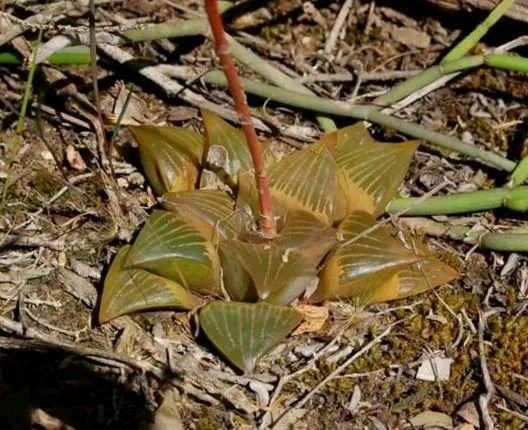
Leaf tip dieback — a zone of dry, brown tissue progressing from the leaf tip toward its base — is the most reported cosmetic complaint in the Haworthia group. It is rarely dangerous and in most cases does not represent a significant care failure. The tip of a haworthia leaf is physiologically the most exposed point: furthest from the root supply, with the highest surface-area-to-volume ratio, and first to be affected by any disruption to the plant's water balance. A small amount of tip browning on the outermost leaves is normal. Persistent or progressive tip browning across multiple leaves simultaneously indicates a correctable condition.
Part of the Complete Haworthia Guide.
Drought stress and infrequent watering
The most common correctable cause of widespread tip browning is mild, chronic drought — water stress that does not reach the full shriveling visible across the whole leaf but is severe enough at the tips to cause cell death there. The outer leaves of a Haworthia begin mobilising stored water from their tips and margins before the shriveling visible across the leaf body becomes apparent. At moderate drought levels, the plant robs the tips of their stored water first. The resulting cell death appears as dry, tan-brown tip tissue while the rest of the leaf remains plump and firm.
Diagnosis: the substrate has been dry for more than 14 days during the active growing season (spring or autumn), or more than 21 days at any time of year in a cool indoor environment. The pot feels light. Multiple leaves show browning at the tip in roughly the same zone across the rosette. Correct with one thorough soak — pour water slowly until it exits the drainage holes cleanly, then allow the substrate to drain completely. Resume watering when the top 3–4 cm reads dry, typically every 7–14 days in active growing conditions. New growth from the rosette centre will emerge with undamaged tips once the watering schedule is consistent. See watering frequency method for a structured approach to timing waterings correctly.
Low atmospheric humidity
Soft-leaf Haworthia species — H. cooperi, H. cymbiformis, H. retusa, H. obtusa — are more sensitive to low humidity than their hard-leaf Haworthiopsis relatives. In centrally heated homes in winter, ambient humidity can fall to 20–30%, which is below the 35–50% these plants encounter in their native South African range even during dry seasons. At low humidity, the transpiration rate at the leaf surface exceeds what the plant's roots can match at the leaf tips, where the surface-area-to-volume ratio is highest. The result is tip browning even in a plant that is otherwise correctly watered and root-healthy.
Practical threshold: if indoor humidity falls below 30% for extended periods — measurable with an inexpensive hygrometer — tip browning is likely in sensitive species. Placing a tray of water and pebbles directly below the pot raises local humidity by 5–10% around the plant (the pot must sit on the pebbles, not in the water). A room humidifier is more effective for whole-collection management. Do not mist the plant directly — water droplets on soft-leaf surfaces in cool conditions remain for hours and can cause spotting, encourage tip fungal issues, or, in the case of the crown, contribute to rot risk. Good air circulation around the plant is important alongside any humidity increase: stagnant moist air is worse for haworthias than dry air with movement.
Sunburn on the leaf tip
On soft-leaf haworthias, the translucent apical window of each leaf is simultaneously a photosynthetic adaptation and a structural vulnerability. Intense, unfiltered sun overwhelms window-cell photosystems before the rest of the leaf shows visible damage, because the window tissue is thinner and admits more light per unit of leaf area. This appears as tip browning with a whitened, bleached quality at the damaged zone — slightly more pallid than the tan-brown of drought-related tip browning — and may be accompanied by a slightly depressed, sunken texture.
Diagnosis: the browning appeared following a change in light exposure — the plant was moved outside, repositioned near a south-facing window, or the seasonal increase in sun angle in late spring increased intensity at the window. The browning is on the most light-exposed surfaces and specifically at the leaf tips rather than across the full exposed face (which would indicate broader sunburn). The full comparison between tip bleaching and other browning patterns is in sunburn diagnosis and recovery and in haworthia leaves turning brown.
The correction is to reposition to bright but unshaded indirect light and introduce stronger light gradually over 10–14 days in future transitions. Damaged tips do not recover, but new leaves growing from the rosette centre will have intact window tissue once light intensity is reduced to the correct level.
Fertiliser salt accumulation
Repeated fertilisation in a slow-draining or poorly leached substrate causes salt accumulation at the root zone and the substrate surface. Sodium, potassium, and ammonium salts in excess suppress water uptake osmotically — the roots cannot pull water into the plant efficiently against a high salt concentration gradient. The tips, furthest from the vascular supply, are first to show the resulting deficit as brown, dry dieback. The pattern: multiple leaves show tip browning in the weeks after a fertilisation programme, the substrate is not visibly dry, the leaf body remains firm, and there is a white or pale crust visible at the soil surface.
Haworthia is a slow-growing genus with modest nutritional needs. A weak balanced fertiliser at one-quarter the recommended concentration, applied once in spring and once in early autumn, is entirely sufficient. More frequent or concentrated applications are counterproductive and cause tip burn before any growth benefit is realised. The remedy is to flush the substrate thoroughly: pour water slowly until it runs freely from the drainage hole, allow to drain, then repeat twice in one session. This leaches accumulated salts without requiring repotting. Repeat the flush twice a year as standard practice.
Physical damage and contact with surfaces
Brown tips that appear on just one or two leaves with a sharp, straight-edged boundary rather than the gradual tapering transition of drought or humidity tip browning are almost always the result of mechanical damage — the leaf tip rubbed against a shelf surface during a move, was caught on adjacent foliage, or was compressed by a neighbour as the rosette expanded. There is no treatment beyond allowing the dead tissue to dry fully and trimming it once fully papery. Ensure the plant has clearance from surrounding objects and neighbouring plants after repositioning.
Natural aging of outer leaves
As leaves in the outer whorl of the rosette age, their tips naturally dry and brown before the rest of the leaf begins the full senescence process. This tip-first drying is the initial phase of normal basal senescence. A thin line of brown at the tip of each of the two to four outermost leaves, stable and not progressing deeper into the leaf over weeks, is normal. The full-leaf browning that follows as these leaves age further is covered in haworthia leaves turning brown.
How to identify the cause
| Pattern | Appearance | Context |
|---|---|---|
| Tips brown across many leaves, pot very dry | Dry tan-brown, tapering | Long interval since last watering |
| Tips brown in winter, plant correctly watered | Dry, on outermost tips only | Heated indoor environment, low humidity |
| Tips bleached or whitened, light recently increased | White-pale tan, slightly sunken | New sun exposure or seasonal angle change |
| Tips brown after fertilising, firm leaf body | Similar to drought tip but sudden onset | Recent fertilisation in slow-draining mix |
| One or two leaves only, sharp straight edge | Clean break, abrupt margin | Physical damage from rubbing |
| Thin line on outermost 2–4 leaves, stable | Papery, not progressing | Normal basal aging |
Risk and severity
Tip dieback is cosmetic. It does not spread through the leaf body, it does not kill the plant, and by itself it does not indicate systemic illness. The affected tip tissue is dead and permanent — but leaf tips are not the primary photosynthetic zone in Haworthia. The apical windows function as light pipes; the green chlorenchyma inside the leaf does the photosynthetic work. Losing a millimetre of tip does not meaningfully impair the plant's function.
Risk elevation occurs only when tip browning is accompanied by other symptoms: shriveling of the leaf body (drought or root damage — see haworthia leaves shriveling), yellowing (root rot or deficiency), or unusually rapid progression from tip toward the leaf base over days rather than weeks. In those cases the tip browning is a secondary indicator and the primary symptom drives the diagnosis.
Solutions
Drought or infrequent watering
Water thoroughly until water exits the drainage holes. Drain completely. Return to a schedule of watering when the top 3–4 cm of substrate is dry — every 7–14 days in active growth conditions, every 14–21 days in cool winter conditions. Existing tip damage on current leaves is permanent; new growth will emerge intact.
Low humidity
Raise local humidity with a pebble tray below the pot. Do not mist. Improve air circulation in the room. In winter, move the plant incrementally further from heating vents or radiators that create dry, hot zones.
Sunburn
Reposition to bright indirect light. Introduce stronger light gradually over 10–14 days in future. The bleached tips remain; new growth from the centre will be intact.
Fertiliser salt burn
Flush the substrate twice with plain water in one session. Reduce fertilisation to twice yearly at one-quarter the label concentration. Future tip damage will stop; existing tips remain brown.
Physical damage
Trim only fully papery, dry dead tissue using fine scissors angled to follow the leaf taper. Ensure the plant has clearance from adjacent surfaces and neighbouring plants.
Prevention
Maintain a watering schedule that does not allow the substrate to stay dry for more than 14 days during active growth. Keep ambient humidity above 30% in winter months — a hygrometer near the plant collection makes this easy to monitor. Avoid overhead watering and misting. Fertilise sparingly: twice yearly at one-quarter concentration is the correct rate for this slow-growing genus. When moving plants to stronger light environments, acclimatise over 10–14 days rather than repositioning abruptly. Position plants so leaves are not in contact with shelving edges, walls, or neighbouring plants. These measures collectively eliminate the four most common causes of tip dieback in indoor-grown haworthias.
See also
- Haworthia leaves turning brown — the full progression from tip browning to whole-leaf browning and the five causes behind each pattern.
- Haworthia black tips — when tip discolouration darkens to black rather than tan-brown, which involves different underlying causes.
- Sunburn diagnosis and recovery — distinguishing sunburn tip bleaching from drought tip browning at the diagnostic level.
Frequently Asked Questions
Can I cut the brown tips off my Haworthia?
Only remove tips that are fully dry and papery. Trimming into live green tissue leaves a wet wound that will itself brown, and the result is a larger brown area than you started with. If cosmetics matter, use fine scissors angled to follow the natural leaf taper — this produces a less visible result than a straight horizontal cut.
Why are only the tips dying and not the rest of the leaf?
Leaf tips are the furthest point from the vascular supply and the first to experience water stress, salt accumulation, or humidity deficit. The rest of the leaf has a larger buffer of stored water and direct vascular access, so those cells are the last to be affected.
Is tip browning in Haworthia a sign of root problems?
Tip browning from simple tip dieback is not a primary indicator of root problems. However, if tip browning is accompanied by shriveling, yellowing, or loss of turgor in the leaf body — not just the tip — root damage may be the underlying cause. In that case, follow the shriveling or yellowing diagnostic before addressing the tips.
Do Haworthiopsis species get tip dieback more or less than soft-leaf Haworthia?
Haworthiopsis species (H. fasciata, H. attenuata) show tip dieback less often than soft-leaf Haworthia species because their firmer, lower-water-content leaves are less sensitive to atmospheric humidity fluctuations. When Haworthiopsis tips do die back, drought is more often the cause than humidity alone.