| Question | Short Answer |
|---|---|
| Why is Haworthia retusa called a star window plant? | The recurved triangular leaf tips form flat translucent windows arranged like a five- to eight-pointed star when viewed from above. |
| How large does Haworthia retusa grow? | Mature rosettes are usually 6–10 cm across. |
| Does Haworthia retusa need summer dormancy care? | Yes. |
| Can Haworthia retusa be propagated from leaves? | Leaf propagation is possible but not very reliable. |
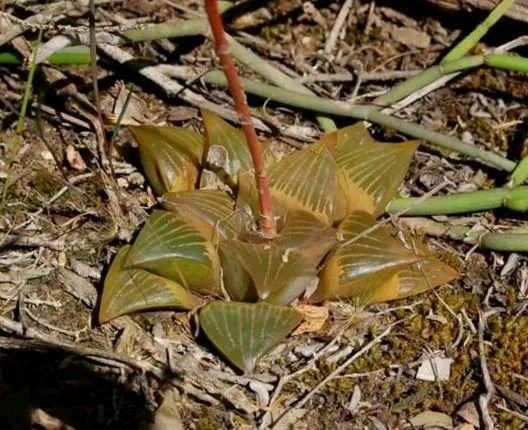
Haworthia retusa (L.) Duval (star cactus, star window plant) is a soft-leaf South African succulent whose mature rosette lies almost flat against the soil, with each thick leaf ending in an abruptly recurved, triangular translucent window. Seen from above, the effect is a tight five-pointed to eight-pointed star of windows, which is where the common names come from.
The species is native to the southern Western Cape, largely in the Riversdale and Heidelberg districts, where it grows on shale slopes in bright but not direct light. Contractile roots pull mature plants down into the substrate so that only the windowed leaf tips sit at ground level.
Part of the Complete Haworthia Guide.
Identification
Rosettes are 6-10 cm across, usually solitary or clumping slowly. Leaves are 3-5 cm long, triangular in cross-section, abruptly recurved at the tip so the upper surface faces straight up. The terminal window is flat or slightly concave, greenish-grey with darker reticulate veins running through the translucent tissue. Unlike H. cooperi, the window is bordered by sharp edges, giving a faceted jewelled look.
Inflorescence is a wiry unbranched raceme 25-40 cm tall with typical small haworthia flowers.
Several related species and varieties are often sold under the same name: var. multilineata with finer parallel window veins, var. nigra with darker leaves, and close relatives H. mutica, H. turgida, and H. mirabilis which share the pressed-rosette habit. Careful sellers label these separately; many do not.
Cultivation
Standard Haworthia care works, with one adjustment: H. retusa appreciates slightly brighter indirect light than H. cooperi. The leaves colour up attractively in copper and purple tones under strong bright indirect exposure, without scarring. An east- or north-facing window in the northern hemisphere, or a shaded south-facing position behind a sheer curtain, is about right. Direct midday summer sun still burns.
Substrate is the standard 60% mineral gritty mix. Water when the top 3-4 cm reads dry. The species semi-dormants in peak summer and grows actively autumn through spring; restraint in July and August is essential.
Propagation
Offsets appear more slowly than on H. cymbiformis or H. cooperi. A mature plant may produce only one or two offsets per year. Wait until the pup has its own roots, separate with a clean cut at the stolon, callus three to five days, and pot in dry grit.
Leaf propagation works less reliably here, with success rates typically 10-20% even for fresh clean-twisted leaves. The thick leaf base callouses slowly and is prone to rotting rather than rooting. Worth trying only as a secondary method.
Seed propagation is practical if you have two unrelated flowering plants. Germination takes two to four weeks under humidity and seedlings reach flowering size in four to five years.
Notes and Quirks
The window reticulation pattern of H. retusa varies enough between populations that specialist collectors distinguish plants by locality code (e.g. Riversdale, Heidelberg, Albertinia). If the label matters for your collection, source from a specialist nursery rather than a generic online seller.
H. retusa hybridises freely with Haworthia mirabilis, H. mutica and others where their ranges meet in the wild, and in cultivation the boundaries between these species are blurrier than the literature suggests. If a plant sold as H. retusa does not match photographs exactly, it may be a natural hybrid rather than a misidentification.
See also
Frequently Asked Questions
Why is Haworthia retusa called a star window plant?
The recurved triangular leaf tips form flat translucent windows arranged like a five- to eight-pointed star when viewed from above.
How large does Haworthia retusa grow?
Mature rosettes are usually 6–10 cm across. They are often solitary or clump slowly.
Does Haworthia retusa need summer dormancy care?
Yes. The species slows in peak summer and grows actively from autumn through spring, so restraint in July and August is essential.
Can Haworthia retusa be propagated from leaves?
Leaf propagation is possible but not very reliable. The post gives typical success around 10–20%, with thick leaf bases prone to rotting rather than rooting.