| Question | Short Answer |
|---|---|
| Is Tulista pumila still a Haworthia? | It is still sold under Haworthia pumila and H. |
| How large does Tulista pumila get? | It reaches 15–20 cm across, unusually large for the old Haworthia complex. |
| Does Tulista pumila need more light than Haworthia cooperi? | Yes. |
| How long does Tulista pumila take from seed? | Seedlings reach flowering size in 5–7 years, and full-size specimens take much longer. |
Tulista pumila (L.) G.D.Rowley (Pearl Plant, Large Pearl Haworthia), formerly Haworthia pumila and still often labelled as Haworthia maxima, is a large rosette-forming succulent from the Western Cape of South Africa. It was separated from Haworthia into the segregate genus Tulista in the 2013 generic split based on molecular phylogeny and flower morphology. Tulista as a genus contains four species, all previously placed in Haworthia and all sharing firm, pearled leaves and a relatively large habit.
T. pumila grows on rocky flats and gentle slopes in the Worcester and Robertson districts, where it sits fully exposed in mineral-rich substrate in bright sun, much more like an Aloe in habitat preference than like a soft-leaf Haworthia.
Part of the Complete Haworthia Guide.
Identification
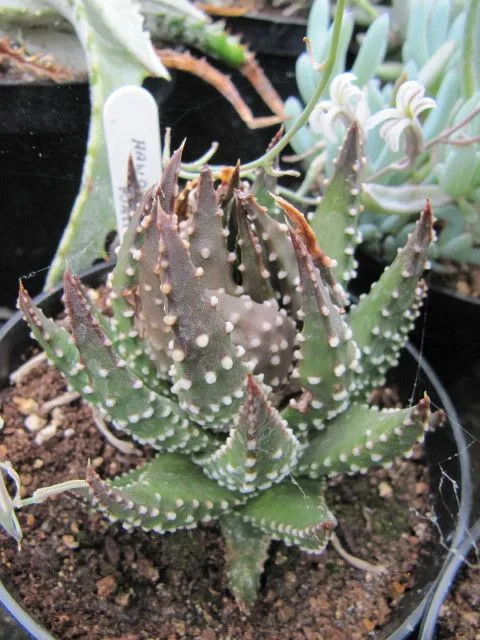
Rosettes are unusually large for the old Haworthia complex, reaching 15-20 cm across and typically solitary, with offsets appearing only on very mature plants. Leaves are stiff, triangular, 8-12 cm long, dark grey-green, and densely covered on both surfaces with raised white pearl-like tubercles. The tubercles can be very dense, giving the plant an almost frosted or beaded appearance.
Inflorescence is a branched panicle (unlike the unbranched racemes of Haworthia and Haworthiopsis) rising 30-60 cm above the rosette, bearing many small two-lipped whitish flowers. The branched inflorescence is a genus-defining feature of Tulista.
The closely related Tulista marginata and T. minima share the firm pearled leaves but have different leaf shapes and pearling patterns. T. pumila is the largest and most densely pearled of the group.
Cultivation
T. pumila wants more light than any of the soft-leaf haworthias. A bright south- or west-facing window in the northern hemisphere, or an outdoor position in dappled to moderate direct sun, is appropriate. The leaves flush attractive deep bronze and purple under strong light without scarring.
Use the standard gritty 60% mineral substrate, or a slightly more mineral version (70% pumice and perlite). Because Tulista species develop deeper, more substantial root systems than haworthias, use a deeper pot than the rosette diameter would suggest.
Watering follows the standard rule: when the top 3-4 cm reads dry. The species tolerates drought well and is forgiving of mild under-watering. Over-watering is the chief killer.
Temperature range 5-35°C is tolerated, with brief exposure to 0°C survivable if dry.
Propagation
Offsetting is slow. Mature plants may produce one offset every one or two years, and many specimens remain solitary. When offsets appear, separate with a sterile blade when they have their own roots, callus 7-10 days in shade, and pot in dry grit.
Leaf propagation is unreliable and rarely worth attempting. Success rates under 10% even with clean-twisted mature leaves.
Seed is the usual route for propagating Tulista species at any scale. The species is self-incompatible, so two unrelated flowering plants are required. Germination under humidity takes 2-4 weeks; seedlings reach flowering size in 5-7 years, longer than most haworthias.
Notes and Quirks
The solitary habit and slow growth make T. pumila a long-term project. A specimen raised from seed takes the better part of a decade to reach full size, and individual plants can live for 50 years or more in cultivation. Buy a young plant and expect to live with it.
Taxonomic labels are messy. The same plant may be sold as Haworthia pumila, H. maxima, H. margaritifera (an older synonym), or Tulista pumila. All refer to the same species. The branched inflorescence confirms it when the plant flowers; for what to expect when the wiry scape appears, see Haworthia flowering and bloom cycles.
The name Tulista was originally coined by Rafinesque in 1840 but largely ignored for 170 years until Manning, Boatwright and colleagues reinstated it in 2014 based on molecular evidence. The World Checklist of Vascular Plants now accepts it.
See also
Frequently Asked Questions
Is Tulista pumila still a Haworthia?
It is still sold under Haworthia pumila and H. maxima, but the post follows the 2013 split that places it in Tulista. The branched inflorescence confirms the genus when it flowers.
How large does Tulista pumila get?
It reaches 15–20 cm across, unusually large for the old Haworthia complex. Leaves are stiff, triangular, and 8–12 cm long.
Does Tulista pumila need more light than Haworthia cooperi?
Yes. It grows in brighter, more exposed habitat and accepts a bright south- or west-facing window or dappled to moderate direct sun.
How long does Tulista pumila take from seed?
Seedlings reach flowering size in 5–7 years, and full-size specimens take much longer. The post describes it as a long-term plant that can live 50 years or more.