| Question | Short Answer |
|---|---|
| What is a Gasterhaworthia? | It is an intergeneric hybrid between Gasteria and Haworthia or Haworthiopsis. |
| How do you identify Haworthia x Gasteria hybrids? | They often show mottled, tuberculed leaves and intermediate rosette size. |
| Are Gasterhaworthia hybrids easy to grow? | Yes. |
| How should Gasterhaworthia be propagated? | Offset division is straightforward and most hybrids produce abundant basal offsets. |
Gasteria and Haworthia are sister genera within the Asphodelaceae. They share a common ancestor, overlap in range in South Africa, and produce fertile intergeneric hybrids in cultivation. These hybrids are known as × Gasterhaworthia (Rowley) and are collected for their intermediate traits: the stouter, paler leaves of Gasteria combined with the tighter rosette habit of Haworthia.
This article covers the hybrids as a group rather than any single named cross. The same general cultivation applies across almost all of them.
Part of the Complete Haworthia Guide.
What Gasteria brings to the cross
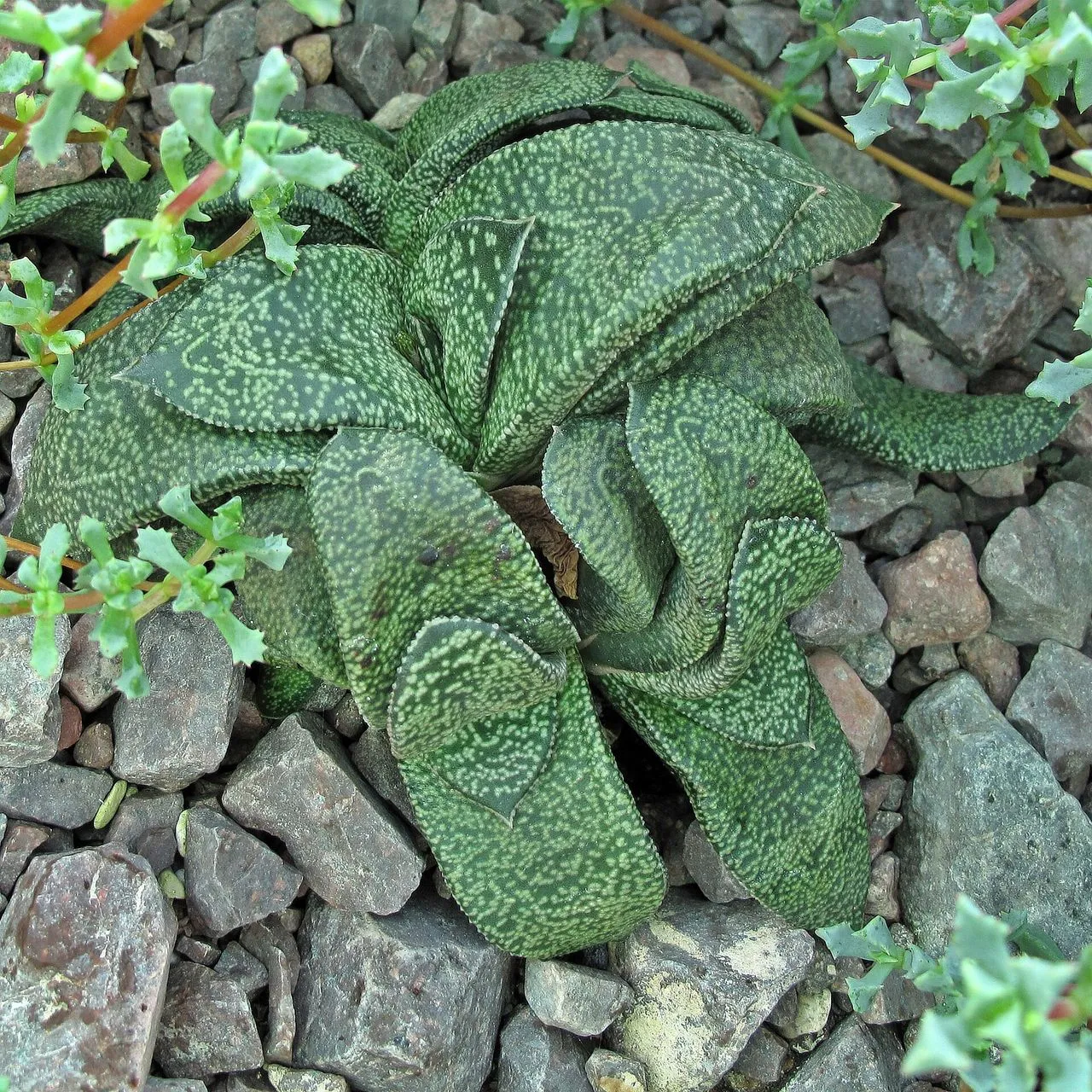
Gasteria is a genus of roughly 30 species of Southern African leaf succulents, distinguished from Haworthia and Haworthiopsis by several features. Leaves are flatter and more strap-like, often arranged in a distichous (two-ranked) pattern in juveniles that transitions to a spiral rosette in adults. Flowers are swollen at the base (the specific shape that gives the genus its name; gaster = stomach in Greek) and typically orange or red. Leaves are often mottled with pale spots or marbled patterns and carry raised tubercles on both surfaces.
Hybrids with Haworthia inherit a mixture. The most common visible traits are: mottled, tuberculed leaves; moderate rosette habit; and flowers intermediate between the two parents, often bicoloured.
Common crosses
Several named hybrids circulate widely in the trade.
- × Gasterhaworthia 'Royal Highness'. Cross of Gasteria batesiana × Haworthiopsis attenuata. Dark leaves, heavy white tuberculation, clumping.
- × Gasterhaworthia 'Beguinii'. An older cross, Gasteria carinata × Haworthia retusa or similar. Medium-green leaves with irregular white spots.
- × Gasterhaworthia 'Silver Swirl'. Cross involving variegated Gasteria with Haworthia; pale cream marbling.
There are also many unnamed nursery hybrids sold as "Haworthia-Gasteria cross" with no further information. These are usually easy growers and visually similar.
Identification
× Gasterhaworthia plants typically form rosettes 8-15 cm across, intermediate in size between the parents. Leaves are stiffer and thicker than typical Haworthia but smoother and more translucent than typical Gasteria, with variable mottling. Juvenile seedlings often start with distichous leaf arrangement and transition to spiral as they mature, which is a reliable tell for hybrid status.
Flowers are the clearest identifier. If the raceme bears swollen-based tubular flowers in cream or pink, the plant has Gasteria parentage; if flowers are fully two-lipped and whitish without basal swelling, it is pure Haworthia.
Cultivation
× Gasterhaworthia plants take their cultivation requirements mostly from the Gasteria parent, which means they tolerate slightly more light than soft-leaf haworthias and slightly more shade than most Gasteria. A bright east or west-facing window, or a position behind a sheer curtain on a south-facing window, suits them well.
Use the standard gritty 60% mineral substrate described in the pillar guide. Water when the top 3-4 cm reads dry. The hybrids are typically easier and more tolerant than either pure parent, a consequence of hybrid vigour.
Temperature range 5-32°C is tolerated. The Gasteria parentage generally confers slightly better cold tolerance than pure Haworthia.
Propagation
Offset division is straightforward. Most hybrids produce abundant offsets at the base; separate and pot as for standard haworthias, with a 5-7 day callus period.
Leaf propagation works better on × Gasterhaworthia than on pure hard-leaf haworthias, thanks to the Gasteria parentage. Success rates of 30-40% are typical for clean-twisted mature leaves.
Seed is almost never worth collecting from intergeneric hybrids; offspring segregate unpredictably and rarely match the parent.
Notes and Quirks
Because these are hybrids, clone integrity depends on vegetative propagation. A plant sold under a specific cultivar name should match a known photograph; if it does not, it may be a different hybrid with the same label applied casually.
The practical appeal of × Gasterhaworthia is robustness. If you are new to succulents or want reliable clumping plants for a shady position, these crosses are more forgiving than most pure species. They also tend to be cheaper than the pure Haworthia and Gasteria parents and are widely available.
For more demanding pure species, see the dedicated guides.
See also
Frequently Asked Questions
What is a Gasterhaworthia?
It is an intergeneric hybrid between Gasteria and Haworthia or Haworthiopsis. These crosses are collected for intermediate traits from both parents.
How do you identify Haworthia x Gasteria hybrids?
They often show mottled, tuberculed leaves and intermediate rosette size. Flowers with a swollen base indicate Gasteria parentage.
Are Gasterhaworthia hybrids easy to grow?
Yes. The post describes them as generally robust and tolerant, taking slightly more light than soft-leaf haworthias and more shade than most Gasteria.
How should Gasterhaworthia be propagated?
Offset division is straightforward and most hybrids produce abundant basal offsets. Leaf propagation can work at roughly 30–40%, but seed will not preserve a named clone.