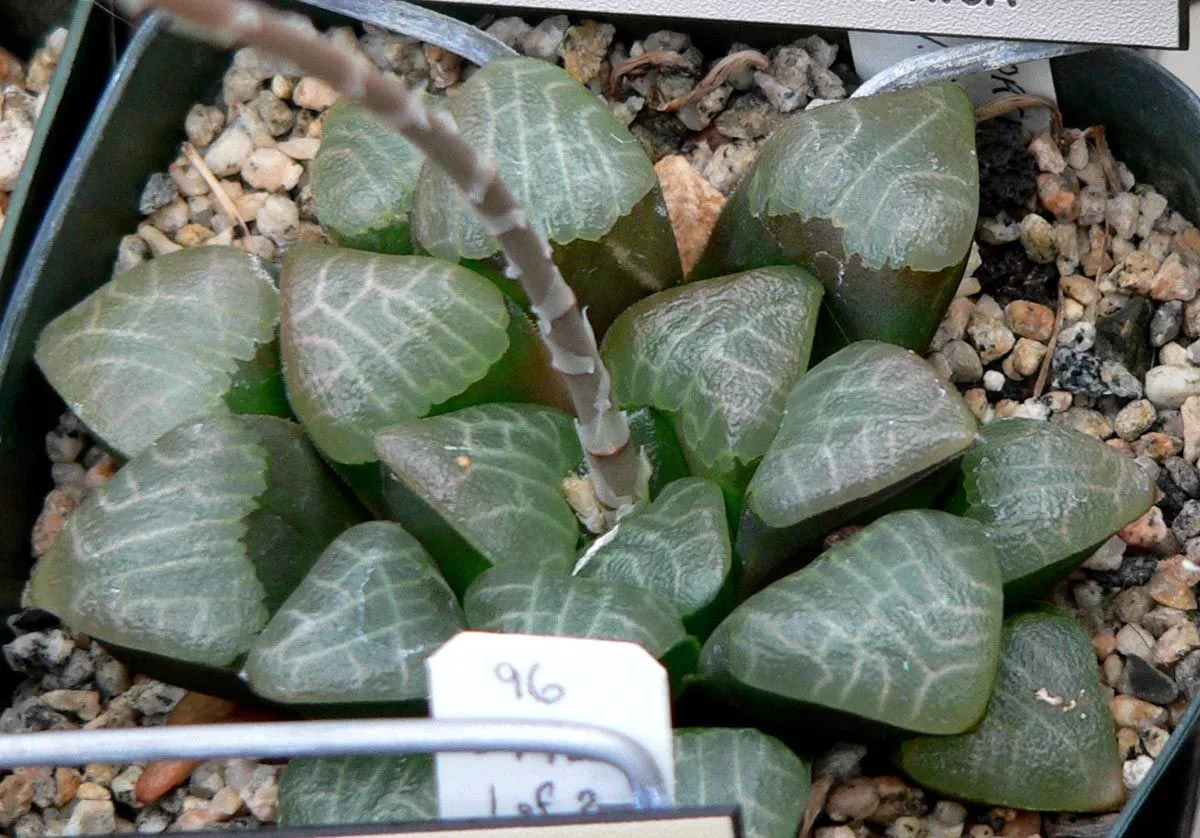
Brown leaves on Haworthia are among the most reported problems for new and experienced growers alike, largely because the word "brown" covers five entirely different conditions requiring five different responses. The basal leaf turning papery over ten days is expected physiology. The crown going brown and wet after a cold week is an emergency. Separating the causes before acting is not a detail — it is the whole of the diagnosis.
Part of the Complete Haworthia Guide.
Normal basal senescence
Every Haworthia rosette produces new leaves from the centre and discards old leaves from the base. Browning in this pattern is controlled, predictable, and no cause for alarm. Diagnostic markers:
- Only the lowest one or two leaves of the rosette are affected.
- Browning begins at the leaf tip and progresses inward toward the stem over 7–21 days.
- Affected leaves become thinner, papery, and translucent-brown rather than mushy or wet.
- The rest of the rosette remains firm, correctly coloured, and continues growing.
- The leaves detach with a gentle downward pull once fully dry.
Remove fully desiccated basal leaves to prevent them trapping moisture against the stem. No other action is required. A healthy haworthia can lose one to two basal leaves per month during active growth and several more during dormancy transition in mid-summer.
Sunburn
Sunburn is the most common pathological cause of browning in soft-leaf Haworthia species such as H. cooperi, H. cymbiformis, H. retusa, and H. bayeri. These species evolved to sit partly buried under rocks or between grass tussocks in South Africa, with only their leaf tips exposed. Unshaded midday sun — especially the harsh light of a south-facing windowsill in spring or the first weeks outdoors after winter — overwhelms the leaf tissue within a few hours.
Sunburn shows as white-to-pale-brown bleached patches on the upper leaf surfaces. The affected patches become papery and slightly depressed compared to surrounding tissue. On Haworthiopsis species such as Haworthiopsis fasciata (still widely sold as Haworthia fasciata), sun exposure typically produces reddish-brown discolouration across the full exposed face of the leaf rather than discrete bleached patches. Both outcomes represent permanent scar tissue — the cells are dead and will not regenerate.
The plant usually survives mild-to-moderate sunburn. Move it immediately to a bright but indirect position: an east-facing window, a position set back 1 m from a south-facing window, or filtered light under a shade cloth. Increase light exposure gradually in future — a 7–14-day acclimatisation period prevents recurrence. A plant going from a windowsill straight to full outdoor sun is the single most common cause of severe browning in this genus.
Cold damage
Haworthia species tolerate cool conditions down to about 5 °C if kept dry. Prolonged exposure below 5 °C, brief frost, or cold water splashing onto leaves in cold conditions causes cell damage that appears as brown patches 24–72 hours after the event. Cold-damaged tissue has a wet, collapsed appearance initially, then dries to tan or brown.
Soft-leaf species with high water content in their leaves are more susceptible than hard-leaf Haworthiopsis species. Window-forming species such as H. cooperi, H. obtusa, and H. truncata can suffer visible browning from a single night below 0 °C, while Haworthiopsis attenuata on the same windowsill may show only mild reddening.
After a cold event, move the plant to a warmer position above 10 °C. Do not water for at least two weeks. Allow the tissue to dry and assess damage once it stabilises — cold-damaged tissue that remains firm may recover partially; tissue that collapses to mush will not. Remove only fully dry damaged leaves. Premature removal of firm-but-brown leaves can introduce secondary infection at the cut site.
Root rot and stem-base browning
Root rot produces basal browning that is distinctly wet and spreads upward from the soil line. Waterlogged roots fail to regulate uptake, leaves fill with excess water, then collapse and turn yellow-brown to brown with a mushy texture. A sour smell from the soil surface or from the stem base is a specific indicator that rot has reached living tissue. This is the most serious cause of browning in the group.
Unpot the plant. Remove all substrate and inspect roots. Healthy Haworthia roots are firm, pale tan to white, and smell faintly earthy. Dead roots are black or brown, hollow, slimy, and may detach as empty sheaths when pulled. Cut all dead root tissue back to clean, firm material with a sterile blade. If the stem base is soft, cut upward into clean firm tissue and treat the plant as a cutting.
Leave the plant bare-root in a dry, shaded position with good airflow for 5–7 days. Repot into a dry mineral mix (at least 50–60% inorganic material: pumice, perlite, or coarse grit). Withhold water for a further week. Mild root rot caught early is fully recoverable. Stem involvement requires faster, more decisive cutting.
Chronic drought
Severe or prolonged drought causes tips to brown across multiple leaves simultaneously. Unlike normal senescence — which only affects the lowest leaves — drought browning can appear across the lower third of the rosette. The texture is dry rather than mushy, the pot is noticeably light, and leaves elsewhere on the plant may be wrinkled or losing turgor.
Haworthia is more drought-tolerant than most succulent genera because its leaf-window system stores water efficiently, but extended drought in fast-draining mixes during summer heat will eventually manifest as tip browning. A single thorough soak until water exits the drainage holes, followed by complete drainage, typically reverses early drought tip browning within 48–72 hours. Already-browned tips will remain; the goal is preventing the browning from progressing further up the leaf.
How to identify the cause
| Pattern | Location | Texture | Most likely cause |
|---|---|---|---|
| Tan-brown, dry from tip inward | Oldest basal leaves only | Papery, thin | Normal senescence |
| White or bleached patches | Exposed upper leaf surface | Crisp, scarred | Sunburn |
| Reddish-brown wash across leaves | All exposed faces, outer leaves | Firm | High light / mild sunburn |
| Brown, wet, mushy with sour smell | Base of rosette, near soil | Wet or collapsed | Root rot |
| Tan tips across lower third | Multiple leaves simultaneously | Dry, not wet | Drought |
| Collapsed brown patches after cold event | Random, often upper surfaces | Wet then papery | Frost or cold damage |
Always check the root zone if the cause is unclear. A dry substrate with pale firm roots rules out root rot even when above-ground symptoms are ambiguous.
Risk and severity
Normal senescence carries no risk. Sunburn and cold damage are cosmetic injuries that leave permanent marks but rarely kill a Haworthia unless the growing crown itself is destroyed. Root rot is the highest-risk cause and should be treated the same day it is identified — delay allows rot to cross from roots into the stem base, where it is far harder to arrest. Drought damage is the lowest-risk non-senescence cause: a water-stressed haworthia recovers quickly once watered correctly.
Act immediately if browning is mushy, wet, accompanied by a sour smell, or spreading upward visibly over days. Observe and wait if browning is papery, dry, confined to the lowest leaves, and not progressing.
Solutions
Sunburn
Move the plant to bright indirect light. Do not apply water to the damaged leaves. The scarred tissue will not heal, but new leaves growing from the centre will emerge undamaged. Introduce stronger light gradually next time — 30-minute daily increments over 10–14 days prevents recurrence.
Cold damage
Move to a position above 10 °C immediately. Do not water until the plant has been stable and warm for two weeks. Allow damaged tissue to dry completely before removing it. Check that the growing point at the rosette centre is still firm before deciding the plant is recoverable — a firm centre means it will regenerate.
Root rot
Unpot, inspect, and trim all dead roots with a sterile blade. Dry bare-root in shade for 5–7 days. Repot into a dry mineral mix in a pot only slightly larger than the remaining root mass. Water once sparingly after 7 days, then return to normal dry-down cycles.
Drought
Water once, thoroughly, until water exits the drainage hole. Drain fully. Return to a schedule of watering only when the top 3–4 cm of substrate is dry. Do not mist the leaves — only root-zone watering rehydrates the plant.
Prevention
Keep soft-leaf Haworthia species in bright indirect light rather than direct sun. Use a mineral mix that dries within 7–14 days in indoor conditions. Water thoroughly but infrequently and skip watering if the substrate is still damp. Maintain temperatures above 5 °C and reduce watering sharply when temperatures drop below 10 °C. When moving plants between light environments, acclimatise gradually over two weeks rather than repositioning them abruptly.
Monthly inspection of the basal leaves keeps normal leaf loss distinct from early rot. Check leaf axils for mealybug colonies while you are at it. Papery and dry with a firm symmetric rosette means the plant is healthy; mushy and wet means root inspection is needed today.
See also
- Sunburn diagnosis and recovery — assessment, treatment, and prevention across succulent genera.
- Root rot diagnosis — the cross-genus root inspection and recovery procedure.
- Haworthia cooperi — a soft-leaf species particularly vulnerable to both sunburn and overwatering.
Frequently Asked Questions
Can brown Haworthia leaves recover their colour?
No. Browning is cell death — chlorophyll is gone and cannot return in that tissue. The goal is correcting the underlying cause so new growth emerges healthy.
Should I remove brown leaves from my Haworthia?
Only when they are fully papery and detach with light pressure, or when they are mushy and the plant is being treated for root rot. Leave firm-but-brown leaves to dry off on their own.
Why did my Haworthia turn brown after I moved it outside?
Almost certainly sunburn. Soft-leaf Haworthia species burn within hours of unshaded midday sun exposure. White or bleached patches appear on the upper leaf surface. Move back to bright indirect light — the scars are permanent but the plant survives.
Is it normal for the bottom leaves of a Haworthia to turn brown?
Yes, if only the oldest basal one or two leaves are affected and they dry from the tip inward to a papery texture. If browning is mushy or spreading upward into the crown, it is pathological.