| Question | Short Answer |
|---|---|
| How large does Haworthia cooperi grow? | Mature rosettes are usually 4–8 cm across and stemless. |
| Why is my Haworthia cooperi sinking into the pot? | Seasonal sinking is normal. |
| Can Haworthia cooperi grow from leaf cuttings? | Yes, but it is slower than offset division. |
| How do you distinguish Haworthia cooperi from Haworthia obtusa? | The article treats the distinction as mostly taxonomic and commercial. |
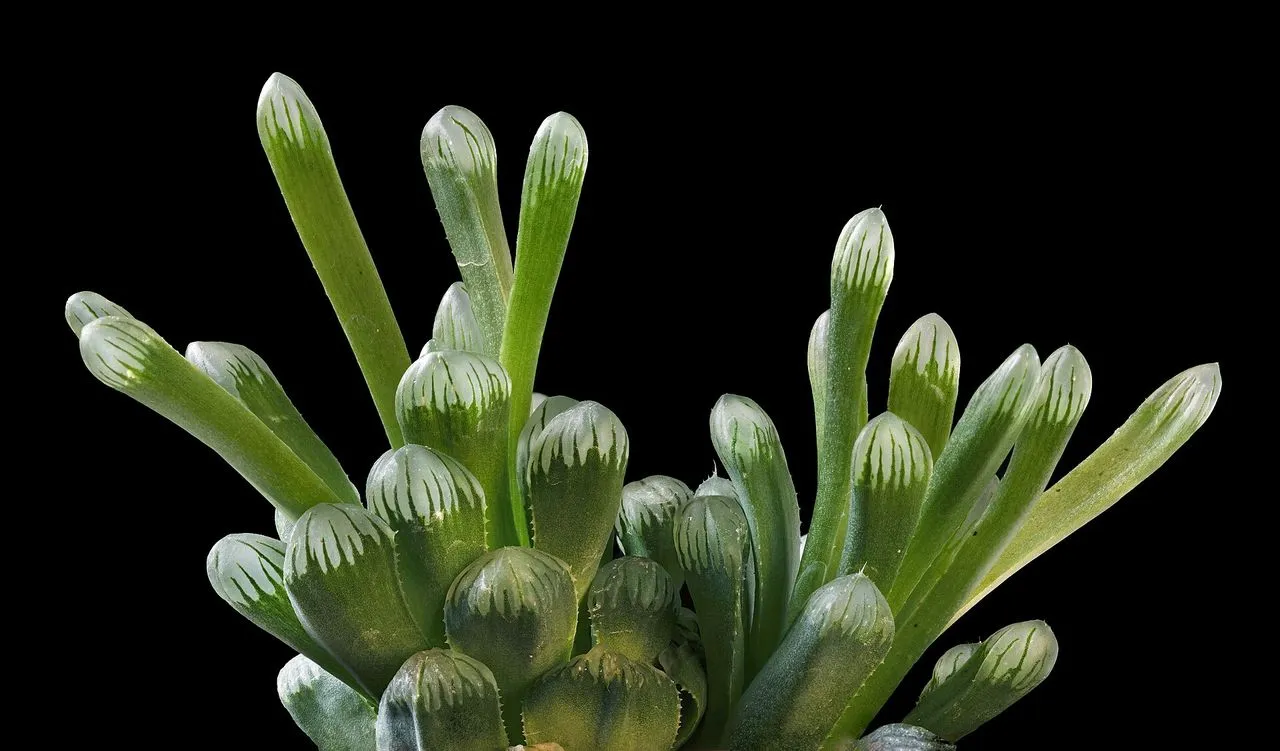
Haworthia cooperi Baker is one of the most recognisable of the soft-leaf haworthias, a small South African rosette succulent whose fat, blunt-tipped leaves end in translucent apical windows clear enough to read small print through. It is the archetype most people think of when they picture a "window plant".
Native to the Eastern Cape of South Africa, particularly the Albany and Bathurst districts, it grows buried to the neck in quartz gravel and grass-tuft shade, with only the glassy leaf tips exposed. That ecology explains both the dramatic leaf windows and the species' preference for filtered light in cultivation.
Part of the Complete Haworthia Guide.
Identification
Rosettes are 4-8 cm across, stemless, and produce dense offsets at the base. Leaves are obovoid to cylindrical, 2-4 cm long, pale to mid green with a distinctly swollen, rounded tip. Hold a leaf to the light and the upper third is genuinely see-through: a silica-rich epidermis over hyaline photosynthetic parenchyma. The inflorescence is a slender unbranched raceme 15-30 cm tall, carrying small zygomorphic white flowers with pale pink veins, as in the rest of the genus.
Several varieties are commonly offered: var. truncata with flat-topped leaves, var. pilifera with fine bristles on the leaf tip, var. obtusa (sometimes treated as a separate species; see below), and var. venusta with soft papillae covering the window surface. All share the same basic cultivation.
Cultivation
Standard Haworthia care applies with two specific notes. First, H. cooperi is unusually sun-sensitive. Direct midday summer light will bleach the windows to opaque white within a few hours; the damage is permanent. An east-facing windowsill or a position set back one metre from a south window is correct. Second, the plant pulls itself down into the substrate seasonally using contractile roots. If the rosette appears to be sinking into the pot, that is normal, not a sign of root rot.
Substrate should be a gritty mineral mix, 60% pumice or perlite with 20% coarse sand and 20% peat-free loam. Water when the top 3-4 cm reads dry, which in cool indoor conditions is every 2-3 weeks. Cut watering in peak summer (July-August in the northern hemisphere) when the plant semi-dormants, and resume in autumn as nights cool.
Propagation
Offsets are the reliable route. Mature clumps push out multiple pups from the base each year. Wait until an offset has two or three of its own roots, tease the substrate aside, and cut the stolon with a sterile blade. Callus for three to five days in shade, then pot into dry grit and water lightly after a week. Establishment is usually quick, within a month.
Leaf propagation works better on H. cooperi than on most hard-leaf haworthias. Detach a fully mature leaf with a clean twist, taking the entire base. Expect roughly a 30-40% success rate; new plantlets appear at the leaf base within two to three months but take at least a year to reach a potting-on size.
Seed is rarely worthwhile unless you are a collector maintaining specific provenance.
Notes and Quirks
The translucent windows are the defining feature, and their clarity depends directly on light levels. Under-lit plants produce darker, greener, less translucent leaves that lose the glassy look entirely. If your H. cooperi looks dull, the fix is more indirect light, not more water.
H. cooperi is frequently confused with Haworthia obtusa, which many taxonomists treat as a synonym or subspecies. The commercial trade uses both names interchangeably. For practical cultivation the distinction does not matter; both respond to identical care.
This is also one of the species most often sold as an unrooted offset at plant markets. Buyers should check for firm, pearl-like leaves with no shrivelling at the base, and suspiciously cheap "rare cultivars" are almost always common var. truncata offsets from bulk propagation.
See also
Frequently Asked Questions
How large does Haworthia cooperi grow?
Mature rosettes are usually 4–8 cm across and stemless. Healthy plants form dense basal offsets over time.
Why is my Haworthia cooperi sinking into the pot?
Seasonal sinking is normal. Contractile roots pull the rosette down into the substrate, matching its buried habit in habitat.
Can Haworthia cooperi grow from leaf cuttings?
Yes, but it is slower than offset division. Clean mature leaves succeed at roughly 30–40%, with plantlets appearing after two to three months and taking at least a year to pot on.
How do you distinguish Haworthia cooperi from Haworthia obtusa?
The article treats the distinction as mostly taxonomic and commercial. Both respond to identical care, and the trade uses the two names interchangeably.