| Question | Short Answer |
|---|---|
| Is Haworthia obtusa a separate species? | The post notes that modern treatments list it as Haworthia cooperi var. |
| How large does Haworthia obtusa grow? | Rosettes reach 4–7 cm across and clump freely. |
| Can Haworthia obtusa take direct sun? | No direct midday summer sun. |
| How is Haworthia obtusa propagated? | Offset division is reliable, with mature plants producing five to ten offsets per season. |
Haworthia obtusa Haw. is a soft-leaf South African succulent closely related to, and now widely treated as a variety or synonym of, Haworthia cooperi. The specific epithet means "blunt", referring to the rounded leaf tips. Modern treatments in the World Checklist of Vascular Plants list it as Haworthia cooperi var. obtusa (Haw.) M.B.Bayer; the horticultural trade continues to use the older species-level name on labels.
In habitat it grows in the Eastern Cape, overlapping with H. cooperi proper, often with most of the rosette buried in grit and only the windowed leaf tips visible at ground level.
Part of the Complete Haworthia Guide.
Identification
Rosettes are 4-7 cm across, stemless, and clump freely. Leaves are obovoid, 2-3 cm long, pale green, tightly packed, and end in a strikingly flat or slightly dished terminal window. Compared with typical H. cooperi, the leaves of H. obtusa are blunter (less tapered), their tips more truncated, and the windows often clearer and less patterned. Held to the light the leaf interior glows translucent lime-green.
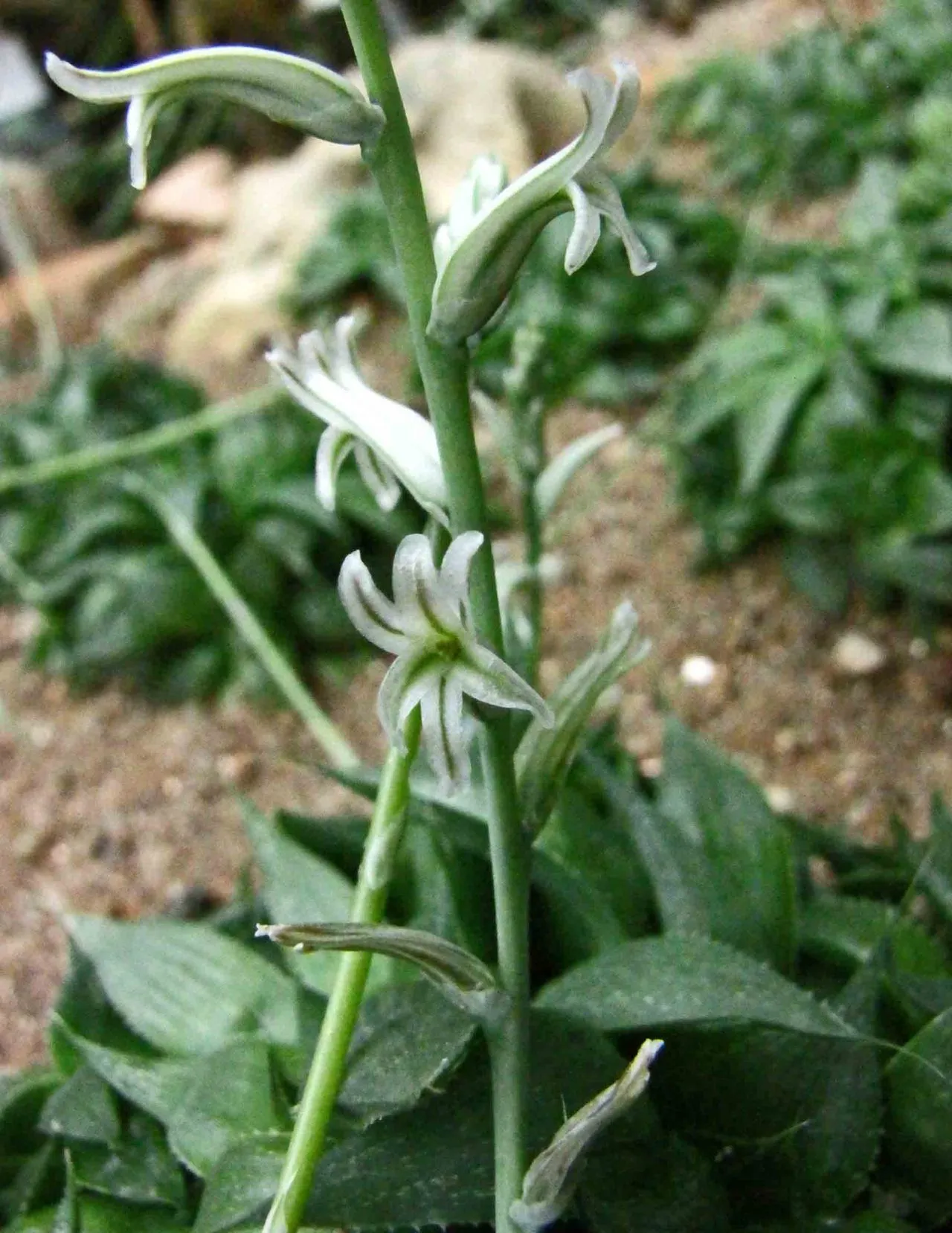
Inflorescence is a slender unbranched raceme 20-30 cm tall with typical small two-lipped whitish flowers.
The Japanese succulent trade has produced a number of named cultivars: 'Dodson' with larger, rounder windows, 'Pilifera' with fine apical bristles, and various variegates. These are often sold at significant premiums and differ from the species mainly in window clarity and size.
Cultivation
Identical to H. cooperi. Standard soft-leaf haworthia care applies: bright indirect light, the gritty 60% mineral mix, and restrained watering every 2-3 weeks in winter and 7-10 days in active growth. The species semi-dormants in peak summer; cut water in July and August and resume in autumn.
Sun sensitivity is the only point worth labouring. Direct midday summer sun on an unshaded H. obtusa bleaches the windows to opaque white within hours and the damage does not reverse. An east-facing windowsill or a south-facing position set well back from the glass is ideal.
Propagation
Offset division is the reliable method. Mature plants produce five to ten offsets per season. Wait until each has its own two or three roots, separate with a sterile blade at the stolon, callus three to five days, and pot in dry grit.
Leaf propagation is more successful here than on most haworthias, with rates around 30-40% for clean-twisted mature leaves laid on damp grit at 20-25°C. Plantlets appear at the leaf base within two to three months.
Notes and Quirks
The taxonomic history of H. obtusa is unsettled. Different authors have treated it as a distinct species, a variety of Haworthia cooperi, a variety of H. cymbiformis, or a horticultural artefact of selective propagation. Molecular evidence to date supports treating it within H. cooperi, but the name persists in the trade and will continue to appear on labels for the foreseeable future.
For practical purposes, if you buy a plant sold as H. obtusa, you are getting something indistinguishable from H. cooperi var. truncata or H. cooperi var. obtusa in all but label. The care is identical, and the plants interbreed freely.
The clearest-windowed specimens sold by Japanese nurseries as "obtusa select" represent decades of propagative selection for window size and transparency. These are genuinely spectacular but grow slowly and cost accordingly.
See also
Frequently Asked Questions
Is Haworthia obtusa a separate species?
The post notes that modern treatments list it as Haworthia cooperi var. obtusa, while the horticultural trade still uses species-level labels.
How large does Haworthia obtusa grow?
Rosettes reach 4–7 cm across and clump freely. The leaves are 2–3 cm long with blunt, clear windows.
Can Haworthia obtusa take direct sun?
No direct midday summer sun. Unshaded sun can bleach the windows opaque white within hours, and the damage does not reverse.
How is Haworthia obtusa propagated?
Offset division is reliable, with mature plants producing five to ten offsets per season. Leaf propagation can also succeed at around 30–40%.