| Question | Short Answer |
|---|---|
| Why is Haworthia mutica prized by collectors? | It has broad, glassy, dominant window faces and slow deliberate growth. |
| How is Haworthia mutica different from Haworthia retusa? | H. |
| How often does Haworthia mutica offset? | Slowly. |
| Can Haworthia mutica be grown from seed? | Yes. |
Haworthia mutica Haw. is a soft-leaf South African succulent from the Overberg region of the Western Cape, counted among the most desirable species in the genus for collectors. The specific epithet means "blunt" or "cut-off", referring to the abruptly truncated tip of each leaf. It is a near relative of H. retusa and shares the flat-topped, pressed rosette habit.
In habitat the species grows in pockets of quartz gravel on shale flats and slopes, often fully buried with only the window faces showing at the surface. Contractile roots pull the rosette down into the substrate seasonally.
Part of the Complete Haworthia Guide.
Identification
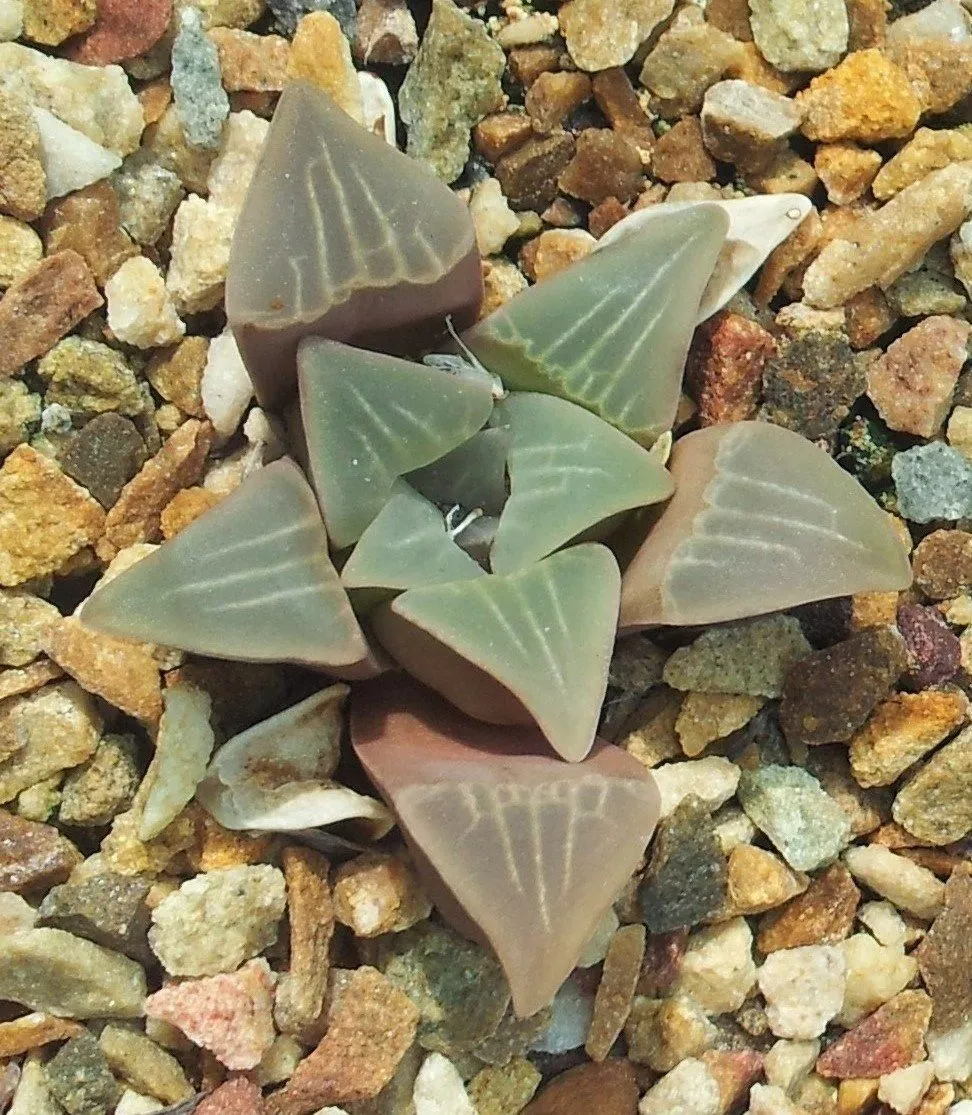
Rosettes are 6-10 cm across, usually solitary and slow to offset. Leaves are 3-5 cm long, triangular in cross-section but abruptly truncated at the tip, so the terminal window is broad, flat, and dominant. The window is pale green to silvery, sometimes with faint reticulate veining, and glassy in appearance under good light. Under strong bright indirect exposure the leaf flanks colour up purple, bronze or deep red.
Inflorescence is a wiry raceme 25-40 cm tall with typical small two-lipped whitish flowers.
H. mutica closely resembles Haworthia retusa and H. pygmaea, and the three can be difficult to separate without provenance information. H. mutica typically has broader, more squared-off window faces than H. retusa, and cleaner, less speckled window surfaces than H. pygmaea. Field botanists rely on locality more than morphology.
Several locality forms are collected and named informally, including plants from Bredasdorp, Napier and the Riversdale plains. These differ subtly in leaf width and window clarity.
Cultivation
H. mutica follows standard soft-leaf care, but with the caution appropriate to a collector species. Bright indirect light is essential; direct midday summer sun scars the window surface irreversibly and destroys most of the visual appeal. An east-facing window or a position set well back from a south-facing window behind a sheer curtain is ideal.
Substrate should be the standard gritty 60% mineral mix or a more mineral version still (70% pumice and perlite) if your climate runs humid. Use a pot only slightly wider than the rosette. Water when the top 3-4 cm reads dry, typically every 2-3 weeks in active growth and every 4-6 weeks in peak summer dormancy.
Temperature range 10-28°C. Protect from frost and from sustained heat above 30°C, both of which cause more damage than cold below 5°C.
Propagation
Offsetting is slow. A mature plant may produce one pup every two or three years, sometimes none at all. Separate with a sterile blade when the offset has its own roots, callus five to seven days, and pot in dry grit.
Leaf propagation is unreliable, with success rates of 5-15%. The leaves are thick and slow to differentiate new meristem, and they rot more readily than they root.
Seed is a practical alternative for producing new plants of this species. Two unrelated flowering plants are needed, since H. mutica is self-incompatible. Germination under humidity at 20-25°C takes 2-4 weeks; seedlings reach a 4-5 cm flowering size at 4-5 years. Progeny vary, which is part of the appeal.
Notes and Quirks
Prices for H. mutica run higher than most soft-leaves. Named selections and locality forms can sell at many times the price of generic offsets. Hybrids between H. mutica and other retusa-complex species are widespread in cultivation and often sold as pure; source from specialist nurseries if provenance matters.
The "silver" or "white" forms occasionally offered at premium prices are usually plants grown in unusually mineral substrate with high light, which maximises window clarity. The same plant in ordinary conditions reverts to typical green tones. The trait is cultivation-responsive rather than genetic.
H. mutica should not be confused with the unrelated Tulista marginata, despite both producing broad flat rosettes.
See also
Frequently Asked Questions
Why is Haworthia mutica prized by collectors?
It has broad, glassy, dominant window faces and slow deliberate growth. Named selections and locality forms can sell for much more than generic offsets.
How is Haworthia mutica different from Haworthia retusa?
H. mutica usually has broader, more squared-off windows than H. retusa and cleaner, less speckled windows than H. pygmaea. Locality information often matters more than morphology.
How often does Haworthia mutica offset?
Slowly. A mature plant may produce one pup every two or three years, and some produce none at all.
Can Haworthia mutica be grown from seed?
Yes. Two unrelated flowering plants are needed because it is self-incompatible, and seedlings reach 4–5 cm flowering size in about 4–5 years.