| Question | Short Answer |
|---|---|
| Is Haworthia cuspidata a true wild species? | Modern treatments regard it as probably a horticultural hybrid, likely involving H. |
| How large does Haworthia cuspidata grow? | Rosettes reach 6–8 cm across and offset freely into tight clumps. |
| Is Haworthia cuspidata easy to propagate? | Yes. |
| Can Haworthia cuspidata tolerate lower light? | It tolerates deeper shade better than many relatives and also accepts more light without scarring. |
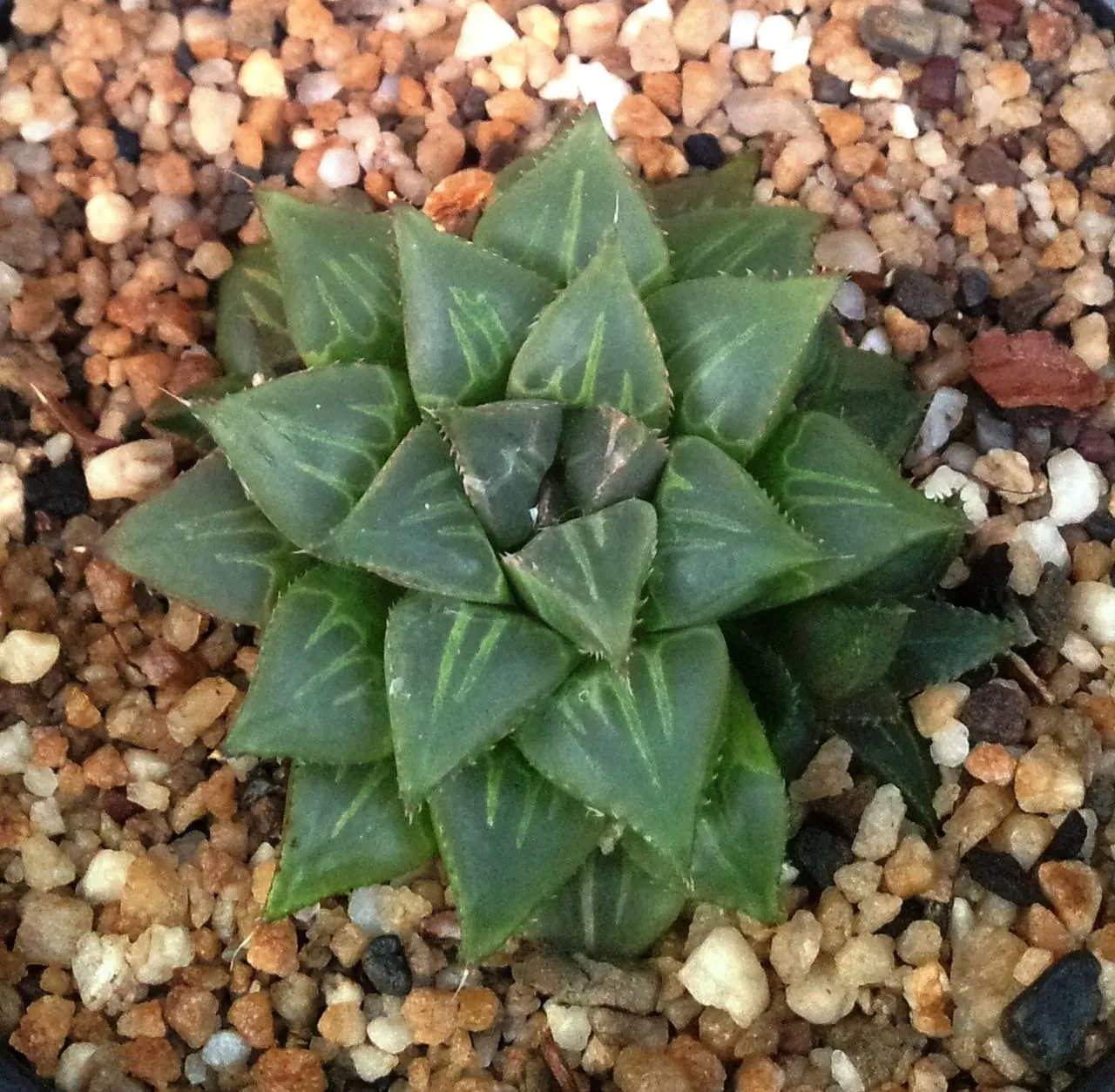
Haworthia cuspidata Haw. (Star Window Plant, Haworthia Cuspidata) is a clumping soft-leaf haworthia of uncertain wild provenance. Modern treatments including the World Checklist of Vascular Plants regard it as probably a horticultural hybrid, most likely H. cymbiformis × H. retusa or similar, that has been in continuous cultivation since Adrian Haworth formally named it in the early nineteenth century. No confirmed wild population has been located in recent field work.
Despite its unclear origin the plant is stable, true-breeding by vegetative propagation, and one of the most forgiving species in the soft-leaf group.
Part of the Complete Haworthia Guide.
Identification
Rosettes reach 6-8 cm across, stemless, and offset freely into tight clumps. Leaves are 2-3 cm long, triangular, pale lime-green to yellow-green, with a translucent apical window streaked with clear longitudinal lines. The leaf is relatively flat on the upper surface and sharply keeled below, and the tip tapers to a short soft cusp, which is the feature the specific epithet describes. Under bright indirect light the leaves flush pinkish-orange at the tips.
Inflorescence is a slim raceme 20-30 cm tall with typical small two-lipped whitish flowers.
The closest lookalike in the trade is Haworthia cymbiformis, which has more uniformly curved boat-shaped leaves and a more consistent green colour, without the cuspidate tip.
Cultivation
Standard soft-leaf Haworthia care applies and the species is unusually forgiving within that. H. cuspidata tolerates more light than most soft-leaves and colours up attractively without scarring, and also tolerates deeper shade without etiolating as badly as its relatives. An east- or lightly shaded south-facing window is ideal, but practically any indirect bright position will work.
Substrate is the standard gritty 60% mineral mix. Water when the top 3-4 cm reads dry, usually every 2-3 weeks in winter and every 7-10 days in active growth.
This is one of the few haworthias that I will recommend for a grower who has already killed a couple of H. cooperi. The tougher leaves and more robust root system survive mistakes that more fastidious soft-leaves will not.
Propagation
Offset division is spectacularly easy. A three-year-old plant produces ten or more offsets per year, and a clump left undisturbed will colonise its pot inside two seasons. Separate offsets with a sterile blade at the stolon, callus three to five days, and pot in dry grit.
Leaf propagation also works reliably for this species, with rates of 40-50% for clean-twisted mature leaves laid on damp grit. Plantlets appear within six to eight weeks.
Seed is viable but of limited interest given the species' probable hybrid origin; seedlings segregate considerably.
Notes and Quirks
Because H. cuspidata is almost certainly of hybrid origin, it has been used extensively as a parent in further horticultural hybrids. Many plants sold under names like "Haworthia 'Star Window'" or generic supermarket labels are H. cuspidata or its descendants. Variegated forms are common and attractive, with yellow or cream longitudinal stripes; they grow somewhat more slowly and need slightly more shade.
If you want a haworthia that will produce enough offsets to share with friends within a couple of years, this is the species. It is also tolerant of being grown in terrariums and unusual containers that would quickly kill more demanding species, though I would not let that tempt you into compromising the drainage.
See also
Frequently Asked Questions
Is Haworthia cuspidata a true wild species?
Modern treatments regard it as probably a horticultural hybrid, likely involving H. cymbiformis and H. retusa. No confirmed wild population has been located.
How large does Haworthia cuspidata grow?
Rosettes reach 6–8 cm across and offset freely into tight clumps. Leaves are 2–3 cm long and pale lime-green to yellow-green.
Is Haworthia cuspidata easy to propagate?
Yes. Offset division is spectacularly easy, and leaf propagation can also reach 40–50% success with plantlets appearing within six to eight weeks.
Can Haworthia cuspidata tolerate lower light?
It tolerates deeper shade better than many relatives and also accepts more light without scarring. Bright indirect light remains the ideal setting.