| Question | Short Answer |
|---|---|
| Why is Haworthiopsis limifolia called fairy washboard? | Each leaf carries neat raised transverse ridges that resemble a miniature washboard. |
| Does Haworthiopsis limifolia have a different growth season? | Yes. |
| How should Haworthiopsis limifolia be propagated? | Offset division is straightforward, with mature plants producing three to six basal offsets per year. |
| Is Haworthiopsis limifolia conservation-sensitive? | The post notes traditional use and pressure on wild populations, with the species listed as Vulnerable on the South African Red List. |
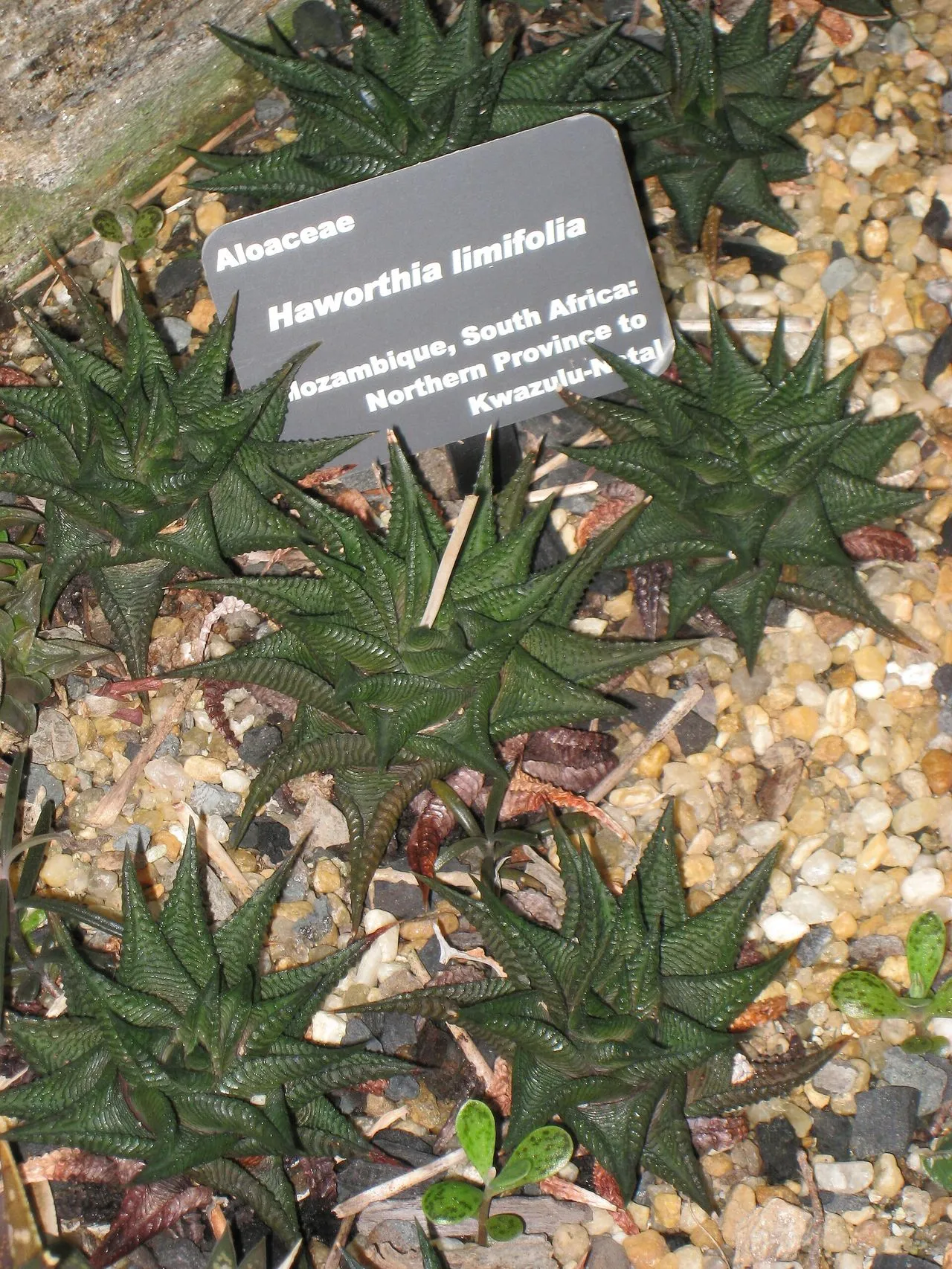
Haworthiopsis limifolia (Marloth) G.D.Rowley (fairy washboard), formerly Haworthia limifolia, is a hard-leaf rosette succulent from southern Africa, moved to Haworthiopsis in the 2013 generic split. The common name comes from the neat transverse ridges running across each leaf, which resemble the surface of a laundry washboard rendered in miniature.
Unusually for the group, H. limifolia ranges beyond the Cape provinces into Limpopo, Eswatini, southern Mozambique, and the northern Transvaal. It grows in summer-rainfall regions, often under grasses and small shrubs on rocky slopes and in shallow soil pockets.
Part of the Complete Haworthia Guide.
Identification
Rosettes are 6-10 cm across, stemless, and offset moderately. Leaves are dark olive-green to almost black-green, triangular, 4-7 cm long and spiralling outward in a flat star pattern. Each leaf carries distinct raised concentric ridges running across its width, a diagnostic feature that no other species in the group reproduces precisely. Under strong light the leaves flush deep bronze or chocolate.
Inflorescence is a wiry raceme 25-40 cm tall with small whitish two-lipped flowers.
Several varieties are commonly grown, including var. ubomboensis with flatter leaves and finer ridges, var. gigantea as its name suggests larger overall, and 'Spider White' with pronounced white markings along the ridges.
Cultivation
H. limifolia differs from the Cape haworthias in one important respect: being a summer-rainfall-zone species, it is more active in summer and less so in winter. This is opposite to the soft-leaf haworthias. Water more generously from April to September (northern hemisphere) and cut back sharply in winter, when the plant rests.
Light requirements are typical of hard-leaf Haworthiopsis: bright indirect or gentle direct, an east- or lightly shaded south-facing window. The leaves respond to strong light with attractive dark coloration.
Substrate is the standard gritty 60% mineral mix. Temperature tolerance is comparable to other Haworthiopsis, with a practical lower limit around 2°C if dry.
Propagation
Offset division is straightforward. Mature plants produce three to six basal offsets per year, each connected by a short stolon. Separate with a sterile blade, callus 5 days in shade, and pot in dry grit. Establishment takes 3-4 weeks.
Leaf propagation is unreliable, as with all hard-leaf species; success rates of 5-10% are typical even with clean-twisted leaves.
Seed is viable but rarely of practical interest outside specialist collections.
Notes and Quirks
H. limifolia has ethnobotanical significance in South Africa and Eswatini, where it has been used traditionally as a protective plant, hung above doorways or planted around homes. Wild populations have suffered from both collecting pressure and habitat loss, and the species is listed as Vulnerable on the South African Red List. Buy only nursery-propagated material.
Because its growth calendar differs from Cape haworthias, a H. limifolia on the same watering schedule as a shelf of Haworthia cooperi will be either overwatered in winter or underwatered in summer. Keep it separate if you can, or at minimum note the reversed dormancy pattern when planning care.
Cultivars with strong white markings grow more slowly than the species and appreciate slightly more shade.
See also
Frequently Asked Questions
Why is Haworthiopsis limifolia called fairy washboard?
Each leaf carries neat raised transverse ridges that resemble a miniature washboard. No other species in the group reproduces the pattern precisely.
Does Haworthiopsis limifolia have a different growth season?
Yes. It comes from summer-rainfall regions and is more active in summer, unlike many Cape soft-leaf haworthias.
How should Haworthiopsis limifolia be propagated?
Offset division is straightforward, with mature plants producing three to six basal offsets per year. Leaf propagation is unreliable at roughly 5–10%.
Is Haworthiopsis limifolia conservation-sensitive?
The post notes traditional use and pressure on wild populations, with the species listed as Vulnerable on the South African Red List. Buy nursery-propagated material only.