| Question | Short Answer |
|---|---|
| Why is Haworthiopsis tessellata called the mosaic haworthia? | The upper leaf surface carries a distinct mosaic of pale reticulate veins. |
| Can Haworthiopsis tessellata grow outdoors? | The post considers it viable for protected outdoor collections in temperate Mediterranean conditions. |
| How is Haworthiopsis tessellata propagated? | Offset division is easy because plants produce stolons freely. |
| Was Haworthiopsis tessellata formerly Haworthia venosa? | It has been treated as Haworthia tessellata and Haworthia venosa subsp. |
Haworthiopsis tessellata (Haw.) G.D.Rowley, formerly Haworthia tessellata and often treated as a subspecies of H. venosa, is a hard-leaf rosette succulent reclassified into Haworthiopsis in the 2013 generic split. The specific epithet means "chequered" or "tiled", referring to the mosaic-like pattern of pale reticulate veining covering the upper leaf surface.
H. tessellata has one of the widest natural distributions of any species in the group, extending across the Northern, Western and Eastern Cape and into southern Namibia and the Free State. That broad range makes it among the most drought- and cold-tolerant of the hard-leaf haworthias.
Part of the Complete Haworthia Guide.
Identification
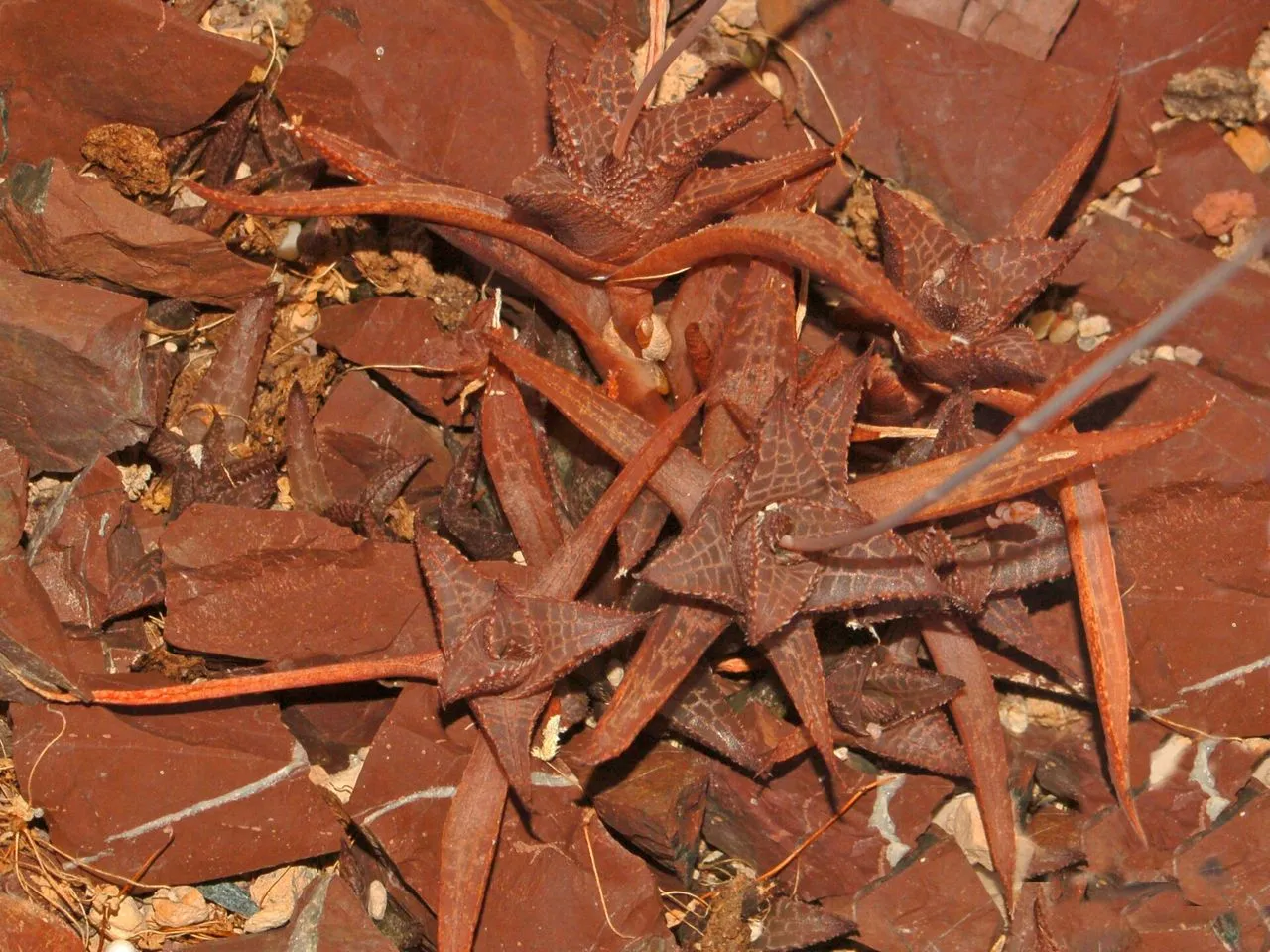
Rosettes are 5-10 cm across, stemless, and offset freely by stolons to form broad mats. Leaves are 3-5 cm long, triangular, recurved at the tip, usually olive to bronze-green with a distinct mosaic pattern of pale reticulate veins across the upper surface. The lower surface carries small tubercles and sometimes longitudinal ridges. Under strong light the leaves flush deep bronze, red-brown or almost black.
Inflorescence is a slender raceme 25-40 cm tall with typical small two-lipped whitish flowers.
The mosaic pattern distinguishes this species from most other Haworthiopsis. Several varieties are cultivated, including var. parva (smaller rosettes), var. luisieri (longer, more pointed leaves) and var. tuberculata (heavier surface tubercles).
Cultivation
H. tessellata is among the easier hard-leaf species. It tolerates a wider range of light than most, from bright indirect to several hours of moderate direct sun per day, and rewards brighter exposure with stronger coloration and tighter rosettes. Indoors, almost any bright windowsill works; outdoors under dappled shade it thrives in Mediterranean and temperate climates.
Substrate is the standard gritty 60% mineral mix. Water when the top 3-4 cm reads dry. This species tolerates drought well and is among the most forgiving haworthias of irregular watering.
Temperature range 0-35°C. Brief frost to -3°C is survivable if the plant is bone dry. This is one of the few species in the group I would consider for a protected outdoor collection in temperate-climate gardens.
Propagation
Offset division is easy and plentiful. Plants produce stolons with offsets freely and can be divided at any point in the growing season. Separate with a sterile blade, callus three to five days, and pot in dry grit.
Leaf propagation is unreliable, as with most hard-leaf species. Success rates under 10% are typical.
Seed is viable but rarely necessary given the plant's vigour from offsets.
Notes and Quirks
The wide distribution of H. tessellata means that cultivated stock varies considerably. Plants from arid Namibian populations look and behave differently from those from moister Cape populations; both are sold under the same name. Locality-sourced material from specialist nurseries is worth seeking out for consistency.
The taxonomic position of the species has shifted repeatedly. It has been treated as Haworthia tessellata, Haworthia venosa subsp. tessellata, and now Haworthiopsis tessellata. Current consensus places it in Haworthiopsis, based on leaf anatomy and molecular evidence. For practical cultivation the name change does not matter.
This is a species I would recommend for anyone building an outdoor succulent collection in Mediterranean climate zones. Its frost tolerance and drought resilience combined with attractive year-round colour make it one of the few haworthias viable outside a greenhouse in much of southern Europe. The beginner's guide to succulents covers the substrate and watering fundamentals that apply whether growing indoors or out.
See also
Frequently Asked Questions
Why is Haworthiopsis tessellata called the mosaic haworthia?
The upper leaf surface carries a distinct mosaic of pale reticulate veins. The epithet tessellata means chequered or tiled.
Can Haworthiopsis tessellata grow outdoors?
The post considers it viable for protected outdoor collections in temperate Mediterranean conditions. It tolerates drought well and brief frost to −3 °C if bone dry.
How is Haworthiopsis tessellata propagated?
Offset division is easy because plants produce stolons freely. Leaf propagation is unreliable, with success typically under 10%.
Was Haworthiopsis tessellata formerly Haworthia venosa?
It has been treated as Haworthia tessellata and Haworthia venosa subsp. tessellata. Current consensus in the post places it in Haworthiopsis.