| Question | Short Answer |
|---|---|
| How do you identify Haworthia venosa? | Look for 5–10 cm clumping rosettes with triangular olive leaves and a network of pale reticulate veins across the upper surface. |
| Is Haworthia venosa easy to grow? | Yes. |
| How should Haworthia venosa be propagated? | Offset division is easy and primary because plants form dense mats within two or three seasons. |
| Is Haworthia tessellata part of Haworthia venosa? | It has often been treated as H. |
Haworthia venosa (Lam.) Haw. is a soft-leaf South African succulent whose specific epithet refers to the prominent network of pale veins visible across the upper surface of each leaf. Distribution extends from the Western Cape eastward into the Eastern Cape, making it one of the more widely distributed species in the genus.
In habitat it grows on rocky slopes and in shallow soil pockets between boulders, usually in partial shade among grass and low shrubs. Several subspecies are recognised from geographically separated populations.
Part of the Complete Haworthia Guide.
Identification
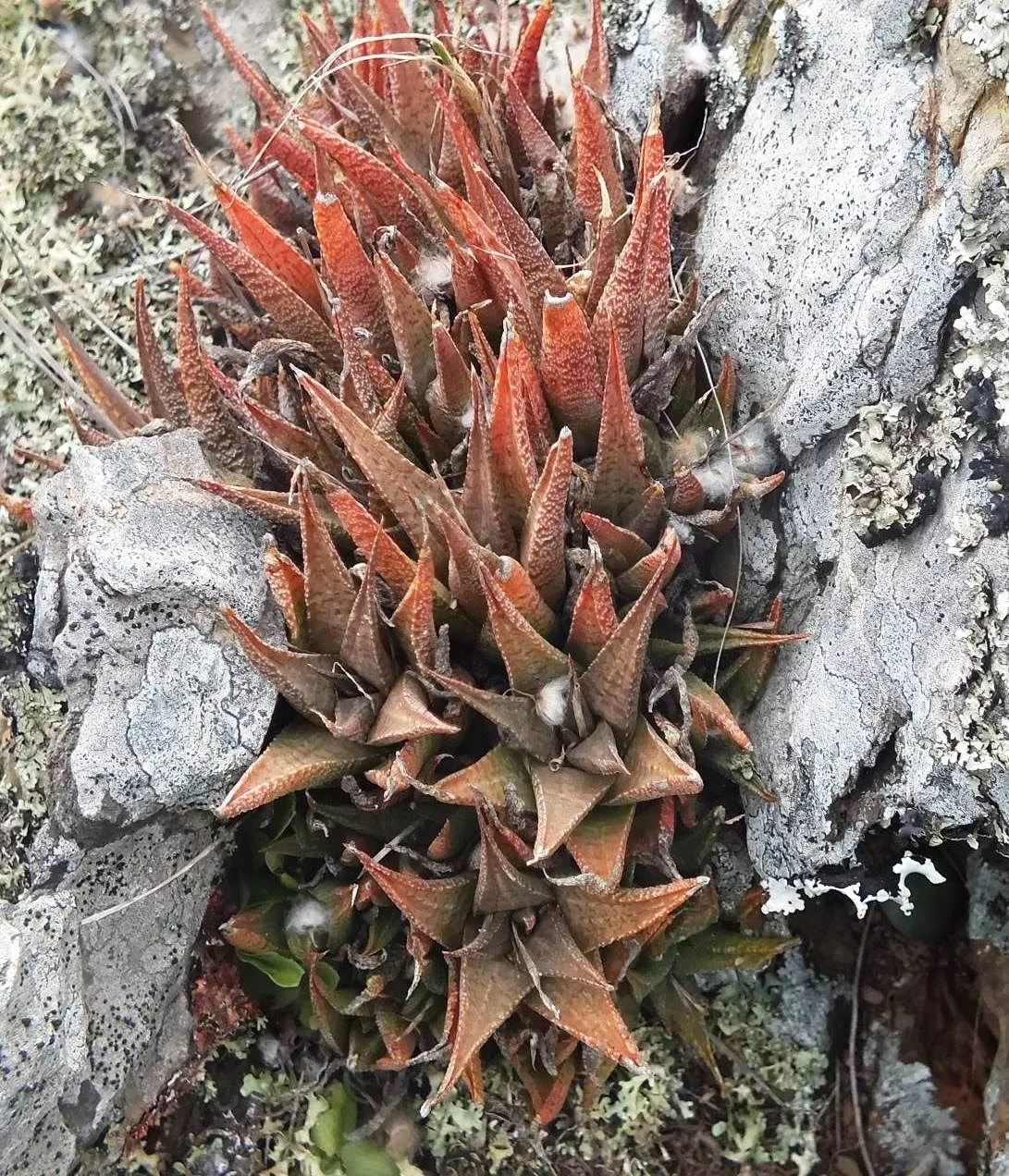
Rosettes are 5-10 cm across, stemless, and offset freely into wide mats. Leaves are 3-6 cm long, triangular, dull green to olive, with a roughened upper surface marked by a distinct network of paler reticulate veins and occasional fine tubercles. The leaves curve gently inward, giving the rosette a cupped appearance. Under bright light the colour deepens to bronze or red-brown.
Inflorescence is a slender raceme 25-40 cm tall with typical small two-lipped whitish flowers.
Four subspecies are commonly recognised: subsp. venosa (the type), subsp. tessellata (which many treatments now elevate to the full species Haworthiopsis tessellata), subsp. granulata and subsp. woolleyi. Only subsp. venosa and its close relatives remain in Haworthia sensu stricto; the hard-leaf subsp. tessellata has moved to Haworthiopsis.
Cultivation
H. venosa is one of the tougher soft-leaf haworthias and tolerates a wider range of conditions than collectors' species like H. bayeri or H. mirabilis. Bright indirect light is the default. The plant will also accept modest direct sun (an east- or west-facing window with a few hours of gentle sun) with only minor leaf colour change.
Use the standard gritty 60% mineral mix. Water when the top 3-4 cm reads dry; every 2-3 weeks in winter and 7-10 days in active growth is typical. The species is unusually drought-tolerant for a soft-leaf haworthia and recovers well from brief neglect.
Temperature range 5-32°C is tolerated. Cold tolerance is comparable to most hard-leaf Haworthiopsis; brief exposure to -1°C is usually survived if the plant is dry.
Propagation
Offset division is the main method and easy. Plants produce copious offsets by stolon, often forming dense mats within two or three seasons. Separate with a sterile blade, callus three to five days, and pot in dry grit.
Leaf propagation works reasonably well for this species, with rates of 20-30% for clean-twisted mature leaves laid on damp grit at 20-25°C.
Seed is viable but generally of limited interest outside specialist collections. The species is self-incompatible.
Notes and Quirks
The wide distribution of H. venosa means cultivated stock is highly variable. Plants from different population sources can differ in leaf shape, vein boldness, and colour response. Locality-sourced material from specialist nurseries is worth seeking out if you want a specific form.
Subsp. tessellata (now generally treated as Haworthiopsis tessellata) is the hardest-leaved and most drought-tolerant member of the old H. venosa group. If you see a plant labelled H. venosa with stiff, clearly tuberculed leaves and a mosaic-patterned upper surface, it is almost certainly H. tessellata under the old name. Treat it as a hard-leaf species; see Haworthiopsis tessellata for care notes specific to that form.
This species is among the easier haworthias for an outdoor Mediterranean-climate collection, surviving on covered terraces with minimal intervention.
See also
Frequently Asked Questions
How do you identify Haworthia venosa?
Look for 5–10 cm clumping rosettes with triangular olive leaves and a network of pale reticulate veins across the upper surface. The rosette has a gently cupped appearance.
Is Haworthia venosa easy to grow?
Yes. The post describes it as one of the tougher soft-leaf haworthias, tolerant of wider conditions than collector species like H. bayeri or H. mirabilis.
How should Haworthia venosa be propagated?
Offset division is easy and primary because plants form dense mats within two or three seasons. Leaf propagation can also work at roughly 20–30%.
Is Haworthia tessellata part of Haworthia venosa?
It has often been treated as H. venosa subsp. tessellata, but current treatment generally places it in Haworthiopsis as H. tessellata. Treat it as a hard-leaf species.