| Question | Short Answer |
|---|---|
| What causes variegation in haworthias? | Most haworthia variegation is chimeral, meaning the plant carries genetically distinct cell lines. |
| Do variegated haworthias need more light? | They need more bright indirect light than green forms to balance their reduced photosynthetic area. |
| Can variegated haworthias revert to green? | Yes. |
| Can variegated haworthias be grown from seed? | Seed is not reliable for reproducing variegation. |
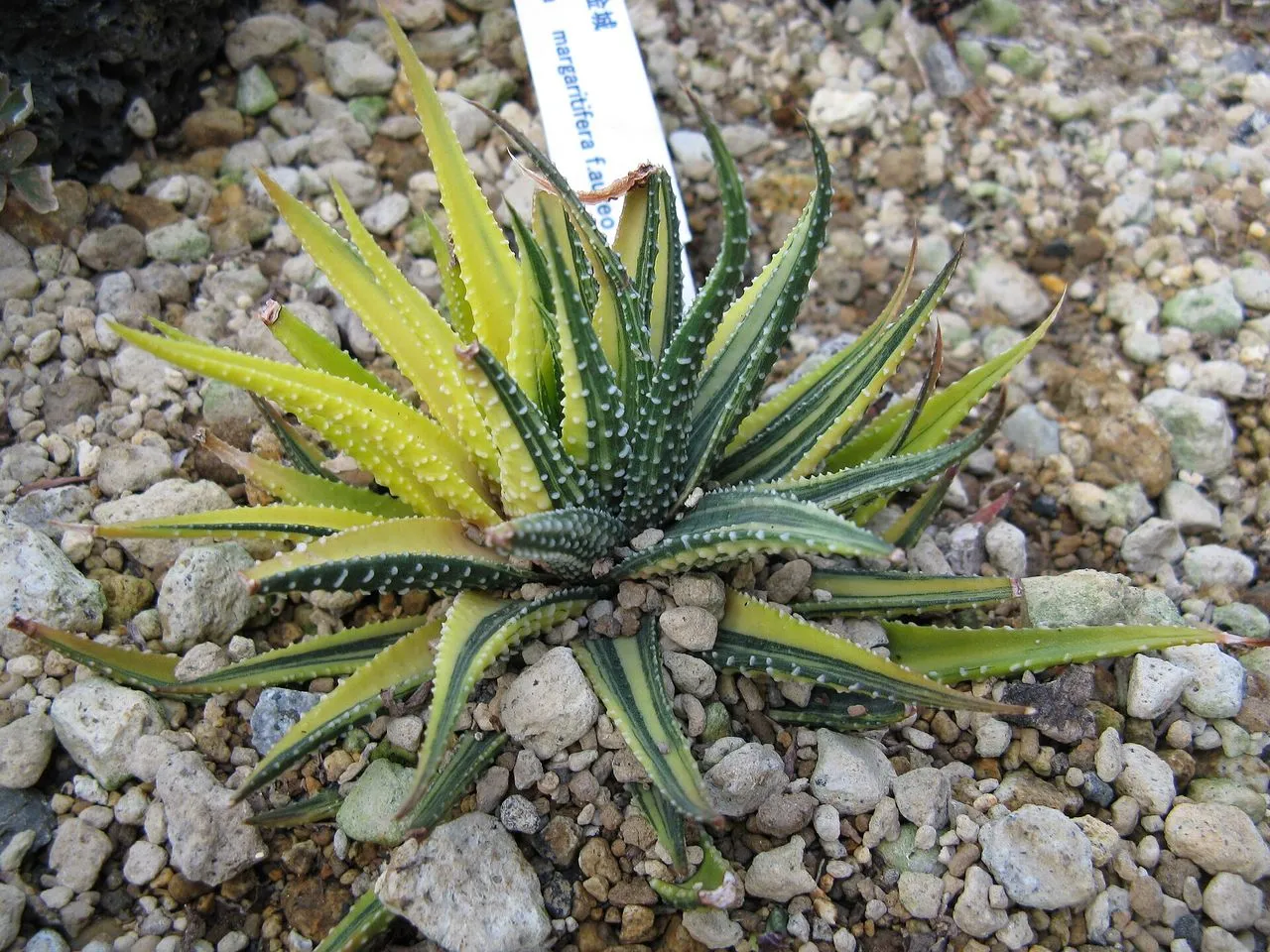
Variegated haworthias are plants in which some of the leaf tissue lacks chlorophyll, producing streaks, bands or sectors of cream, yellow, pink or white amongst the normal green. The trait is a highly collectable one, and specimens with well-placed stable variegation command some of the highest prices in the group. The underlying biology, however, makes them more demanding than their species form counterparts in several specific ways.
This article covers variegation as a general phenomenon across the soft-leaf Haworthia, hard-leaf Haworthiopsis, and Tulista species. The same principles apply.
Part of the Complete Haworthia Guide.
What variegation is
Most haworthia variegation is chimeral: the plant is a mosaic of genetically distinct cell lines, some with functional chloroplasts and some without. The non-green tissue is visible as streaks or sectors because its cells produce no chlorophyll, revealing the underlying carotenoid pigments (yellow, cream) or structural colour (pink, white). The pattern arises from a mutation in a single apical meristem cell early in development, and persists as that cell lineage produces successive leaves.
Because the trait is chimeral, it propagates only through vegetative means (offsets, leaf, division) that carry the original mutated cell line forward. Seed from a variegated parent almost always produces plain-green or entirely albino offspring; the mosaic does not pass through meiosis.
A small number of variegated haworthias are periclinal rather than sectoral, with the non-green tissue forming a continuous outer layer over a green core. These tend to be more stable and produce more uniformly variegated offsets.
Identification
Variegated haworthias look like the species form with patches, stripes or sectors of non-green tissue. Common patterns include longitudinal stripes (most Haworthia cymbiformis variegates), central cream sectors (many Haworthiopsis fasciata variegates), and peripheral banding. The variegation is visible from the youngest leaves onward and remains consistent in pattern on a given rosette.
Beware of "stress variegation": plants that temporarily produce paler leaves under cold or drought stress but return to plain green when conditions normalise. This is reversible environmental response, not genuine variegation.
Cultivation
Variegated plants grow more slowly than the species form, sometimes by half or more. Non-green tissue does not photosynthesise, so the plant has less effective leaf area for its size. This has two cultivation consequences.
First, variegated plants need more light than their green counterparts to maintain energy balance, but they also sunburn more readily because the non-green tissue lacks the chlorophyll shielding the cells beneath. The sweet spot is a bright indirect position with no direct midday sun, shaded behind a curtain or one metre back from a south-facing window.
Second, water more sparingly than the species form. Reduced leaf area means less water loss through transpiration and a correspondingly higher risk of root rot from the same watering schedule. Water only when the top 3-4 cm of substrate reads completely dry, and keep the substrate more mineral (70-80% pumice and perlite) than for plain species.
Substrate and temperature otherwise follow the pillar guide.
Propagation
Vegetative propagation is the only way to keep variegation. Offset division is the primary route. Each offset carries a sample of the parent's chimeric mosaic; some will be well-variegated, some plain green, and occasionally some fully albino (chlorophyll-free and unable to survive alone). Select and retain the best-variegated offsets and discard or grow on the plain ones as the species form.
Leaf propagation is possible but unreliable. A variegated leaf may produce plantlets that match the parent, but often produces plain-green or fully albino progeny instead, because leaf-based rooting goes through a single meristem cell and that cell may or may not be from the variegated lineage.
Seed should not be used to reproduce variegated plants. The trait is not reliably inherited.
Tissue culture can produce large numbers of variegated plants from a single chimera but is beyond most amateur growers.
Notes and Quirks
Fully albino (chlorophyll-free) sectors can persist on an otherwise variegated plant because they are supported by adjacent green tissue. Entirely albino offsets, however, cannot photosynthesise and will die within weeks of separation from the parent. Some growers attempt to graft albino offsets onto green rootstock to preserve them; success is mixed.
Variegation can revert. A previously well-variegated plant may produce plain-green leaves from a new lateral meristem and, over time, crowd out the variegated tissue. If this happens, cut the plain-green portion off promptly to preserve the variegated lineage.
Prices for variegated haworthias run from modest (common variegated Haworthiopsis attenuata) to extraordinary (rare Japanese selections of H. cooperi with unique patterns). Provenance and photographic verification matter more at the higher end.
See also
Frequently Asked Questions
What causes variegation in haworthias?
Most haworthia variegation is chimeral, meaning the plant carries genetically distinct cell lines. Some tissue lacks functional chloroplasts and appears cream, yellow, pink, or white.
Do variegated haworthias need more light?
They need more bright indirect light than green forms to balance their reduced photosynthetic area. They still burn more readily because the non-green tissue lacks chlorophyll shielding.
Can variegated haworthias revert to green?
Yes. A plant may produce plain-green growth from a lateral meristem, and that vigorous tissue can crowd out the variegated lineage unless removed promptly.
Can variegated haworthias be grown from seed?
Seed is not reliable for reproducing variegation. The post recommends vegetative propagation because the chimeral mosaic does not pass predictably through meiosis.