| Question | Short Answer |
|---|---|
| What is the first step for variegation: stable cultivars vs chimeric drift? | Start by matching the symptom to the plant, substrate, light, and season before changing watering or treatment. |
| What should be avoided? | Avoid changing several variables at once; correct the limiting factor and observe the plant before escalating. |
| Which care factor matters most? | Match the plant to its light, substrate, pot size, and season. |
| When should the plant be checked again? | Recheck after one to two weeks unless tissue is actively collapsing. |
Quick Answer
The short answer: Most variegated succulents are chimeras (two cell layers mixed) and will drift or revert over time. True genetic variegation is stable but rare.
Best first step: If you see a reverted all-green shoot, cut it out within 4-6 weeks or it will dominate the plant.
Avoid: Paying high prices for "rare" variegated forms that revert quickly - older stable cultivars like Crassula 'Variegata' are better value.
Variegation is the visible patterning of pale tissue (white, cream, pale yellow, sometimes pink) mixed with normal-pigmented green tissue on the same plant. Most variegated succulents in circulation are chimeric, meaning the plant carries two genetically distinct cell layers stacked in the same growing point, and chimeras drift. A small minority is genetic, where every cell of the plant carries the same heritable mutation in pigment biosynthesis, and these stay put. The difference matters for how often you take a knife to your collection, how much light the plant wants, and what you should be willing to pay for it. Here is the rest of the picture.
Part of the Beginner's Guide to Succulents.
What variegation is
Variegated tissue is missing or has reduced amounts of chlorophyll, and often reduced carotenoids as well. The pale sectors photosynthesise poorly or not at all, so the green tissue carries the photosynthetic load for the whole plant. A variegated specimen lives on a smaller engine than its fully green sibling, and that single fact drives most of the care differences below. Underneath the visible pattern sit two different mechanisms, and knowing which one your plant has tells you whether the markings will hold or melt away by the third spring.
Genetic vs chimeric variegation
In a genetic variegation, every cell of the plant carries the same heritable mutation in a chlorophyll or carotenoid biosynthesis gene. The mutation sits in the seed-line DNA, and the trait passes through cuttings, offsets, and (sometimes) seed. The pattern is usually subtle and even across the rosette: a soft yellow tone, a uniform pale tinge, or regular striping that returns in the same place on each new leaf. Truly genetic variegation is rare in succulents because most pigment-loss mutations are recessive and lethal in homozygous form (a fully white seedling cannot photosynthesise enough to survive). Echeveria 'Compton Carousel' is one of the more cited examples in the trade, with a yellow-cream overlay that sits relatively stably across the rosette.
In a chimeric variegation, the plant carries two genetically distinct cell layers sitting in the same growing point. The shoot meristem of an angiosperm is built from concentric tissue layers (called L1, L2, and L3, from outermost to innermost) that each divide on their own and keep their own genotype. A chimera has two of these layers running different genotypes: for example a normal green L1 over a mutant white L2, or the reverse. The visible pattern depends on how the layers fold during leaf or stem development, which is why chimeric variegation typically looks irregular: streaks, half-leaves, sectors, blotches that vary from one growing point to the next.
The key consequence of the chimera architecture is that the layers are not glued together. Under stress or chance, a meristem can lose one layer and continue with only the other. If a chimera drops the mutant layer, every new cell is normal green, and the plant reverts to typical form. If it drops the normal layer, every new cell is mutant white, and the shoot dies of carbon starvation. Most succulent variegations sold under names like 'Variegata', 'Albo', or 'Mediopicta' are chimeric, and most will drift one way or the other given enough time.
Stable vs unstable patterns
Stability is a spectrum, not a binary. A few practical markers separate the durable end from the drifty end.
A stable variegation tends to:
- Repeat its pattern faithfully across new leaves, offsets, and propagated cuttings.
- Hold its proportions of green and pale tissue for years under normal cultivation.
- Survive moderate stress (a missed watering, a shift in light) without losing markings.
- Have been on the market for at least a decade under a stable name.
An unstable variegation tends to:
- Throw all-green or all-white shoots within the first one to two years of growth.
- Shift the green-to-pale ratio month by month, with leaves drifting paler or greener as conditions change.
- Lose markings under low light specifically (the meristem favours the green layer when carbon supply is short).
- Carry a recent collector hype name and a steep price.
The mechanism behind the split is straightforward. Decades of selection in commercial nurseries (especially in Sansevieria, Dracaena, and Gonialoe variegata) weeded out lineages where the chimera drifted, and what remains is the small subset stable enough to survive routine stock multiplication. Recent collector cultivars have not been through that filter, and are often only one or two propagation generations from the original mother plant.
Famous stable variegations
A handful of long-circulated cultivars sit reliably at the stable end.
- Sansevieria trifasciata 'Laurentii' (now Dracaena trifasciata 'Laurentii') has held its yellow leaf margins under commercial production since the 1940s. Drift is rare and usually traces to vegetative propagation from a reverted offset rather than from a stable plant.
- Aloe variegata (the partridge-breast aloe, now Gonialoe variegata) carries banding from genetic, not chimeric, origin and stays patterned faithfully across seedlings.
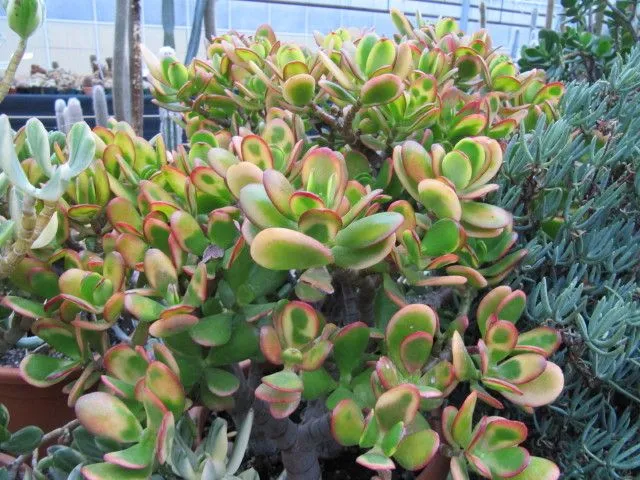
- Crassula ovata 'Variegata' (the variegated jade) is moderately stable when given enough light. It can revert under low light, but a well-placed plant can hold its cream-and-green markings for ten to fifteen years.
- Sansevieria trifasciata 'Moonshine' and 'Hahnii Golden' fall in the same long-stabilised category.
- Agave americana 'Mediopicta Alba' and A. americana 'Marginata' are chimeric but have been multiplied vegetatively for over a century and behave reliably stable in cultivation.
The shared theme is age. A cultivar that has survived twenty propagation cycles is usually a cultivar that does not drift much.
Famous unstable cultivars
The collector market has a parallel set of cultivars that look spectacular and behave erratically.
- Echeveria 'Compton Carousel' is sometimes listed as genetic, but the pale tone often weakens with age, and reverted clumps are common in mature collections. Treat it as semi-stable rather than fully stable.
- Variegated Haworthia cultivars (variegated H. cooperi, variegated H. cymbiformis, and the various imported Japanese-bred forms) sit at the highly unstable end. Many revert within one or two years even under good care, and a clump that looked half-white when bought commonly returns to fully green by the second growing season.
- Most variegated Sedum forms (variegated S. rubrotinctum, variegated S. clavatum) revert readily, particularly under low light or fast growth.
- Crassula ovata 'Variegata' under insufficient light reverts quickly, sometimes within a single growing season. The same cultivar lives at the stable end with adequate light, which makes its behaviour as much about cultivation as about genetics.
- Monstera 'Albo Variegata' (an aroid, not a succulent, but the canonical case study) is a half-leaf chimera famous for both spectacular markings and high reversion rates.
If a plant is sold under a recent collector name with a four-figure price, assume the chimera has not been filtered for stability and plan to manage drift actively.
Care differences
A variegated plant has less chlorophyll per unit leaf area than its all-green counterpart, which shifts the cultivation envelope in two opposing ways.
The first shift is upward: total photosynthesis requires more light per unit leaf, because each unit of leaf has fewer working chloroplasts. A typical green succulent does well at 150 to 300 µmol/m²/s of photosynthetic photon flux density (PPFD). A variegated counterpart usually needs 200 to 400 µmol/m²/s to match that net carbon gain, especially during active growth.
The second shift is downward: pale tissue carries little or no chlorophyll, and chlorophyll itself dissipates excess light energy. Pale tissue is therefore more vulnerable to UV-driven damage and heat stress than green tissue. Direct midday summer sun, which a fully green Echeveria tolerates without comment, will scorch the white sectors of a variegated Echeveria in a single afternoon, and the scorched cells do not recover.
The practical operating window is bright indirect light: a sunny east window, a shaded south window behind a sheer curtain, or 30 to 50 cm under a strong T5 or LED grow light running 10 to 12 hours. Never midday direct sun in summer. In winter under low natural light, supplement before reversion sets in rather than after. The full framework for managing indoor light across all succulents is in indoor succulent care.
Two more care points matter:
- Watering. Variegated plants transpire less than their all-green counterparts (less chlorophyll, slower growth), so let the substrate dry one stage further before watering than you would for the typical form.
- Pot size. Drop one nursery size. A weakly growing variegated jade in a pot built for a vigorous green jade sits in too-wet substrate for too long, and root rot becomes the real failure mode rather than reversion.
Reverting growth: removal protocol
Reversion almost always begins as a single shoot. A reverted shoot grows visibly faster than the surrounding variegated tissue (more chlorophyll equals more sugar) and, left in place, will dominate the plant within one to two years. The variegated portion shrinks, weakens, and eventually dies in the shade of its own reverted twin.
Manage reversion proactively.
- Inspect the plant once a week during active growth. A reverted leaf or shoot is easy to spot: uniform deep green, no streaks or sectors, often more turgid than its neighbours.
- Cut the reverted shoot back to the last clearly variegated growing point. Use a sterilised blade. Do this within four to six weeks of first appearance. After about six weeks the vascular connection from the reverted meristem deepens and the plant has begun to commit resources to it; cutting later still works, but the variegated portion has lost ground that may not come back.
- Dust the wound with sulphur or cinnamon and keep the plant dry for seven to ten days while the cut calluses.
- If the reverted tissue is itself a useful, fast-growing cutting of the all-green form, root it separately. It will grow back as the typical species without markings.
If the plant throws reverted shoots repeatedly from multiple points within a single growing season, the chimera has begun to collapse. Continued pruning may stabilise it, but in many cases the meristem returns to the typical form within a season or two. This is not a failure of care; it is the chimera reverting on its own clock.
Pricing and ethics
Pricing on variegated succulents tells a story about stability that is worth reading before buying.
Stable cultivars sit at €15 to €50 in European garden centres and online specialist nurseries: variegated Crassula ovata, variegated Sansevieria selections, Agave americana 'Mediopicta', Gonialoe variegata. These prices match the underlying biology, mature plants are decades-stable, and reversion is uncommon under reasonable care.
Unstable rare forms run €100 to €2000 and occasionally far higher at peak. Monstera 'Albo Variegata' was selling at €5000 or more during the 2021 to 2022 hype cycle and has since corrected sharply. Variegated Haworthia from Japanese breeding programmes varies widely with stability and provenance, with collector-quality plants in the €300 to €1500 range. The price reflects scarcity, not durability, and a plant bought at peak can be worth a fraction of its purchase price within two years if it reverts.
Two ethical points deserve attention.
The first is propagation source. Tissue-cultured (TC) variegated plants are now common in the trade and are particularly prone to reversion, because the conditions of TC propagation tend to favour the green-only somatic cell lineage during meristem regeneration. A reputable seller will state whether a plant is TC, division, or seed-grown, and will price accordingly. Treat undisclosed TC stock as inherently less stable than long-stabilised vegetative lineages.
The second is provenance for protected genera. Variegated forms of CITES-listed species (variegated Ariocarpus, variegated Astrophytum asterias, variegated Lophophora) are subject to the same trade rules as the typical form. Buy only from sellers who can produce CITES paperwork or verifiable artificial propagation records. Variegation does not change the legal status of the underlying plant.
See also
- A Beginner's Guide to Succulents: the underlying light, water, substrate, and pot-size decisions that frame variegated care, with the small modifications above
- Crested and cristate forms: another morphological variant with its own care divergences from the typical form
- LED grow lights spectrum: supplementing winter light for variegated plants that cannot tolerate direct sun
- Indoor succulent care: the full framework for light, water, and seasonal adjustment
FAQ
Can variegated plants go in direct sunlight?
No. Pale tissue lacks chlorophyll and can scorch in direct summer sun. Use bright indirect light instead.
Will my variegated plant eventually go all green?
Possibly. Chimeric variegation can revert - the green layer takes over. Cut reverted shoots promptly to preserve variegation.
What's a fair price for a variegated succulent?
Stable cultivars like variegated Crassula ovata cost €15-50. Rare unstable Japanese variegated Haworthia can cost €300-2000 but often revert.
Does tissue culture produce stable variegation?
No - TC propagation often favors the green cell line, making reversion more likely. Long-established vegetative lineages are more stable.
Frequently Asked Questions
What is the first step for variegation: stable cultivars vs chimeric drift?
Start by matching the symptom to the plant, substrate, light, and season before changing watering or treatment.
What should be avoided?
Avoid changing several variables at once; correct the limiting factor and observe the plant before escalating.
Which care factor matters most?
Match the plant to its light, substrate, pot size, and season. Most succulent failures trace to a mismatch between drying speed and the plant's current growth rate.
When should the plant be checked again?
Recheck after one to two weeks unless tissue is actively collapsing. Stable firmness and new growth are better signs than a fixed calendar interval.