| Question | Short Answer |
|---|---|
| Are fungus gnats harmful to my succulents? | Adults are harmless. |
| What's the best way to get rid of fungus gnats? | Let soil dry completely between waterings. |
| Can I use hydrogen peroxide to kill fungus gnat larvae? | Yes, a 1:4 dilution of 3% hydrogen peroxide to water kills larvae on contact. |
| What is the first step for fungus gnats on succulents: adult id, larval damage & eradication? | Let soil dry completely between waterings. |
Question: are the tiny black flies lifting from your succulent pots fungus gnats, and are they actually harming the plants? The bottom-line answer: adult gnats are mostly a warning light, while their larvae live in damp organic substrate and can injure fine roots. Chronic fungus gnats mean chronic substrate moisture; if you ignore that signal, root rot is usually the next problem. Here is the rest of the picture.
Quick Answer
- Adult fungus gnats are harmless - it's the larvae in damp soil that can damage fine roots. Their presence signals overwatering.
- Let soil dry completely between waterings. Use a gritty, fast-draining substrate to break the preferred larval habitat.
- Control with bottom-watering, Bti dunks, sticky traps for adults, and a gritty top dressing to block egg-laying.
Part of the Beginner's Guide to Succulents.
What it is
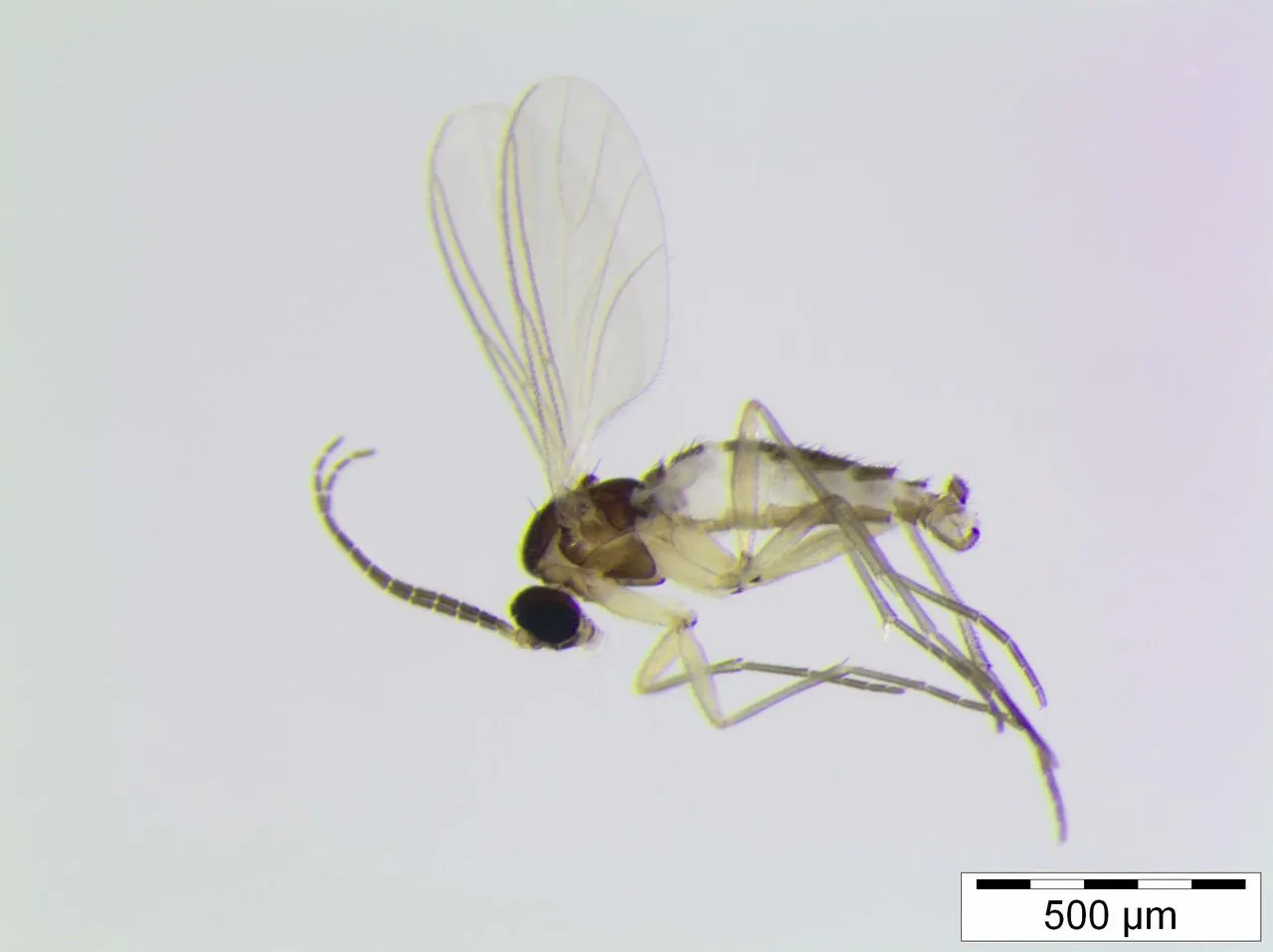
Fungus gnats are small flies in the family Sciaridae. In succulent collections, the genus that matters most is Bradysia, especially Bradysia impatiens and Bradysia coprophila in warm indoor and greenhouse situations. Other small dark flies can appear around houseplants, including shore flies and moth flies, but true fungus gnats have a particular relationship with damp substrate. They breed where fungi, algae, decomposing organic matter, and tender roots are available in the upper potting layer.
The adult fly is the stage you notice first. It is 2 to 4 mm long, dark grey to black, with long legs, bead-like antennae, and a narrow body. Adults are weak fliers. They do not launch cleanly across a room; they lift a few centimetres, hover or zigzag close to the substrate, then settle again on a pot rim, saucer, plant label, or the lower leaves.
Adult fungus gnats do not chew succulent leaves. They do not suck sap like mealybugs or scale. Their job is reproduction: mating, locating a moist oviposition site, and laying eggs in the potting mix. At 21 to 24 °C, eggs hatch within several days, and the larval stage can complete in roughly two weeks when the surface stays damp.
The larvae are the more relevant stage for plant health. They are translucent white, legless, and slender, with a shiny black head capsule. Mature larvae reach about 4 to 6 mm. They live mainly in the upper 2 to 3 cm of substrate, exactly where a peat-heavy or compost-rich mix remains damp after the deeper pot has already started to dry. Their preferred diet is fungal growth and decomposing organic matter, but they also graze on young roots and root hairs when populations are high or when seedlings and fresh cuttings provide soft tissue.
On established succulents with firm roots, fungus gnat larvae usually cause less direct injury than root mealybugs, scale, or repeated overwatering. That does not make them harmless. Their feeding can open small wounds in roots, and those wounds are useful entry points for water moulds such as Pythium and Phytophthora. In practice, the larger issue is diagnostic: a pot that grows fungus gnats well is also a pot that is staying wet long enough to grow root rot organisms well.
How to identify it
Start with adult behaviour. When you water or move a suspect pot, fungus gnats lift from the substrate surface rather than from the plant body. They fly weakly, often in short hops, and return to the pot instead of moving toward windows with the confidence of fruit flies. They are most visible in the morning or after watering, when the surface layer is humid and adults are active.
Yellow sticky cards help confirm the adult stage. Place one card vertically with the lower edge 1 to 2 cm above the substrate, not high over the canopy. Fungus gnats are caught near pot level. If the card fills at the bottom edge while the upper half remains mostly clean, the source is the substrate. Sticky cards are also useful after treatment because they show whether the adult population is declining. They do not kill larvae, so do not mistake a clean-looking card for a solved root-zone problem.
Larval inspection takes a little more effort. Gently scrape away the top 1 cm of mix with a wooden label or spoon and look with a 10x hand lens. Larvae appear as glassy white threads with black heads, often moving slowly when exposed to light. They are easiest to see against a dark, moist substrate. You may also find them along the inner pot wall after sliding a root ball partly from its pot, especially in plastic containers where condensation forms.
The potato slice test is useful when you suspect larvae but cannot see them. Cut a raw potato slice 5 to 8 mm thick, lay it flat on the substrate, and check the underside after 24 hours. Larvae gather beneath it. Remove and discard the slice after inspection so it does not become another decomposing food source.
Larval damage on succulents is subtle. Seedlings may lean, stall, or collapse because their root systems are still shallow and tender. Freshly rooted echeveria leaves, sedum cuttings, and small haworthia offsets may fail to anchor because larvae remove new root hairs as quickly as the plant produces them. Larger plants show indirect signs: poor uptake after watering, slow recovery from dehydration, or roots that look sparse when unpotted. If the stem base is brown and soft, the gnats did not cause the whole problem. They told you the pot stayed wet enough for the whole problem to develop.
Why it appears
Fungus gnats appear when three conditions overlap: moisture, organic food, and a protected surface where adults can lay eggs. Succulent growers often create that combination by using general houseplant compost, peat-heavy cactus mix, decorative cachepots without drainage, or a watering schedule that keeps the upper substrate damp every week.
The upper 2 to 3 cm of the pot matters more than most beginners expect. Adult Bradysia females do not need a swamp. They need a surface that remains moist long enough for eggs and newly hatched larvae to avoid drying out. A pot can feel acceptable at finger depth and still have a wet, organic cap under moss, bark fines, coir, or compacted peat. If the surface layer is green with algae or smells earthy and mushroom-like, it is already feeding the fungal side of the gnat lifecycle.
Organic-heavy mixes make the problem worse. Peat, coir, composted bark, worm castings, and fine potting compost hold water in small pores and provide microbial food. Those ingredients are not automatically wrong for every plant, but succulents grown indoors usually need a much higher mineral fraction. Pumice, scoria, lava rock, coarse sand, granite grit, and calcined clay dry through larger air spaces and leave fewer damp pockets for larvae.
New plants are a common entry point. Nursery-grown succulents are often raised in peat-based plug media because it is lightweight and easy for automated irrigation. Once placed among mineral-grown plants and watered on the same schedule, the old nursery core stays wetter than the surrounding mix and becomes the breeding pocket.
The critical interpretation is this: fungus gnats are not mostly a fly problem. They are a wet-substrate marker. If you kill the visible adults but leave the substrate unchanged, you have hidden the alarm while the root zone continues moving toward rot.
How to fix it
Begin by isolating the worst pots and stopping automatic watering. Let the substrate dry until the pot is noticeably lighter and the top several centimetres are dry. For most established succulents, a short dry interval is safer than adding another drench to a mix that is already supporting larvae.
The first real treatment is substrate correction. Unpot any plant with repeated gnat activity, especially if it is in peat-heavy nursery soil. Remove loose organic mix from around the root ball, trim black or mushy roots with sterile scissors, and repot into a mineral-leaning succulent mix. For indoor succulents, aim for 70 to 80% mineral material by volume. A practical blend is 2 parts pumice, 1 part scoria or lava rock, 1 part coarse grit, and 1 part sieved potting compost. For species that resent rich soil, such as many mesembs and compact haworthias, go even leaner.
Add a surface barrier. A 1 to 2 cm top-dressing of pumice, granite grit, or coarse horticultural sand makes the oviposition site less inviting and dries quickly after watering. If using sand specifically as a barrier, choose 3 to 4 mm horticultural sand, not fine play sand. Fine sand can crust, trap moisture below it, and make the root-zone problem worse. The barrier works because adult females prefer damp, organic surfaces where the larvae can enter immediately after hatching.
Use Bacillus thuringiensis var. israelensis (Bti) as the larval biological control. Bti produces toxins that fungus gnat larvae ingest while feeding; the larvae stop feeding and die, while the plant is unharmed. Use a soil drench at the label rate once weekly for three weeks. For common liquid Bti products, that often means 0.5 to 1 mL per litre of water, or about 2 to 4 mL per US gallon. For mosquito dunk formulations, steep one quarter dunk in 4 litres of water for 12 to 24 hours, then water the affected pots with that infusion. Labels vary by formulation, so the label wins if it conflicts with those ranges.
Keep yellow sticky cards in place during treatment. They reduce the number of egg-laying adults and give you a population trend. Replace cards when crowded with insects or dust. If you still catch fresh adults three weeks after Bti and substrate correction, look for an untreated pot nearby, a damp propagation tray, or a cachepot holding runoff.
Hydrogen peroxide can be used as a short-term substrate flush, but it is not a substitute for fixing the mix. Dilute standard 3% hydrogen peroxide at 1:4 with water, which gives roughly 0.6% hydrogen peroxide in the final solution. Pour it through the already moist substrate until it drains freely. The bubbling releases oxygen and can kill exposed larvae on contact. Use it once, then let the pot dry. Repeated peroxide flushing can disturb the microbial community and stress fine roots, especially in small pots.
Systemic imidacloprid is the last resort, not the first move. It can suppress fungus gnat larvae when used as a substrate drench at 0.05 to 0.1%, but it is a broad systemic insecticide and should not be used casually, near edible plants, or on flowering plants accessible to pollinators. In most succulent collections, imidacloprid is better reserved for persistent sap-feeding pests. If fungus gnats are the only issue, mineral substrate, drying discipline, Bti, and barriers are usually enough.
How to prevent it
Quarantine new succulents for four weeks and inspect the substrate, not only the leaves. If a new plant arrives in a peat plug, bare-root it or keep it isolated until you are confident the plug dries fully between waterings.
Match watering to drying, not the calendar. Lift the pot, check the surface, and use a wooden skewer or moisture probe if the plant is valuable. For many indoor succulents in 7 to 10 cm pots, the interval may be 10 to 21 days in active growth and much longer in winter. The mix should pass through a dry phase before the next watering. That wet-dry rhythm is central to basic succulent culture, and it is covered in the Beginner's Guide to Succulents.
Manage propagation trays separately. Leaf propagation trays, seedling pots, and freshly rooted cuttings need more consistent moisture than mature succulents. That makes them the highest-risk gnat reservoirs. Use sterile, low-organic propagation media, bottom heat only when airflow is good, and yellow sticky cards at tray level. Once cuttings have roots, transition them toward a drier mineral mix rather than keeping them in a nursery-style damp bed.
The prevention standard is simple: if the substrate surface dries quickly and the root zone has air, fungus gnats struggle to complete their life cycle. If gnats are chronic, the substrate is chronic too. Treat the flies, but believe the warning.
See also
- A Beginner's Guide to Succulents, the care baseline for light, drainage, watering rhythm, and substrate choice.
- Wet-Dry Cycle Explained, how drying phases protect succulent roots and interrupt moisture-loving pests.
- IPM for Succulents, monitoring habits, quarantine routines, biological controls, and pesticide escalation.
- Top-dressing materials: how a grit surface layer blocks egg-laying and suppresses adult fungus gnat emergence
FAQ
Are fungus gnats harmful to my succulents?Adults are harmless. Their larvae live in damp soil and can damage fine roots, making plants more susceptible to root rot. The presence of gnats usually means the soil is staying too wet.
What's the best way to get rid of fungus gnats?Let soil dry completely between waterings. Use Bti mosquito dunks in watering water, sticky traps for adults, and add a gritty top dressing to prevent egg-laying.
Can I use hydrogen peroxide to kill fungus gnat larvae?Yes, a 1:4 dilution of 3% hydrogen peroxide to water kills larvae on contact. Use as a drench, but only after letting the soil dry first.
Frequently Asked Questions
Are fungus gnats harmful to my succulents?
Adults are harmless. Their larvae live in damp soil and can damage fine roots, making plants more susceptible to root rot. The presence of gnats usually means the soil is staying too wet.
What's the best way to get rid of fungus gnats?
Let soil dry completely between waterings. Use Bti mosquito dunks in watering water, sticky traps for adults, and add a gritty top dressing to prevent egg-laying.
Can I use hydrogen peroxide to kill fungus gnat larvae?
Yes, a 1:4 dilution of 3% hydrogen peroxide to water kills larvae on contact. Use as a drench, but only after letting the soil dry first.
What is the first step for fungus gnats on succulents: adult id, larval damage & eradication?
Let soil dry completely between waterings. Use a gritty, fast-draining substrate to break the preferred larval habitat.