| Question | Short Answer |
|---|---|
| When should I use systemic insecticides? | Only as a last resort after contact treatments (alcohol, neem oil) fail for severe mealybug or scale infestations. |
| Are systemics safe for edible succulents? | No - systemics translocate into plant tissue. |
| Can systemics harm pollinators? | Yes - systemic insecticides (imidacloprid) move into nectar and pollen. |
| What is the first step for systemic insecticides on succulents: when to reach for them? | Use as a last resort after contact treatments fail. |
A systemic insecticide is a compound the plant absorbs and carries inside its own tissue, so any insect that feeds on the plant takes up a lethal dose. For a succulent collection, the question is rarely whether these products work but whether you should be reaching for one at all. The bottom-line answer: keep systemics in reserve. Use them for heavy mealybug or scale infestations that have failed contact treatment, on indoor ornamental plants only, and never on a plant you might eat from or that pollinators visit. Treat them as a controlled escalation, not a default. Here is the rest of the picture.
Quick Answer
- Systemic insecticides (imidacloprid, acetamiprid) are absorbed into plant tissue - insects feeding on the plant ingest the poison.
- Use as a last resort after contact treatments fail. Not for edible plants or those visited by pollinators.
- Apply as soil drench, not foliar spray, for best absorption. Keep in reserve for severe infestations.
Part of the Beginner's Guide to Succulents.
What systemic insecticides are
A systemic insecticide is taken into the plant, either through the roots from a soil drench or through the foliage from a spray, and translocated through the xylem and phloem to all living tissue. Sap-sucking insects that tap the phloem with their stylets ingest the compound and die from neurological disruption. Depending on the chemistry, the dose, and the plant's growth rate, the protective window lasts roughly two to twelve weeks after a single application.
This is fundamentally different from contact insecticides, including 70% isopropyl alcohol, neem oil, and insecticidal soaps. A contact product kills only what it physically reaches, so anything sheltering in deep leaf axils, under the pot rim, or hidden in the substrate survives. With a systemic the plant itself is the delivery mechanism, which is why a root drench can reach mealybugs hidden in a rosette centre and root mealybugs (Rhizoecus spp.) feeding on rootlets you cannot see without unpotting.
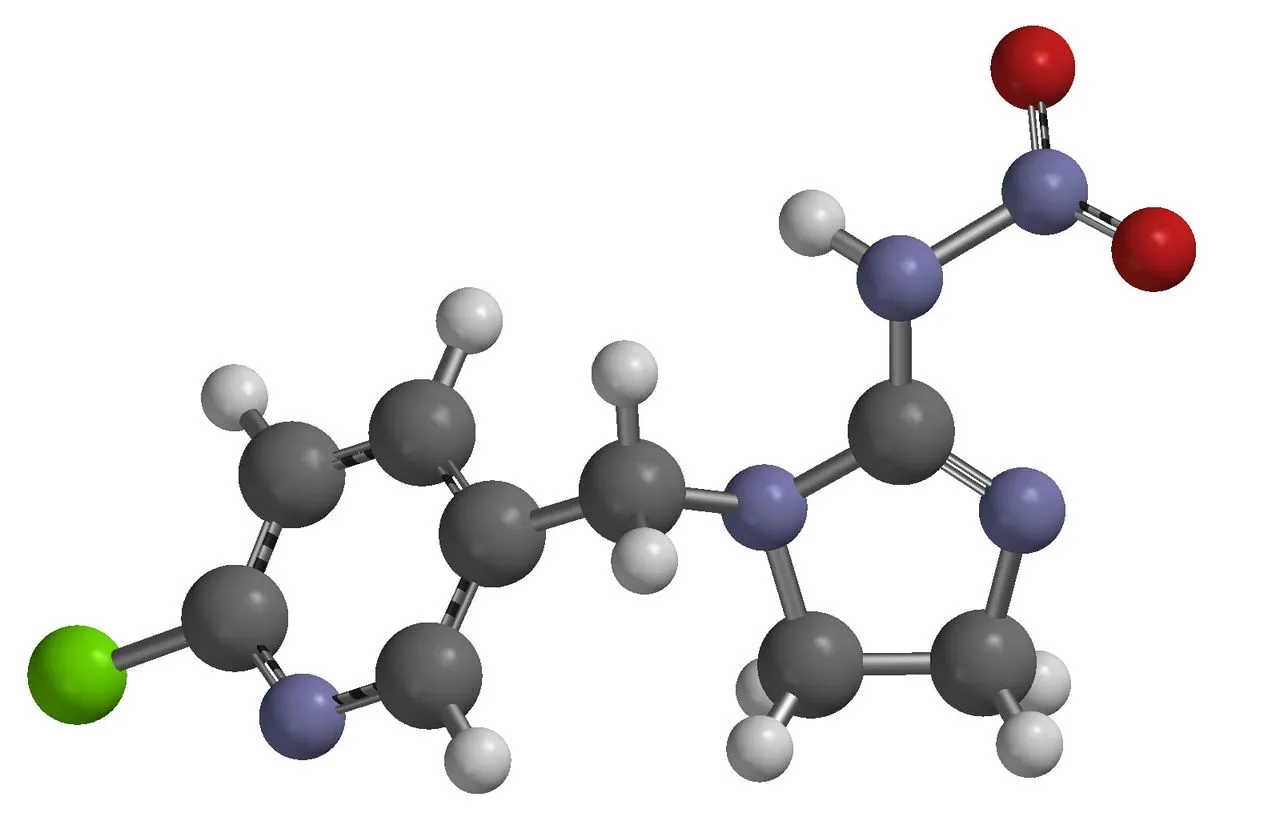
The class most often used on succulents is the neonicotinoids: imidacloprid, acetamiprid, dinotefuran, thiamethoxam, and clothianidin. All five act as nicotinic acetylcholine receptor agonists in insects, binding the receptor and causing continuous nerve firing. The receptor occurs in mammals as well, but the mammalian form binds neonicotinoids weakly, which is why oral toxicity to humans, dogs, cats, and rabbits at home-use rates is low. The same is not true for many bees and other pollinators, which is the central reason these compounds carry restrictions.
When they make sense (and when they don't)
A systemic is appropriate when:
- Mealybug or scale infestations are heavy and refractory to repeated contact treatment, especially in deep rosette centres on Echeveria, Pachyphytum, or older Aloe clumps where swabbing every insect is no longer practical.
- Root mealybugs in Rhizoecus have been confirmed by unpotting and substrate replacement alone is not sufficient, for instance in a multi-pot collection where unpotting every plant is unrealistic.
- A whole shelf is involved and contact spraying every leaf surface, top and underside, is no longer feasible without missing crawler refugia.
A systemic is not appropriate when:
- The infestation is small. Two or three mealybugs in a leaf axil are faster to treat with a cotton swab and 70% isopropyl alcohol, and you avoid leaving residual neurotoxin in the plant for weeks.
- The plant is grown for food. Aloe vera leaves used for skin or culinary purposes, Opuntia pads, Agave nectar harvested for pulque or syrup, and any culinary herbs sharing a tray must not receive systemic treatment. Neonicotinoids translocate into edible tissues at concentrations the manufacturer's label does not authorise for food use.
- The plant flowers and is visited by bees. Aloe, Agave, and many Sedum and Crassula species attract honey bees, bumblebees, and solitary bees in bloom. Imidacloprid and its relatives persist in pollen and nectar at sublethal doses for weeks, doses high enough to impair foraging and brood development even when not killing outright.
- The pest is a thrips, a spider mite, or another non-target. Thrips show only weak knockdown from neonicotinoids and generally need a different chemistry. Spider mites are arachnids, not insects, and are not affected at all.
The honest framing: most home-collection problems do not need a systemic. A disciplined contact program, isopropyl spot treatment plus insecticidal soap or correctly diluted neem on a four-week cycle, clears the majority of mealybug and soft scale outbreaks. Systemics are the second-line tool for the small fraction of cases where that program has been run faithfully and has still failed.
The chemistry: imidacloprid, acetamiprid, dinotefuran
Imidacloprid is the most widely sold neonicotinoid for ornamental use and is the active in many granular and liquid concentrates. As a soil drench, dilute a 21.4% concentrate to 0.05 to 0.1% (5 to 10 mL per litre of water) and apply 200 to 500 mL per pot depending on size. A single drench at full label rate gives six to eight weeks of protection. Imidacloprid is the most-studied compound in this class for non-target effects, which is why the European Union banned its outdoor field use in 2018. Indoor and protected ornamental use remains permitted in the EU, the UK, and most other jurisdictions.
Acetamiprid has lower bee toxicity than imidacloprid and a faster knockdown profile. Foliar spray dilution is 0.02 to 0.05%, and it can also be used as a drench. It tends to outperform imidacloprid on hard armoured scale during crawler emergence, partly because the foliar spray reaches exposed crawlers directly while still being taken up systemically. It is the compound to consider when imidacloprid has been used repeatedly in the same collection and resistance is suspected.
Dinotefuran is the most water-soluble of the three and translocates fastest. That speed makes it the better choice for root mealybugs, where the active needs to reach the rhizosphere quickly, and for mealybug populations sheltering in dense crown growth. It is more expensive and harder to source as a hobbyist product in some markets but is widely used in commercial succulent nurseries.
Thiamethoxam and clothianidin appear in some agricultural products and lawn-care concentrates. They work, but they are rarely the right tool for a small ornamental collection because home-rate dilutions are awkward and the bee restrictions on them are tighter still.
Application protocols
For sap-sucking pests on aerial plant parts (mealybugs, scale, aphids), a soil drench is the preferred route. Mix the concentrate to label rate, water the pot first with plain water if the substrate is bone-dry so the drench distributes evenly rather than channelling, then apply the measured volume slowly over the substrate surface. Do not apply to a freshly repotted plant whose roots are still damaged: uptake will be erratic and the dose may be wasted.
For root mealybugs and any soil-dwelling pest, a drench is the only sensible application. A foliar spray will not reach insects feeding on rootlets, and surface granules dissolve too slowly to give a clinical kill. Drench the entire root volume so the active reaches the bottom of the pot.
Foliar acetamiprid sprays at 0.02 to 0.05% are useful for armoured scale during crawler emergence or as a top-up between drenches. Spray to runoff, undersides included, in cool light, never on a sunny windowsill or above 27 °C, and never on farina-coated species like Echeveria subsessilis or Dudleya brittonii where a wetting agent will strip the bloom.
Single drench applications at full label rate give six to eight weeks of protection. Do not double-dose hoping for longer cover: residue persists in the plant whether or not insects are present, and overdosing risks phytotoxicity in slow-growing succulents whose root systems cannot dilute the load.
What systemics won't fix
A neonicotinoid is not a general pest spray. It works on insects with a piercing-sucking feeding apparatus that draws phloem sap continuously and so reliably ingests the compound. It does not control:
- Spider mites (Tetranychus urticae and relatives). Mites are arachnids; their target receptors differ. Use a miticide such as abamectin or, for hobby collections, a horticultural oil program.
- Thrips. Knockdown is variable and incomplete. Spinosad or a thrips-specific product is more appropriate.
- Fungus gnats in their larval stage feeding in saturated substrate. The fix is substrate moisture management and Bacillus thuringiensis israelensis drenches, not a neonicotinoid.
- Snails, slugs, and isopods chewing soft seedling tissue. Different feeding mode entirely.
- Sooty mould or fungal pathogens that follow honeydew. Killing the insect source helps, but the existing mould must be wiped off mechanically and conditions improved.
Reaching for a systemic against the wrong pest is how resistance builds in non-target species elsewhere on the plant. For the contact-treatment program that should precede any systemic escalation, neem oil application covers mix ratios and application timing.
Bee and pet safety
The bee question is the single most important constraint on neonicotinoid use, and it applies whether or not you keep your plants strictly indoors. Aloe and Agave in particular produce abundant nectar that bees and small birds visit; Sedum and Crassula flowers carry pollen that foragers will collect. Imidacloprid persists in nectar and pollen at sublethal doses for weeks after application, and those doses impair navigation and brood development in honey bees and bumblebees even when they do not cause acute mortality. The rule is straightforward: never apply a systemic to any plant that may flower while the residue is still active, and never to a plant you intend to move outdoors during its bloom season. The EU's 2018 ban on outdoor imidacloprid field use rests on this evidence, and the indoor exemption assumes pollinators do not have access to treated plants.
Pet safety at home-use rates is comparatively forgiving. Mammalian oral toxicity for imidacloprid, acetamiprid, and dinotefuran is low, and a curious dog or cat licking a treated leaf is not at acute risk. The two situations to avoid are pet-grazing animals (rabbits, tortoises, iguanas) with regular access to Aloe vera or Opuntia pads, where chronic ingestion is plausible, and any household where a child might chew on a houseplant. In both cases, choose a different management approach. Wash hands after mixing concentrate, do not eat or drink while applying, and store the concentrate in its original labelled container away from food.
Resistance management
Mealybug and soft scale populations exposed continuously to a single neonicotinoid for five years or more develop measurable resistance. The mechanism is overexpression of detoxifying enzymes, especially cytochrome P450 monooxygenases, with minor changes to the receptor itself in some lineages. Resistance has been documented in Planococcus citri on European greenhouse ornamentals and in Phenacoccus solenopsis on agricultural crops; once it appears in a population it is effectively permanent in that lineage.
For a hobby collection, the practical rule is to rotate. If you used imidacloprid this year, switch to acetamiprid or dinotefuran next time. Do not apply more than two or three drenches in a calendar year on the same plants. Combine systemic intervention with non-chemical measures (quarantine, ant control, airflow, manual removal) so the compound is not the only selective pressure on the population. If contact methods clear the visible problem, stop there: every avoided drench is a generation of pests not selected for resistance and a small amount of residue not entering the wider environment.
The closing thought is the one to start with. Systemic insecticides are a controlled escalation. They are the right tool when the alternative is losing a serious collection to pests that contact methods can no longer reach, and they are the wrong first reach when a cotton swab and patience would have done the job.
See also
- A Beginner's Guide to Succulents, the underlying care framework that prevents most situations where a systemic would be needed.
- Mealybug Identification, the lifecycle and contact-treatment program a systemic is meant to escalate from when it fails.
- Scale Insect Identification, hard-shell and soft-bodied separation and crawler timing relevant to drench scheduling.
- IPM for Succulents — the integrated approach that positions systemics as a controlled escalation within a broader pest management strategy.
- Root Mealybug Identification — the underground pest that soil drenches specifically address.
FAQ
When should I use systemic insecticides?Only as a last resort after contact treatments (alcohol, neem oil) fail for severe mealybug or scale infestations.
Are systemics safe for edible succulents?No - systemics translocate into plant tissue. Don't use on Aloe vera or any plant you might eat.
Can systemics harm pollinators?Yes - systemic insecticides (imidacloprid) move into nectar and pollen. Never use on plants that flower outdoors.
Frequently Asked Questions
When should I use systemic insecticides?
Only as a last resort after contact treatments (alcohol, neem oil) fail for severe mealybug or scale infestations.
Are systemics safe for edible succulents?
No - systemics translocate into plant tissue. Don't use on Aloe vera or any plant you might eat.
Can systemics harm pollinators?
Yes - systemic insecticides (imidacloprid) move into nectar and pollen. Never use on plants that flower outdoors.
What is the first step for systemic insecticides on succulents: when to reach for them?
Use as a last resort after contact treatments fail. Not for edible plants or those visited by pollinators.