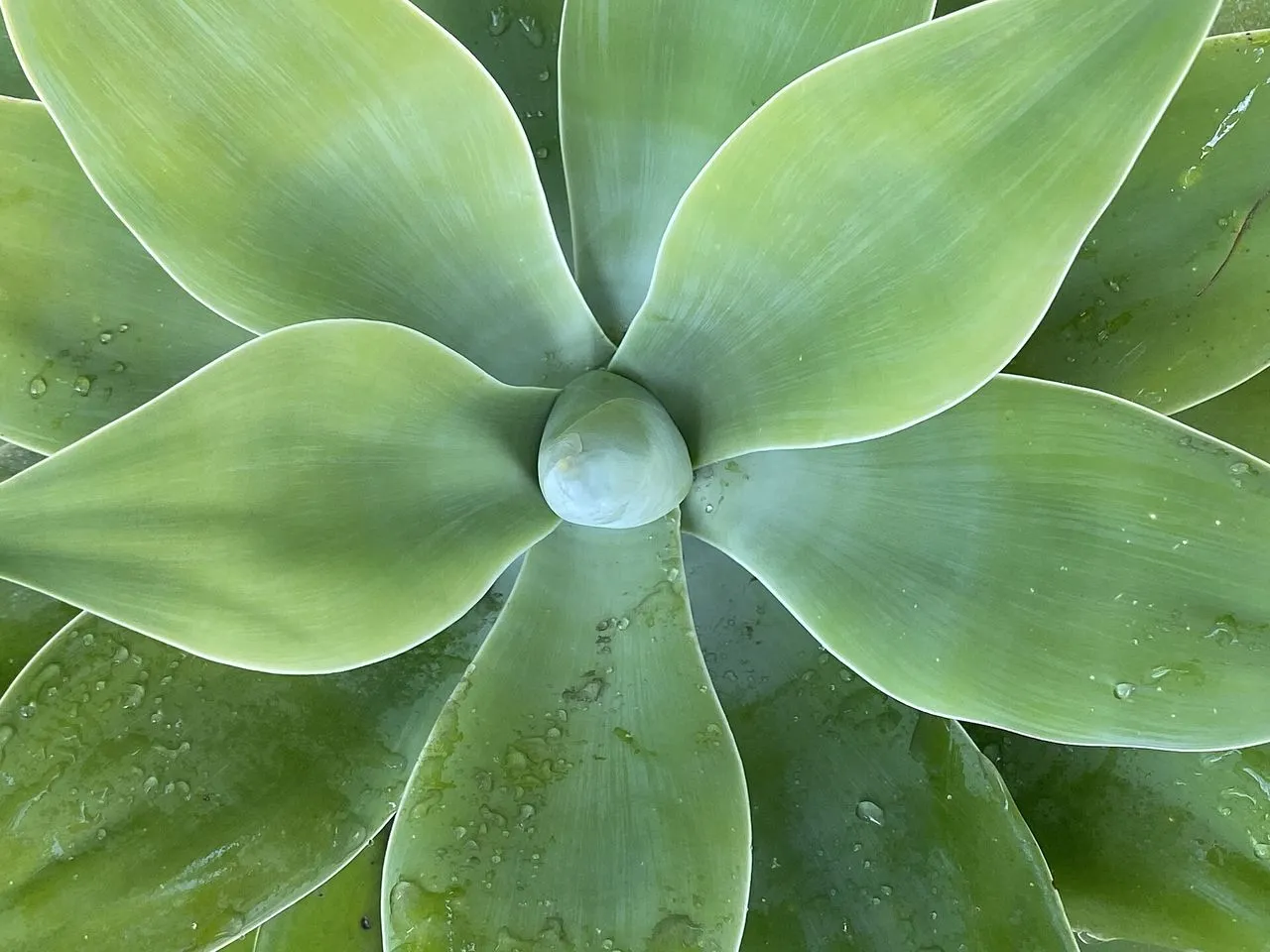
Black tissue on an agave is always dead or dying tissue, but it is not always an emergency. A dry black scar from frost or sun exposure is a record of past injury. A wet black base, black centre, or black leaf combined with sour smell is active collapse and needs immediate action.
The diagnostic order is simple: texture first, position second, recent conditions third. Colour alone is not enough. Part of the Complete Agave Guide.
Crown rot from trapped water
Crown rot is the most dangerous cause of black agave leaves in containers and cool climates. Water sits in the central cup or between tight leaves, temperatures drop, and the tissue loses its ability to defend itself. The centre turns dark olive, then brown-black, and the youngest leaves soften. In advanced cases the central spear pulls free with little resistance.
This is especially common when agaves are watered from above in autumn or winter, or when plants are kept under glass with poor air movement. Tight rosettes such as Agave victoriae-reginae can hold water between leaves for longer than expected. Spineless, softer species such as A. attenuata blacken quickly after cold wet conditions.
Root rot moving upward
Root rot can also turn leaves black, but the pattern starts lower. The oldest leaves yellow first, then the bases become soft, grey, or black as the failure moves into the stem. The pot may remain heavy, the mix may smell sour, and roots appear black, hollow, or slimy when exposed.
Agaves tolerate drought far better than stagnant wet substrate. A peat-heavy mix that seemed acceptable in summer can become dangerous in winter when evaporation slows. Below about 10 °C, a wet root ball may stay wet for weeks. The leaves then blacken not because the plant is thirsty, but because the roots can no longer function.
Frost injury and freeze collapse
Frost damage creates blackened patches where cells have ruptured. The pattern depends on exposure. Leaf tips and upper surfaces blacken first if the air was briefly below the species' tolerance. Whole leaves collapse if the freeze was severe or the plant was wet. Tender species such as Agave attenuata and A. tequilana may show black tissue near 0 °C, while dry A. parryi can tolerate far colder conditions.
Frost damage often looks worse after 48 to 96 hours than it did on the morning after the freeze. The correct response is patience. Keep the plant dry, protect it from another freeze, and wait until the boundary between dead and living tissue is clear before trimming.
Sun scorch and heat marks
Black or dark brown dry patches can follow sudden exposure to full sun, especially when a greenhouse or indoor plant is moved outdoors without acclimation. Agaves are high-light plants, but shade-grown leaves have not built the wax, pigments, and tissue density needed for direct afternoon sun. The damage appears on exposed surfaces, often as tan patches that later darken at the edges.
Sun scorch is dry and stable. It does not smell, spread through the crown, or make the central spear loose. The scar remains until that leaf ages out, which may take years on a slow agave. The solution is not shade forever; it is controlled acclimation over 2 to 3 weeks.
Agave snout weevil and secondary black rot
Snout weevil can produce black tissue when larvae tunnel through the crown and secondary microbes liquefy the plant. The blackening is usually wet, basal, and associated with collapse. Large mature plants may lean or release the centre. If you cut into the crown, you may find tunnels, larvae, or a hollow sour-smelling stem.
This differs from ordinary frost scarring because it attacks the structural core. A dry black patch on one leaf does not threaten the plant. A black crown with a fermented odour threatens every neighbouring agave because the pest may still be present.
Old wounds and oxidised sap
Agave sap can oxidise to dark brown or black around old cuts, punctures, and spine injuries. Leaves rub against walls, tools scrape the wax, or a terminal spine pierces a neighbouring leaf. The resulting mark may look alarming but remains hard, dry, and sharply bounded.
Mechanical marks are common on large landscape plants and on agaves moved through doorways. They do not require treatment unless the wound stays wet or becomes an entry point for rot. Avoid repeated handling; the glaucous wax on many species does not regenerate once rubbed away.
How to identify black leaf causes
| Black tissue pattern | Likely cause | Action |
|---|---|---|
| Soft black centre, spear pulls free | Crown rot | Keep dry, inspect, discard if crown is destroyed |
| Black lower bases with wet mix | Root rot | Unpot, remove rotten roots, dry bare-root |
| Black tips after freezing night | Frost injury | Keep dry and wait before trimming |
| Dry patches on sun-facing leaves | Sun scorch | Acclimate to light; leave scars alone |
| Black basal collapse plus sour smell | Snout weevil | Remove plant and inspect neighbours |
| Hard black line around old cut | Oxidised wound | Monitor only |
If a black area is dry, firm, and not expanding, it is usually a scar. If it is wet, soft, smelly, or moving toward the centre, treat it as active rot.
Risk and severity
Act immediately when the central spear loosens, black tissue is wet at the crown, the base smells sour, or several leaves collapse from the same point. These signs mean the growing point may already be dead. Isolate container plants and stop watering.
Wait when black tissue is limited to exposed tips after frost or one dry sun-scorched patch. Agaves are slow; cosmetic damage remains visible for years, but the plant can resume normal growth from a firm centre. Professional help is appropriate for large in-ground plants with black basal collapse, because cutting heavy spiny leaves from a rotting crown is hazardous.
Solutions
For crown rot
Remove standing water and move the plant to a dry, bright, ventilated position above 10 °C. If the central spear is still firm, withholding water may stop minor damage. If the centre is black and loose, the mother rosette is usually unrecoverable. Save only firm offsets with clean bases.
For root rot
Take the plant out of its pot and remove all old substrate. Cut rotten roots back to firm pale tissue with a sterile blade. Dry the plant bare-root for 5 to 10 days, then pot into a dry mineral mix. Do not water for at least 7 days after potting, and resume only when the mix is dry to the bottom.
For frost damage
Keep the agave dry and protected from further frost. Do not fertilise and do not cut immediately. Once damaged areas have dried, remove collapsed leaves if they trap moisture against the crown. Leave firm black scars alone.
For sun scorch
Move the plant to bright shade for several days, then reintroduce direct sun gradually. Existing black marks will not heal, but new central leaves should emerge clean. If a scorched plant is also dehydrated, water thoroughly only after the substrate is dry and temperatures are stable.
Prevention
Water the substrate, not the rosette. Avoid overhead irrigation in autumn and winter. Use a gritty mix that drains quickly and a pot with an open drainage hole. Keep tender species above their cold limit, and keep hardy species dry during freezes.
Acclimate all agaves to stronger light. A plant grown under 30% shade cloth or indoors should receive morning sun first, then longer exposure after 7 to 14 days. Inspect the crown after storms, cold snaps, and pest activity. Black tissue caught while dry and localised is usually manageable; black tissue at the centre is a different problem.
See also
- Agave leaves yellowing — earlier colour changes that often precede black rot.
- Agave snout weevil — the pest cause of sudden black crown collapse.
- Agave attenuata — a tender species where cold blackening is common outside mild climates.
- Agave winter damage — frost triage and dry-root recovery after cold events.
Frequently Asked Questions
Why is the centre of my agave turning black?
A black soft centre usually means crown rot, often from water held in the rosette during cool weather. It can also follow agave snout weevil damage in warm climates.
Can black frost damage heal on agave leaves?
The damaged tissue will not turn green again. If the crown remains firm, new leaves can grow normally and the old blackened areas can be left until they dry.
Should I cut black agave leaves immediately?
Cut only rotten tissue that is spreading or leaves that have fully collapsed. Dry black scars are cosmetic and cutting them creates fresh wounds.
What is the difference between black rot and black sun damage?
Rot is soft, wet, often smelly, and concentrated at the crown or leaf bases. Sun damage is dry, fixed in place, and usually appears on the most exposed leaf surfaces.