| Question | Short Answer |
|---|---|
| Does Agave geminiflora produce offsets? | No. |
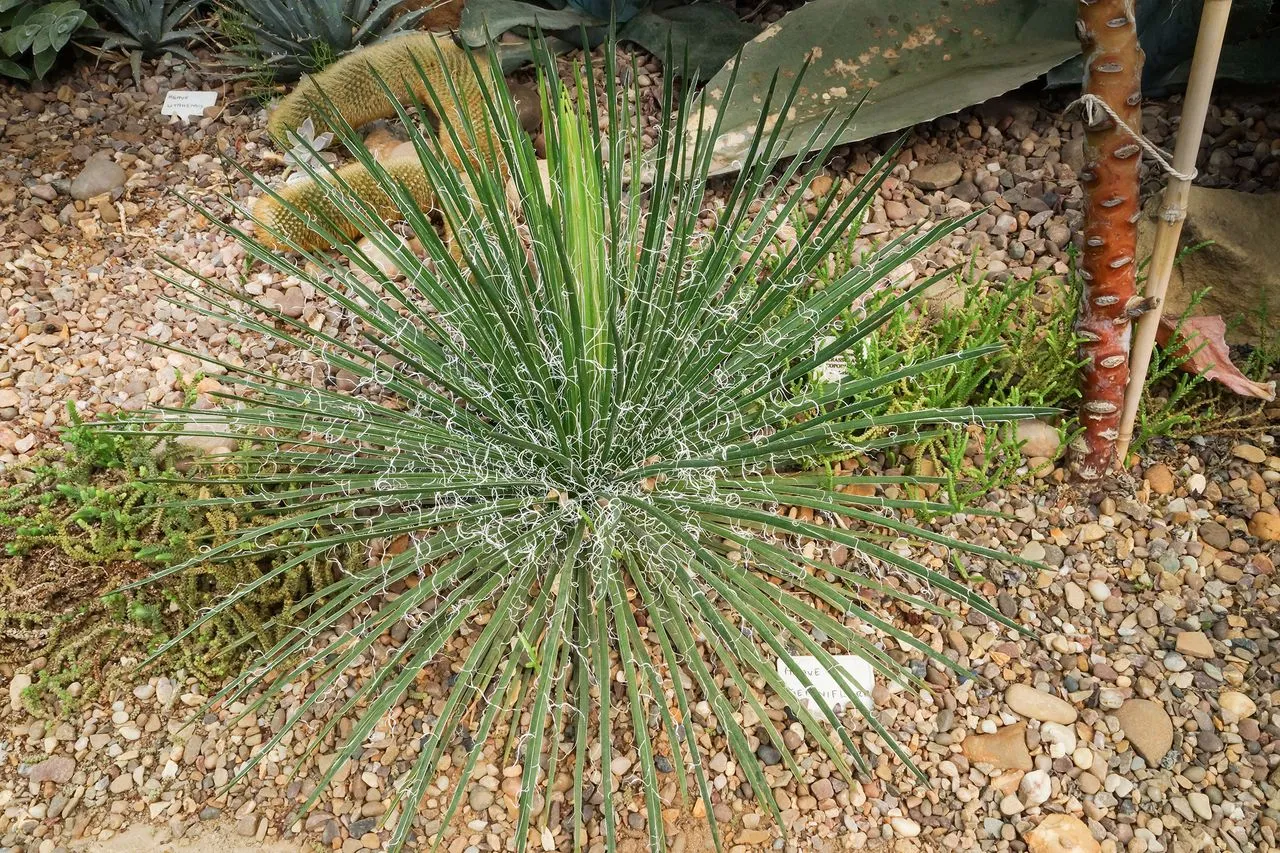
| How do you identify Agave geminiflora? | The key combination is a large mop-shaped rosette, 300 to 500 narrow leaves, white curling marginal fibres, and a soft non-puncturing tip. |
| Is Agave geminiflora cold-hardy? | Only moderately. |
| Why does provenance matter for Agave geminiflora? | The species is Vulnerable and has a narrow Nayarit range. |
Agave geminiflora Boissier, the twin-flowered agave, was formally described in 1842 by the Swiss botanist Edmond Boissier, who transferred the plant from the older basionym Littaea geminiflora. The species is endemic to a very restricted slice of Nayarit in western Mexico, in particular the Sierra de Vallejo, where rosettes grow on volcanic slopes between roughly 1,000 and 1,300 m. The defining features are a solitary rosette of 300 to 500 very thin pliable dark green leaves, each carrying curtains of curly white fibres along the margins, and a soft tip in place of the rigid terminal spine that almost every other agave on a comparable bench carries.
In habitat, A. geminiflora belongs to humid pine-oak transitions and tropical deciduous forest on weathered volcanic substrate, where the soil is acidic to slightly acidic, drainage is rapid through the gravel beneath, and the canopy sits open enough that direct sun reaches the rosette for several hours a day. Wild populations are localised, often on steep slopes where the plant occupies fissures and low ledges. The IUCN lists the species as Vulnerable, driven by the narrow range, ongoing forest conversion, and collection pressure on a plant with no large cultivated commercial production inside Mexico to absorb demand. If you are buying A. geminiflora, sourcing nursery-propagated material rather than wild-collected stock matters here in a way that it does not for the broadly distributed agaves.
Part of the Complete Agave Guide.
Identification
A mature A. geminiflora forms a solitary, dome-shaped rosette typically 60-90 cm wide and 60-80 cm tall, the leaf count alone (300 to 500 individual blades on a healthy adult) producing a flowing mop silhouette that is hard to mistake once you have seen it in person. Leaves are 30-50 cm long but only 3-8 mm wide, dark green to grey-green, and pliable enough to bend through thirty degrees without snapping. They radiate from a very short central axis, lower leaves arching outward as upper spear ranks rise.
Two leaf details settle the identification. First, the margins peel into long curly white fibres, the so-called filiferous habit, and on a plant of three or four hundred leaves those fibres collectively read as a curtain of pale threads draped through the rosette. Second, and unusually for an agave at this size, the leaf does not end in a true rigid terminal spine. It tapers to a small soft tip that may extend the blade by a millimetre or two but does not puncture skin. That combination, very many narrow leaves, prominent marginal fibres, and a soft apex, is diagnostic.
Flowering is monocarpic and rare in cultivation. After fifteen to twenty-five years, an individual rosette sends up an unbranched panicle to about 5-6 m tall, with greenish-yellow tubular flowers carried in pairs along the upper portion. The paired arrangement gives the species its epithet (gemini, twin) and matches no other agave commonly grown in temperate collections. The flowering rosette dies after fruiting. Because A. geminiflora is one of the few agaves that does not sucker, the plant does not carry on through a surrounding clump the way Agave stricta or Agave parviflora do; for continuity you need seed or the apomictic bulbils that occasionally develop along the inflorescence.
Three lookalikes account for most trade confusion. Agave filifera is the closest superficial match and shares the white marginal fibres, but its leaves are decidedly more rigid, the fibres themselves are heavier and more prominent, and the mature rosette is smaller, typically 30-50 cm wide rather than 60-90 cm. A. stricta, the hedgehog agave, also forms a many-leaved globular rosette, but its leaves carry no marginal fibres at all and end in a sharp brown-black terminal spine. A. parviflora is much smaller (15-20 cm rosettes) and sits clearly in the dwarf-agave size class. If the plant in front of you is large, mop-shaped, with hundreds of narrow leaves and white fibres curling through the rosette, you have A. geminiflora; the other three each give one decisive character to the contrary.
Cultivation
Light should be bright but not the harshest direct exposure. Outdoors in temperate or Mediterranean climates, six to eight hours of morning and midday sun with afternoon dapple suit A. geminiflora well. The thin pliable leaves can scorch under reflected wall heat or sustained desert sun, especially on plants moved suddenly out of nursery shade, so introduce stronger light gradually over two to three weeks. Indoors, the plant accepts a bright unobstructed south or southwest window, or a strong horticultural grow light. In lower light, the rosette opens out and the leaf curtain thins, which on a species this dependent on its silhouette costs the plant most of its visual character. The broader principles of light, watering, and substrate for new growers are covered in the beginner's guide.
Substrate should be mineral and slightly on the acidic side. A useful container mix is 60-70% mineral material, with pumice, lava rock, and coarse granite grit as appropriate components, and 30-40% loam-based compost. Avoid limestone or dolomite chips, which suit alkaline-substrate agaves but not this one; the volcanic origin of A. geminiflora means it has not evolved on alkaline scree, and a strongly basic mix produces slower, weaker growth than a near-neutral one. Avoid peat-heavy mixes, which hold water inside the deep leaf canopy and invite crown rot before the surface above gives any clue.
Water deeply during active growth, then let the upper third to half of the substrate dry before watering again. In a 25 cm terracotta pot in warm weather, that interval is typically 8-14 days. Because the leaves are thin rather than thickly succulent, the firmness cue you might use on broad-leaved agaves is less helpful here. Use a moisture probe at the 4-5 cm depth, or judge from the weight of the pot in your hand. In winter, especially below 10 °C, keep the root zone almost dry; the plant has no tolerance for cold wet substrate.
Frost tolerance is moderate. A settled plant with a bone-dry root ball survives brief drops to about -3 °C without lasting damage. Below that, leaf tips brown, the central spear can blacken, and prolonged wet cold is lethal. In winter-rain climates, container plants belong under glass, in an unheated bright shelter, or beneath a deep eave. Open-ground plantings need a south-facing slope or a raised mineral bed where rainwater leaves the crown immediately. The plant suits coastal Mediterranean gardens well, where the winter low rarely strays below freezing.
Pots can be wider rather than deeper because the root system is shallow and fibrous. Terracotta is helpful in temperate or coastal climates because the porous wall accelerates drying after watering. Feed lightly: a low-nitrogen fertiliser at one-quarter to one-half label strength, once in spring and once in early summer, is enough. Heavier feeding produces longer, weaker leaves and starts to spoil the dense mop habit that gives the species its character.
Propagation
Seed is the practical method, though it is slow. A. geminiflora does not sucker, so the offsets that propagate most agaves do not exist for this species. Fresh seed germinates in 14-28 days at 22-26 °C on a fine mineral surface with light coverage. Seedlings begin as narrow green threads, almost indistinguishable from grass at the first leaf stage, and only gradually broaden enough to read as agave at all. Plan on three to five years before a seedling fills a 12 cm pot with anything resembling the adult silhouette.
The other route is apomictic bulbils, the small plantlets that occasionally develop along the inflorescence after flowering. The yield from any one inflorescence is small, but each bulbil is a clone of the parent and can be detached, callused for a week in shade, and potted into dry mineral mix. Rooting takes six to ten weeks in warm conditions. If you have access to a flowering plant, this is the only way to keep a particular clone going past the parent's monocarpic death. Detached leaves do not root, so do not waste material trying.
Notes
The two practical risks for A. geminiflora in cultivation are crown rot inside the dense leaf curtain, and slow loss of the mop habit on plants kept in too little light. Crown rot follows from peat-heavy substrate, oversized pots, or winter watering that continues out of habit; the dense canopy hides the early signs until the central spear collapses. The light problem is subtler: a plant that looks fine for one season can quietly thin its leaf count, lengthen its remaining leaves, and lose the diagnostic curtain over two or three years.
Mealybugs occasionally settle deep in the rosette where the leaf base hides them; the same fibre curtain that defines the species also conceals pests, so check the centre by parting outer leaves with a soft probe rather than fingers, and inspect with a hand lens. Scale appears occasionally on plants kept in still indoor air. The agave snout weevil rarely concerns A. geminiflora at typical container size.
A point worth flagging on provenance: because the species is IUCN Vulnerable and has a very narrow native range, wild-collected plants do appear in trade. Buy from nurseries that propagate from seed or in-house bulbils, ask where stock came from, and avoid sellers offering large field-dug rosettes at prices that do not match the years of nursery time a seed-grown plant represents. For genus-level cultivation, hardiness, flowering, and propagation context that frames this species against its narrow-leaved siblings, see the Complete Agave Guide.
See also
- Complete Agave Guide - genus-level cultivation, flowering, hardiness, and propagation.
- Agave stricta - the hedgehog agave, with similarly many narrow leaves but no fibres and a sharp terminal spine.
- Agave attenuata - the foxtail agave, with broad pale leaves and a similarly soft, unarmed apex.
- Agave parviflora — a dwarf filiferous species that sometimes causes trade confusion at small container size.
Frequently Asked Questions
Does Agave geminiflora produce offsets?
No. It is one of the agaves that does not sucker, so seed or occasional apomictic bulbils are needed for continuity.
How do you identify Agave geminiflora?
The key combination is a large mop-shaped rosette, 300 to 500 narrow leaves, white curling marginal fibres, and a soft non-puncturing tip.
Is Agave geminiflora cold-hardy?
Only moderately. A dry plant can survive brief drops to about −3 °C, but wet cold causes spear damage and rot.
Why does provenance matter for Agave geminiflora?
The species is Vulnerable and has a narrow Nayarit range. Nursery-propagated material avoids pressure on wild populations.