| Question | Short Answer |
|---|---|
| Is Agave attenuata spineless? | Yes. |
| How cold-hardy is Agave attenuata? | It is the least cold-hardy common agave. |
| Does Agave attenuata need full sun? | It prefers bright filtered light or morning sun in hot climates. |
| How do you propagate Agave attenuata? | Use offsets, trunk cuttings, or bulbils from the spent inflorescence. |
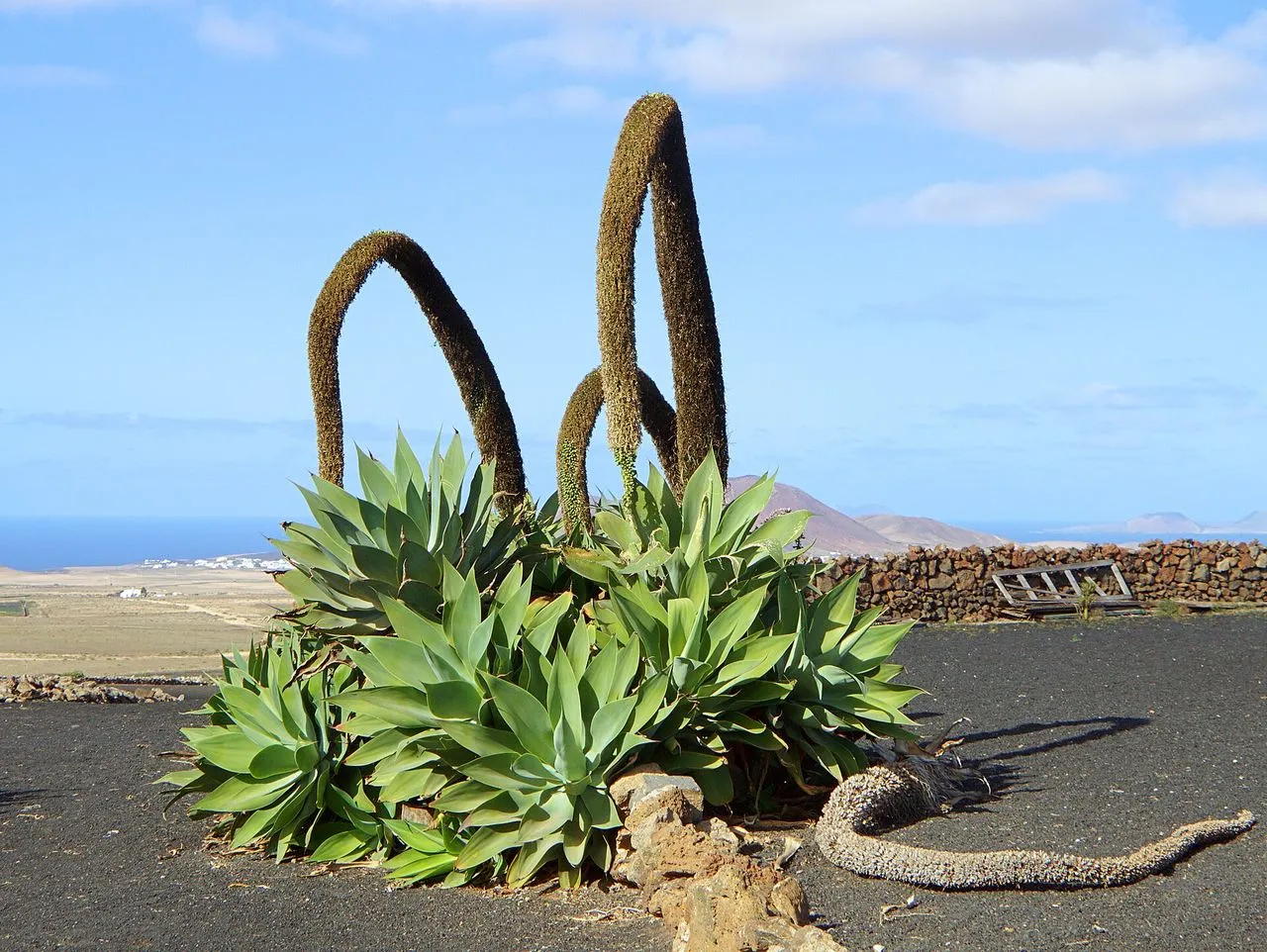
Agave attenuata Salm-Dyck (foxtail agave, lion's tail, dragon-tree agave) is the most widely grown spineless agave, distinguished by the smooth, unarmed leaf margins and arching inflorescence that gives the species its common name. It is native to the volcanic highlands of central Mexico, principally in the states of Jalisco and México, at elevations between 1,900 m and 2,500 m.
Taxonomically it sits in its own group Attenuatae, loosely allied to A. vilmoriniana and A. bracteosa, the other spineless or near-spineless species. In habitat it grows in open rocky outcrops and oak-woodland edges, receiving regular summer rainfall and relatively mild winters.
Part of the Complete Agave Guide.
Identification
- Leaves. Soft for an agave, broadly lanceolate, 50 cm to 80 cm long, pale glaucous grey-green to silvery, without marginal teeth and with only a vestigial, non-stabbing apical point. The leaf surface is pliable enough to bend without cracking, unusual in the genus.
- Rosette. Develops a visible upright trunk 1 m to 2 m tall with age, unlike the ground-hugging rosettes of most agaves. Eventual rosette diameter is 1 m to 1.5 m.
- Inflorescence. Densely flowered spicate raceme 2.5 m to 3.5 m long, initially upright then curving markedly downward under its own weight, from which the common name "foxtail" derives. Flowers are greenish-yellow.
The cultivar 'Nova' (sometimes sold as 'Boutin Blue') is a selected bluer-leaved form; 'Variegata' has white-striped leaves. Both are offset-propagated.
Cultivation
A. attenuata diverges from the pillar defaults in several important ways:
- Cold tolerance. Minimal. Leaves damage at 0 °C and the crown rots at any prolonged temperature below −2 °C. In any climate with hard frost it must be grown under glass or moved indoors for winter. This is the least cold-hardy common agave.
- Light. Prefers bright filtered light or morning sun rather than full midday sun in hot climates. The soft leaves scorch readily in unacclimated full summer sun, producing tan patches that remain for the life of the leaf. In cool maritime climates full sun is fine.
- Water. Tolerates more regular summer watering than drought-adapted agaves, reflecting its summer-rainfall habitat. Water weekly in active growth, withhold entirely below 10 °C.
Substrate as per the pillar. Because of the aerial trunk, tall specimens become top-heavy in small containers; use weighted or wide-based pots for mature plants.
Propagation
Offsets form prolifically along the rhizomes and at the base of the trunk once the rosette is established. Sever pups with a clean blade, callus for 5 to 7 days, and pot up in dry mineral substrate. Rooting is typically complete in 3 to 5 weeks.
Unusually for the genus, A. attenuata can also be propagated from stem cuttings. Sections of the trunk, 15 cm to 30 cm long, callus for two weeks and root reliably in pumice if kept warm and barely moist. This is useful when rejuvenating a fallen-over specimen with a bare lower trunk.
Bulbils form on the spent inflorescence in abundance and root easily, as described in the pillar.
Notes
The absence of leaf spines makes this the agave for households with children or pets, poolside plantings, and pedestrian traffic areas, where a spiny A. americana would be a liability. For the same reason it is popular in coastal resort landscaping in warm temperate regions from California to Australia.
Horticultural confusion is common between A. attenuata and A. pedunculifera, a narrower-leaved sister species also occasionally sold as foxtail agave. If the inflorescence is strictly erect rather than arching, the plant is likely A. pedunculifera.
For a companion spineless species that stays under 50 cm and handles cooler winters, see Agave bracteosa.
See also: Agave vilmoriniana, Agave americana, Agave parryi.
Frequently Asked Questions
Is Agave attenuata spineless?
Yes. The leaf margins are smooth and the apical point is vestigial and non-stabbing, which makes it useful near paths and pools.
How cold-hardy is Agave attenuata?
It is the least cold-hardy common agave. Leaves damage at 0 °C, and the crown rots under prolonged temperatures below −2 °C.
Does Agave attenuata need full sun?
It prefers bright filtered light or morning sun in hot climates. Unacclimated full summer sun scorches the soft leaves permanently.
How do you propagate Agave attenuata?
Use offsets, trunk cuttings, or bulbils from the spent inflorescence. Trunk sections 15 cm to 30 cm long can root in pumice when warm.