| Question | Short Answer |
|---|---|
| How large does Agave americana get? | A mature rosette reaches 1.5 m to 2 m across, and the surrounding pups can occupy a 4 m footprint or more. |
| Is Agave americana really a century plant? | No. |
| How cold-hardy is Agave americana? | Leaf damage begins around −4 °C and severe tissue loss around −8 °C. |
| How should variegated Agave americana be propagated? | Use offsets only. |
Agave americana L. (century plant, maguey) is the type species of the genus and the plant most people picture when they hear the word agave. It is native to the semi-arid uplands of northeastern Mexico and has naturalised widely across the Mediterranean basin, southern California, and parts of southern Africa, where it is now a landscape staple and in some regions a problematic invader.
Within the genus, A. americana sits among the large paniculate-inflorescence species, alongside A. palmeri and A. salmiana. In habitat it occupies rocky limestone slopes between 1,000 m and 2,400 m, producing mature rosettes 1.5 m to 2 m across and flowering spikes of 6 m to 9 m.
Part of the Complete Agave Guide.
Identification
- Leaves. Grey-blue to glaucous, 1 m to 2 m long, lanceolate, with a distinctly recurved profile. Margins bear stout brown teeth 3 mm to 8 mm long, spaced 2 cm to 4 cm apart, and a dark terminal spine 3 cm to 5 cm long.
- Rosette. Solitary in youth, eventually producing vigorous basal offsets from rhizomatous connections up to 3 m from the parent. A single mature rosette with its surrounding pups occupies a footprint of 4 m or more.
- Inflorescence. Paniculate, 6 m to 9 m tall, with 15 to 30 lateral branches bearing yellow tubular flowers. Emerges after 10 to 30 years in cultivation, not a century.
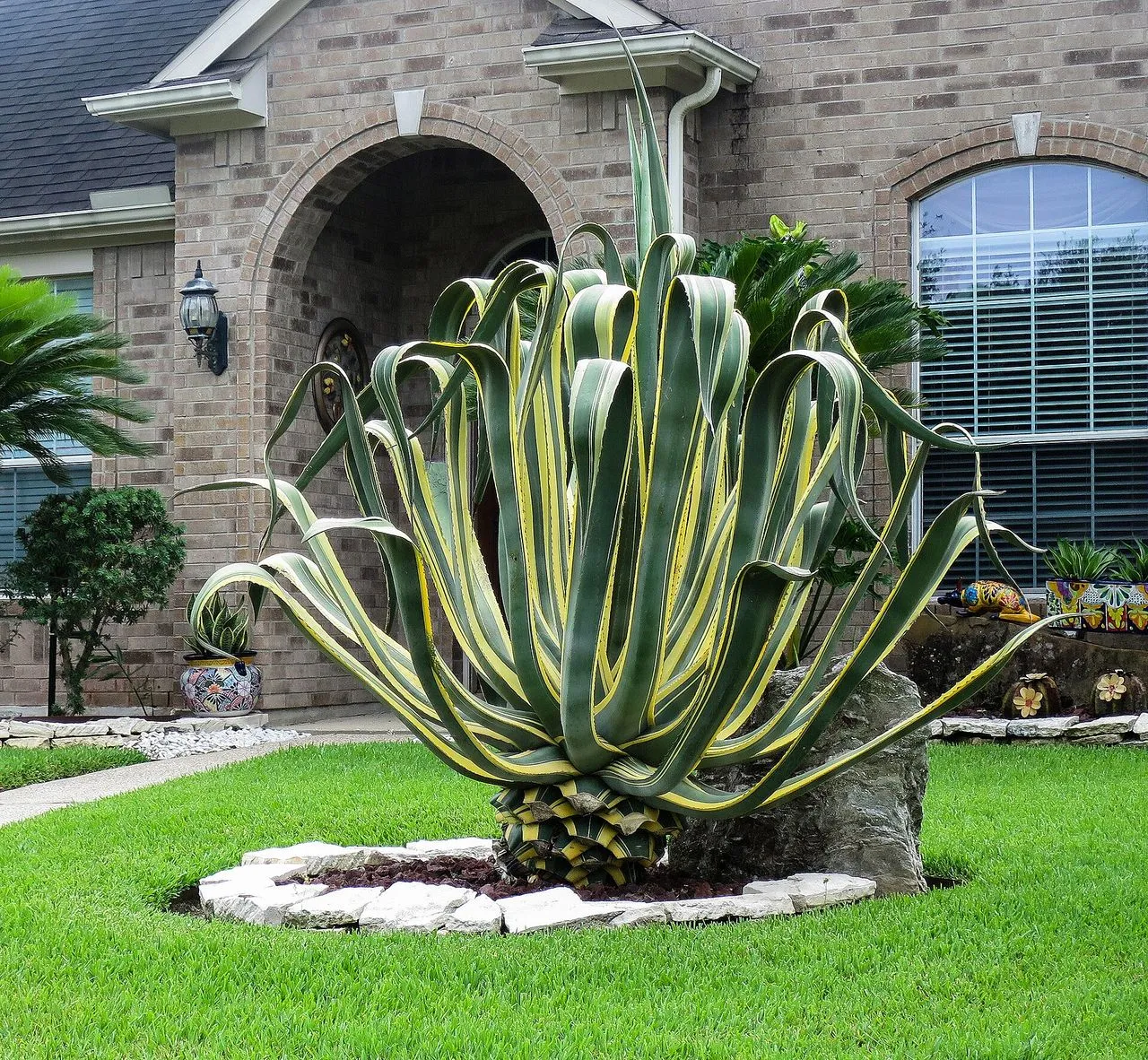
Two ornamental cultivars dominate the trade. A. americana 'Marginata' has broad yellow leaf margins; 'Mediopicta Alba' has a central creamy-white stripe. Both are clonally propagated from offsets and do not come true from seed.
Cultivation
Cultivation mostly follows the pillar defaults. The points where A. americana diverges:
- Space. This is not a pot plant for the long term. A mature rosette will eventually outgrow any domestic container and must either be planted out or regularly divided. In Mediterranean climates it performs as a landscape specimen without irrigation once established.
- Cold tolerance. Leaf damage begins at about −4 °C and severe tissue loss at −8 °C. The crown survives brief dips to −10 °C in dry soil but rots readily in wet cold. In USDA zones 7 and colder it is a conservatory plant only.
- Invasiveness. In Mediterranean coastal regions A. americana has escaped cultivation and displaces native flora. Check local regulations before planting outdoors; some Spanish autonomous regions and Australian states restrict it.
Soil and water follow the standard agave regime. If anything it tolerates more water in summer than the smaller species, provided drainage is sharp.
Propagation
Offsets are produced prolifically once the rosette reaches about 50 cm across. Sever them with a spade or sharp knife where the underground rhizome meets the pup, leaving any rootlets intact. Callus for a week in shade before potting or planting out. Variegated clones must be propagated from offsets only; seed-grown plants revert to the plain-green wild type.
After flowering the parent dies over 6 to 12 months; leave it standing until the leaves are fully desiccated, then cut the spike at the base. Bulbils form on the old flower stalk in some years and can be potted up as described in the pillar.
Notes
The sap of A. americana is a skin irritant, containing calcium oxalate raphides and saponins. Prolonged skin contact during pruning causes contact dermatitis in a significant fraction of handlers; wear long sleeves and eye protection. The sap also stains clothing a persistent rust-brown as it oxidises.
Taxonomic confusion is common between A. americana and A. salmiana subsp. crassispina, the latter being the principal species for pulque production. A. salmiana has broader, more incurved leaves and shorter marginal teeth. Nursery stock labelled "century plant" in North American trade is almost always A. americana, but in Mexican horticulture it may be either. For winter care of large outdoor specimens, see Agave winter damage for the wet-cold conditions that threaten even partially hardy species.
See also: Agave victoriae-reginae, Agave parryi, Agave tequilana.
Frequently Asked Questions
How large does Agave americana get?
A mature rosette reaches 1.5 m to 2 m across, and the surrounding pups can occupy a 4 m footprint or more. The flower spike rises 6 m to 9 m.
Is Agave americana really a century plant?
No. It usually flowers after 10 to 30 years in cultivation, then the parent rosette dies over 6 to 12 months.
How cold-hardy is Agave americana?
Leaf damage begins around −4 °C and severe tissue loss around −8 °C. The crown can survive brief dry dips to −10 °C, but wet cold causes rot.
How should variegated Agave americana be propagated?
Use offsets only. Seed-grown plants from variegated clones usually revert to the plain-green wild type.