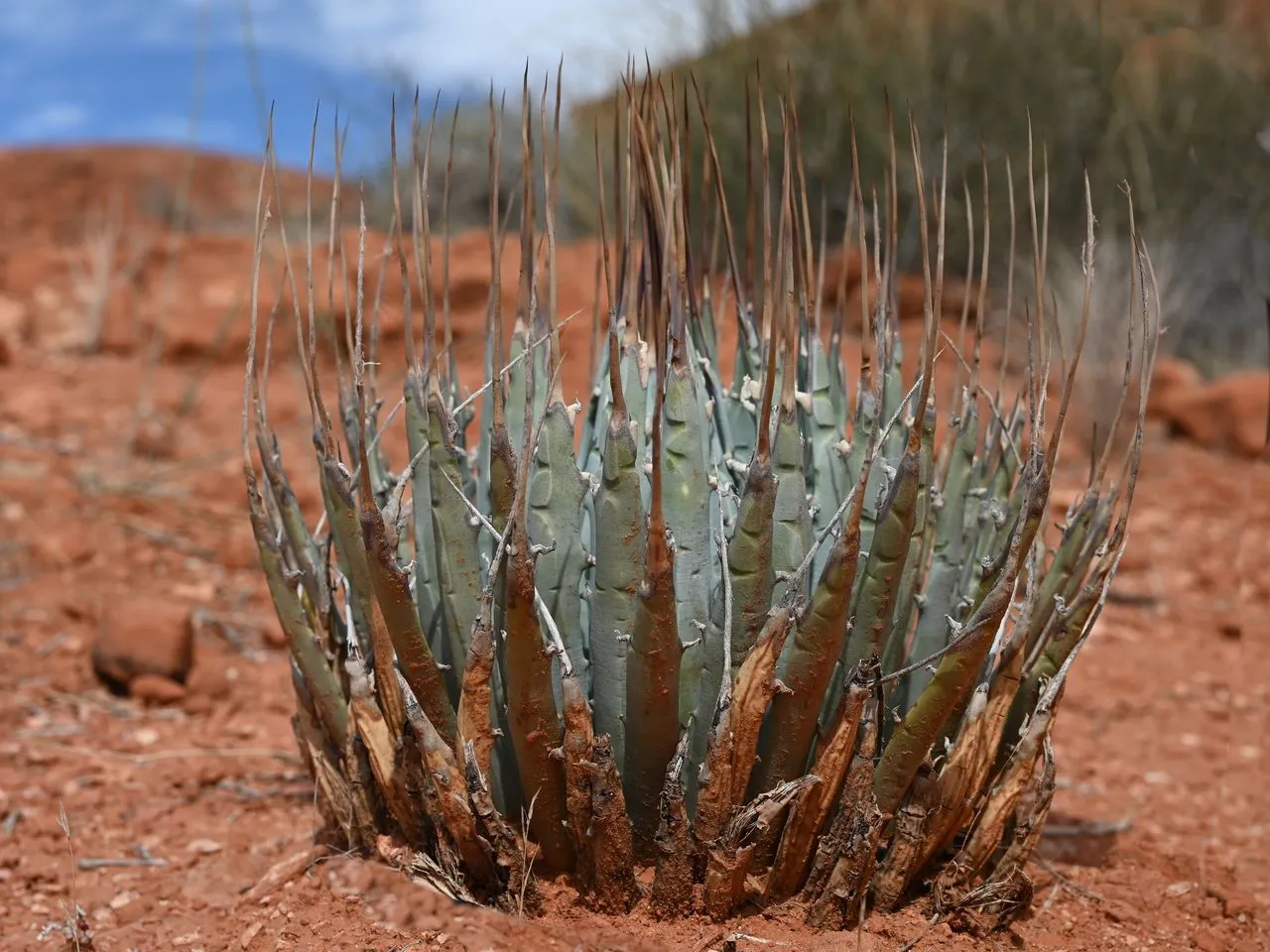
Agave leaves are rigid by design. The leaf structure is a marvel of fibrous engineering: vascular bundles run from base to tip, holding water in mesophyll cells that maintain internal pressure — turgor — which keeps each leaf stiff enough to carry a terminal spine upright for a decade or more. When that pressure drops below the threshold needed to maintain rigidity, the leaf curls: bowing inward along the midrib, folding lengthwise, or rolling at the margins. This is the plant signalling that water supply has failed at some point in the system.
The important diagnostic step is identifying where the failure is. Drought in the root zone, dead or damaged roots, cold-induced hydraulic slowdown, and substrate problems all produce similar curling but require very different responses. Getting the diagnosis wrong — particularly watering heavily when root damage is the cause — can accelerate the problem rather than correct it.
Part of the Complete Agave Guide.
Acute drought stress
The most straightforward cause. When the root zone becomes completely dry, the plant draws on water stored in its own leaf tissue. Agave is remarkably drought-tolerant because of this reserve, but the reserve is not infinite. Once leaf cells contribute water to the plant's metabolic processes faster than roots can supply it, turgor drops and the leaf deforms.
Drought curling typically starts at the oldest outer leaves, which have the lowest reserve and the greatest surface area exposed to evaporation. The curling is usually longitudinal — the leaf bows or folds along its length rather than twisting — and the leaf surface may feel slightly softer than normal without any discolouration. If the substrate is rewetted thoroughly, leaves return to their rigid posture within 3 to 7 days as root cells rehydrate the tissue.
In containers, drought is easy to confirm: lift the pot. A bone-dry container with a curling plant needs water. Water thoroughly until runoff exits the drainage holes, empty the saucer, and allow the substrate to drain completely. Do not water again until the pot is light and dry to the bottom.
Root damage from overwatering
Counterintuitively, root rot produces the same curling symptom as drought — because the mechanism is the same. When roots are killed by prolonged waterlogged conditions, the plant can no longer move water from the substrate into the leaves even if water is present. The leaves curl because the hydraulic supply has been severed at the root, not at the substrate.
The diagnostic difference is the pot weight. A heavy, wet container with a plant showing curled leaves points immediately to root damage rather than drought. Unpot the plant and inspect the roots. Healthy Agave roots are pale tan to white, firm, and faintly smell of damp mineral soil. Roots killed by wet conditions are brown to black, hollow, soft, and may smell sour or fermented.
Cut all dead roots back to firm tissue with a sterile blade. Allow the plant to dry bare-root for 5 to 10 days in a shaded location before re-potting into a fresh, dry mineral mix. Do not water again for at least 7 days. Leaves may remain curled for 2 to 4 weeks while a new root system establishes. Improvement shows as new central leaf growth, not immediate leaf-uncurling.
Cold-induced hydraulic failure
Water movement through plant vascular tissue is driven partly by evaporative pull from the leaves and partly by root pressure; both processes slow dramatically in cold conditions. Below approximately 5 °C, water moves through agave roots slowly. Below 0 °C, it stops. Even cold-hardy species like Agave parryi can show temporary leaf curling during a sudden temperature drop, particularly if the plant has been watered recently and the root zone is cold and wet.
Cold curling is temporary if the plant is hardy to the experienced temperature and the roots are dry. Move the plant to a warmer, dry location, do not water, and leaves will regain rigidity as temperatures rise. The risk is conflating cold-curled leaves with drought and watering a plant that is already cold and wet — that combination is the primary cause of crown rot and root failure.
Tender species such as Agave attenuata and A. tequilana may curl and then blacken if temperatures fall below 0 °C. In those cases, the curling is not recoverable; it is the first stage of freeze damage. The key distinguishing factor is whether the leaf tissue is still firm under the curled surface (recoverable) or has already lost structural integrity and is becoming soft (damage).
Transplant shock and root disturbance
Repotting disrupts the fine root hairs through which most water and nutrient uptake occurs. Even a careful repot in a mineral mix removes some functional roots, and the plant may show modest leaf curling for 7 to 21 days while new root hairs form. This is not a problem and does not require intervention beyond keeping the plant in bright, warm conditions with low initial watering.
The curling in transplant shock is mild and confined to newer central leaves — unlike drought, which affects outer leaves first. If curling is severe after repotting, or if it does not improve within 3 weeks, unpot again and check for root damage that occurred during the process.
Purchased plants that have been shipped are in extended transplant shock. The root zone may be compressed, damaged, or barely present. Allow several weeks of establishment before expecting the leaf posture to stabilise, and do not start a heavy watering regime immediately.
Substrate compaction and waterlogging
Old, organic-heavy substrate can compact over time into a dense matrix that holds water for weeks and restricts oxygen to roots. Agave grown in compost-heavy mixes in cold or shaded conditions are at particular risk. The substrate may feel moist but be largely anaerobic, killing fine roots progressively while appearing normal at the surface.
A plant in a compact dense mix with curling leaves that does not respond to normal watering adjustments should be unpotted. Replace the substrate with a mineral mix of 60% pumice or lava grit, 25% coarse sand, and 15% loam. Use a pot with drainage and size it only slightly larger than the root ball. A correctly aerated mix allows the roots to dry between waterings and prevents the slow root attrition that produces chronic curling.
How to identify the cause of leaf curling
| Observation | Likely cause | Key differentiator |
|---|---|---|
| Light dry pot, outer leaves curl | Drought stress | Water thoroughly; leaves should straighten within a week |
| Heavy wet pot, leaves curl | Root rot | Unpot and inspect roots for black or sour tissue |
| Curling after a cold snap, firm leaves | Cold hydraulic slowing | Warm and dry; leaves should recover |
| Curling after a cold snap, soft leaves | Freeze damage | Tissue is dying; assess crown firmness |
| Mild curling after repotting | Transplant shock | Wait 2 to 3 weeks with minimal water |
| Curling with substrate that never dries | Compaction or waterlogging | Change substrate and pot size |
Risk and severity
Act immediately when curling leaves are accompanied by soft, black, or sour-smelling tissue at the base or crown. That combination indicates rot is active, not just water stress. Unpot and cut back roots without waiting. Do not water. Isolate the plant if other agaves are nearby.
Wait when curling is mild, the plant is dry, and the cause is clearly identifiable as drought or cold. A firm agave can tolerate temporary turgor loss without lasting damage. Professional intervention is rarely needed, but large landscape specimens showing multiple curled leaves after frost may require professional assessment if the crown cannot be safely accessed.
Solutions
For drought curling
Water thoroughly, once, until runoff exits the drainage hole. Empty any saucer. Do not water again until the substrate is dry to the bottom. Supplement with a move to brighter, warmer conditions if the season allows. Repeat thorough watering only when the pot weight confirms dryness.
For root damage
Remove all old substrate, cut dead roots back to firm, pale tissue, and allow bare-root drying for 5 to 10 days. Re-pot in a dry mineral mix. Start watering cautiously after 7 days, and resume normal care only after new leaf growth appears at the centre.
For cold stress
Move plants to a warmer location above 10 °C. Do not water until the root zone is at or above 15 °C and the substrate is dry. For frost-damaged species, assess crown firmness before taking any further action. A loose central spear after a cold event signals crown rot, not just curling.
For transplant shock
Keep the plant bright and dry for the first week, then water once carefully. Do not disturb roots again. Allow 3 to 6 weeks for re-establishment. If no improvement shows after 6 weeks, unpot and inspect the roots for persistence of damage.
Prevention
Water agaves based on pot weight and substrate dryness, not on a schedule. A mineral mix that dries within a predictable interval for your climate prevents chronic moisture problems. Container sizes should be appropriate to the root ball — not decoratively oversized. Protect tender species from temperatures below their cold tolerance in advance of cold fronts.
When acclimating outdoor plants to the active growing season in spring, reintroduce watering gradually as temperatures at root level rise above 15 °C. A plant emerging from cool, dry winter conditions needs warmth in the root zone before the first substantial watering of the season. This prevents cold, wet roots from losing function just as the plant attempts to begin growth.
See also
- Agave brown tips — tip desiccation that accompanies severe drought stress and often appears alongside curling.
- Agave leaves yellowing — colour changes that typically follow root damage and confirm curling is pathological.
- Agave not growing — when curling and arrested growth occur together after root loss.
- Agave winter damage — cold-induced curling and freeze triage for affected rosettes.
Frequently Asked Questions
Can agave leaves uncurl after drought stress?
Yes. If roots are intact and the substrate is rewetted thoroughly, curled leaves typically return to their normal rigid posture within 3 to 7 days.
Why are my agave leaves curling inward after repotting?
Transplant shock reduces root function for several weeks. The plant may curl modestly while new root hairs form. Keep it bright and dry at first, then water lightly after 7 to 10 days.
Do cold temperatures cause agave leaves to curl?
Yes. Water movement through plant tissue slows dramatically below 5 °C, and some species show temporary leaf curling during cold snaps even without actual frost damage.
Is leaf curling in agaves reversible?
If caused by drought or cold, yes — once normal water supply is restored, leaf tension returns. If caused by severe root rot, the leaf may not recover until a new root system establishes.