| Question | Short Answer |
|---|---|
| Can an etiolated agave rosette return to its compact shape? | No. |
| How do I know if my agave is etiolated or just a naturally tall-growing species? | Etiolated leaves are narrower than species-typical width and paler than normal. |
| Can grow lights fix agave etiolation? | A strong grow light positioned 20 to 30 cm above the rosette providing the equivalent of 40,000 lux can halt further etiolation and produce compact new growth. |
| What is the minimum light level for compact agave growth? | In practice, at least 6 hours of direct sun or 40,000 to 60,000 lux of artificial light is needed for most species. |
An agave grown in insufficient light does not look like a stressed plant in any dramatic sense — it does not wilt, yellow quickly, or collapse. It simply grows wrong. Leaves emerge longer, narrower, and paler than species-typical form. Spacing between leaf insertions on the stem may become visible where it should not be. The rosette loses the tight, geometric character that makes Agave distinctive. This process is etiolation, and it is entirely driven by light deprivation.
The problem is durable. Unlike soft succulents where etiolation may be partially corrected by beheading and re-rooting a compact new top, agave leaves once formed are fixed structures. A leaf that emerged elongated under low light will remain elongated for the decade or more it persists on the rosette. The correction happens only in future growth, which is why preventing etiolation matters far more than responding to it.
Part of the Complete Agave Guide.
How light drives agave leaf form
In full-sun conditions, agave leaves develop with the thickness, width, and structural density that characterises the species. The photosynthetic machinery is running at or near capacity, sugars are produced at a high rate, and the tissue built from them is dense and compact. The leaf has the resources to construct full-width mesophyll layers, heavy fibrous vascular bundles, and a thick waxy cuticle.
In low light, photosynthate production drops. The plant still needs to extend new leaves toward available light — this is the adaptive response that etiolation represents, and it is the correct response in a plant's natural context of shading by neighbouring vegetation. Leaves are produced quickly but with less material per unit length. The result is an elongated leaf with a narrower profile, thinner walls, less fibrous density, and often reduced pigmentation. The epidermal wax may also be thinner, making the leaf slightly shinier than normal.
For a genus that naturally forms dense fibrous structures designed to store water and resist mechanical stress for years, etiolated leaves are structurally weaker than normal and more susceptible to physical damage, pest access, and dehydration during drought.
What etiolation looks like on agave
The earliest sign is often subtle: new central leaves are slightly longer and narrower than the previous ring. At this stage, without a reference plant or species photograph, it may not be obvious. As the light deficit continues, the difference becomes unmistakeable.
Visible stem elongation — internodal stretching — is the most unambiguous sign. Agave rosettes in proper light conditions have a compressed stem that is entirely hidden within the leaf bases; no bare stem should be visible between successive leaf attachments. When internodes stretch, a pale or slightly woody section of stem becomes visible between leaf bases, and the rosette takes on a tower-like rather than a flat or dome-like form.
Leaf colour is a supporting indicator. Normal agave leaves in full sun are glaucous grey-green, blue-grey, or dark green depending on species. Etiolated leaves are often lighter, more yellow-green, and may lack the characteristic waxy bloom. Species with strong terminal spine pigmentation may show reduced spine development in the etiolated state, because the fibrous tissue that forms and supports the spines develops inadequately under low light.
Marginal teeth on species that normally carry them may be reduced, smaller, or more widely spaced on etiolated leaves. This is a reliable indicator in species like Agave americana and A. salmiana where tooth development is normally bold and regular.
Distinguishing etiolation from species variation
Not all elongated agaves are etiolated. Some species have naturally open or tall forms:
- Agave attenuata has relatively soft, wide, grey-green leaves that arch outward in an open form — this is species-typical, not light deficiency.
- Agave stricta has long, narrow, rigid leaves in a globe-like form — again, species character.
- Agave vilmoriniana has long, curved, narrow leaves in a loose rosette — normal form for the octopus agave.
Compare new growth against reference photographs of the species in full sun. The diagnostic criteria are: is the leaf narrower than species-typical width? Is visible bare stem present between leaf bases where it should not be? Is the colour paler or more yellow-green than expected for the species? If the answer to all three is yes, etiolation is likely regardless of species identity.
A useful calibration: if the plant was purchased from a shaded garden centre bench or has been kept indoors near — but not on — a window since acquisition, light deficiency should be the first hypothesis.
Why indoor growing produces almost all cases
Outdoor agaves in temperate climates sometimes etiolate when grown against a shaded fence or in a deep courtyard, but the overwhelming majority of etiolation cases occur indoors. The physics explain why clearly. Direct outdoor sun at midday in summer delivers 80,000 to 100,000 lux. A south-facing windowsill in the same conditions may deliver 10,000 to 30,000 lux because the glass filters ultraviolet and infrared radiation, the angle reduces intensity, and the field of view is restricted to a portion of the sky rather than the whole hemisphere.
Move 1 m back from the glass and light levels drop by a factor of 4 to 10. At 3,000 to 5,000 lux — common in living room conditions away from windows — an agave can survive indefinitely but cannot grow compactly. It produces leaves, but they are weak, pale, and elongated.
The seasonal factor compounds this problem. In winter at temperate latitudes, even a south-facing window receives fewer than 5,000 lux on overcast days, and day length may provide only 4 to 6 hours of any meaningful light at all. An agave that holds its compact form through summer often begins etiolating visibly between October and March, with the damage appearing in the following growing season's new leaves.
Risk and severity
Etiolation is not an emergency. A leggy agave is not in acute danger; it is simply growing incorrectly. Act when new central leaves are noticeably thinner and longer than the previous ring, when any visible bare stem appears between leaf bases, or when the plant is indoors and cannot be moved to a brighter position within the next 4 weeks.
The urgency is proportional to how long the plant will continue generating deformed leaves. A plant that will spend another 6 months in low light will have substantially more distorted tissue than one moved this week. Since each deformed leaf persists for years, the cumulative effect on a slow agave is significant.
Solutions
Move to appropriate light
The primary correction is a move to better light. Outdoors in full sun is the ideal endpoint for most Agave species. The target is at least 40,000 lux for 6 or more hours per day during the growing season. If the plant cannot go outdoors, a south-facing windowsill with no net curtain, in a room without close obstructions, is the best available indoor option.
Critical: acclimate the transition. An etiolated plant has leaves constructed for low-light conditions — thin cuticle, reduced wax, lower pigment density. Moving it directly into full summer sun, particularly afternoon sun above 60,000 lux, will cause surface scorch on those leaves within hours. The scorch will be permanent. Move the plant to morning sun only (east exposure or filtered south) for 2 to 3 weeks before introducing it to unfiltered afternoon exposure. A scorch scar on an already-distorted leaf compounds the problem without correcting it.
Grow lights
A high-output LED grow light positioned 20 to 30 cm above the rosette can provide sufficient light for compact growth where outdoor placement is not possible. Lights rated at a photosynthetic photon flux density (PPFD) equivalent to 40,000 to 60,000 lux in the PAR range are appropriate. Run for 12 to 14 hours per day during the growing season. Grow light use halts further etiolation and produces compact new leaves, but does not correct existing distorted tissue.
Position the light directly above the rosette rather than at an angle, to prevent the plant bending toward the light source and producing asymmetric growth.
Accepting permanent distortion
Once the plant is receiving adequate light and producing compact new central leaves, the etiolated outer leaves remain on the plant. They are not a practical problem — they function as normal leaves, photosynthesize at a lower rate, and will eventually senesce and be shed. The rosette will look asymmetric during the transition period as compact new leaves emerge alongside older elongated ones. This period lasts until enough normal leaves have replaced the etiolated ring, which may take 2 to 5 years in a slow species such as Agave parryi or A. victoriae-reginae.
No beheading, pruning, or other intervention is appropriate for agave etiolation. The plant cannot be re-rooted from a cut top as many soft succulents can. The rosette grows from a single meristem; cutting it destroys it.
Prevention
Assess light availability before acquiring any agave. Measure with a phone lux meter app or a dedicated device at different times of day in the intended growing position. If the location delivers fewer than 20,000 lux for most of the day, choose a shade-tolerant genus. Agave is not shade-tolerant; it etiolates reliably under indoor conditions that sustain most other succulents.
If growing under glass, choose the sunniest face of the structure and do not shade agaves unless temperatures exceed 45 °C. In winter, either move agaves to the brightest available position or accept dormancy with no new growth. A dormant plant in adequate light is better than a plant producing etiolated growth in poor light.
Rotate pot-grown agaves quarterly to equalise light on all sides of the rosette. Asymmetric growth is common when only one face receives good light; rotation prevents one side etiolating while the other remains compact.
See also
- Agave not growing — when low light arrests growth entirely rather than distorting it.
- Agave brown tips — tip damage that can follow post-acclimation scorch when etiolated leaves are moved into full sun.
- Agave attenuata — a naturally open-form species where normal morphology is commonly mistaken for etiolation.
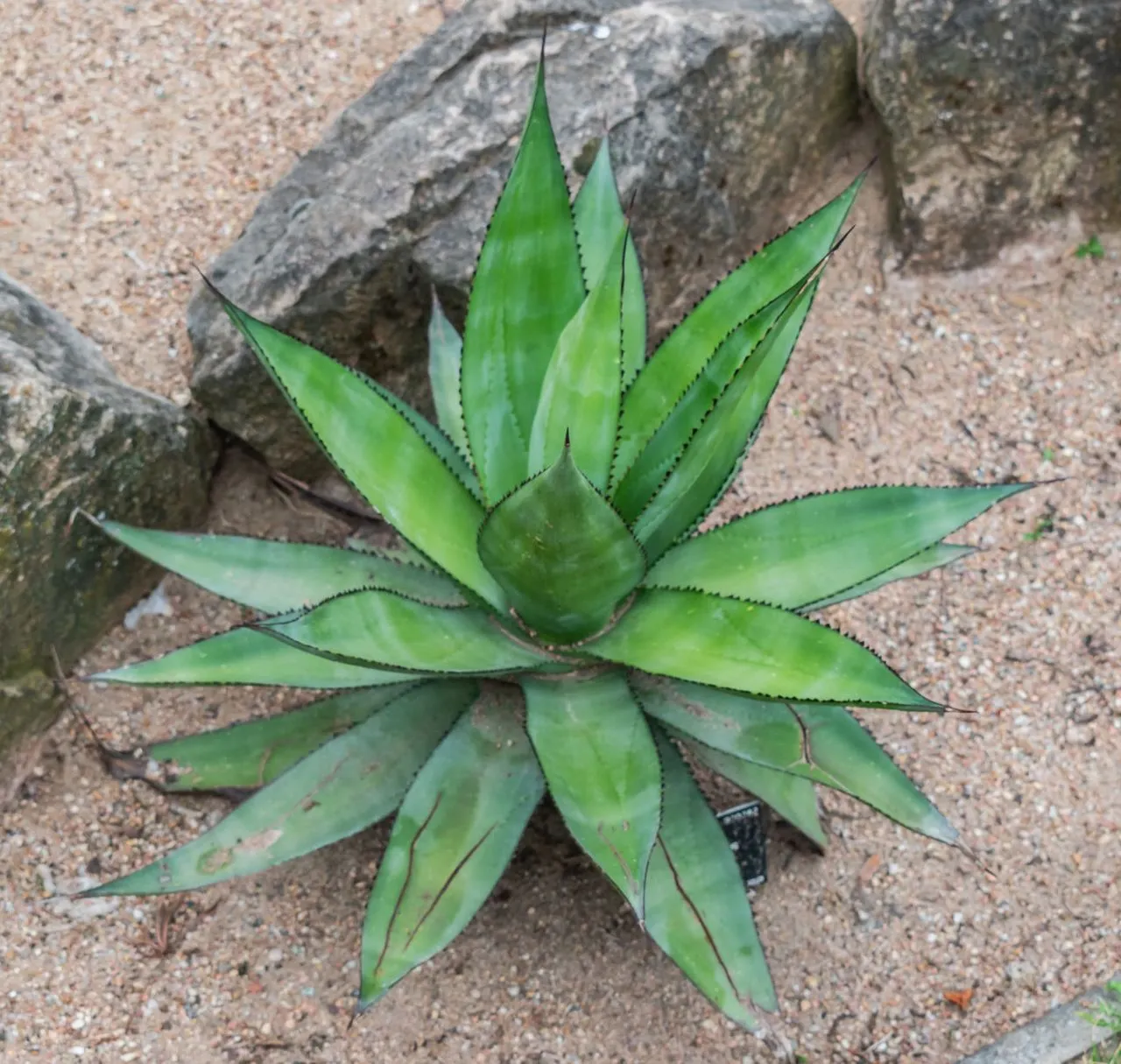
- Agave parryi — a compact species that illustrates normal agave rosette geometry under adequate direct sun.
Frequently Asked Questions
Can an etiolated agave rosette return to its compact shape?
No. Distorted leaves that formed under low light do not shrink or recompact. Improvement appears only in new leaves produced after the move to better light. The etiolated leaves remain until they age out naturally.
How do I know if my agave is etiolated or just a naturally tall-growing species?
Etiolated leaves are narrower than species-typical width and paler than normal. A naturally tall species maintains its characteristic colour, leaf thickness, and spine development. Compare to reference images of the species in full sun.
Can grow lights fix agave etiolation?
A strong grow light positioned 20 to 30 cm above the rosette providing the equivalent of 40,000 lux can halt further etiolation and produce compact new growth. It will not correct existing distorted leaves.
What is the minimum light level for compact agave growth?
In practice, at least 6 hours of direct sun or 40,000 to 60,000 lux of artificial light is needed for most species. Below 20,000 lux, leaves broaden less and produce a stretched appearance over time.