| Question | Short Answer |
|---|---|
| Do spider mites leave webbing on agaves? | Yes. |
| Can spider mites kill an agave? | Heavy infestations weaken the plant by piercing leaf cells and removing cell contents. |
| Are agaves more susceptible to spider mites than other succulents? | Agaves are not uniquely susceptible, but their enclosed leaf axils and concave central cups provide sheltered microhabitats that mites exploit, making infestations harder to detect and treat. |
| What temperature kills spider mites? | Spider mites are suppressed above 40 °C and killed at sustained temperatures above 45 °C, but this is not a practical treatment for agave. |
Spider mites — most commonly Tetranychus urticae, the two-spotted spider mite — are among the most easily overlooked pests on agave. They are small enough that early infestations are invisible to the naked eye, and the damage they leave resembles abiotic problems: pale speckling, slightly dulled leaf surfaces, and occasional bronze or silvered patches. By the time webbing is clearly visible in the axils, the population is already substantial.
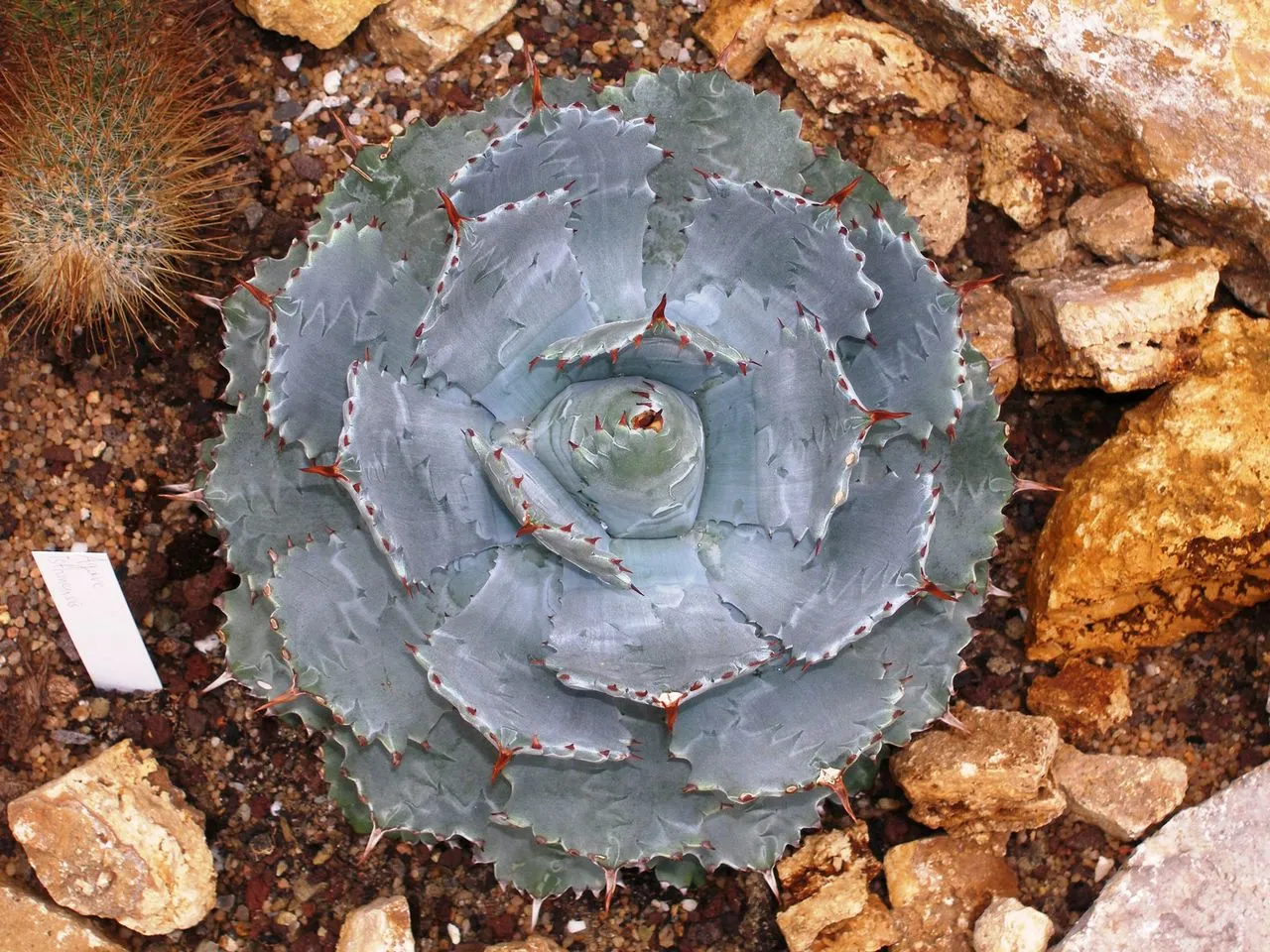
Agaves create good mite habitat. The enclosed angles between successive leaves, particularly in tight compact rosettes, offer shelter from wind and from predatory insects. Under glass or indoors — with low humidity, elevated temperatures, and poor air movement — mites thrive and reproduce rapidly. A single female can lay 100 to 200 eggs across her lifespan of 2 to 4 weeks; populations can reach damaging levels within a single warm month.
Part of the Complete Agave Guide.
How spider mites feed and why agave is vulnerable
Spider mites are arachnids, not insects, and do not respond to standard insecticides. They feed by piercing individual leaf cells with their stylet mouthparts and removing cell contents. Each feeding site becomes a tiny pale or silvery puncture. At low density these punctures are scattered and barely visible. At high density they coalesce into continuous pale streaks or patches, and the leaf surface takes on a silvered, bronze, or grey cast as chlorophyll is destroyed across large areas.
The webbing spider mites produce serves as a structural scaffold for the colony, protection from contact-type sprays, and a dispersal path for young mites. On agave, webbing is most often found in the tight inner angles where leaf bases meet the stem, where it may initially be overlooked as white dust or wax deposits.
The fibrous surface of many agave leaves is less amenable to tight mite attachment than the smooth flat surfaces of softer succulents, but the rosette geometry compensates by providing deep, protected chambers between leaves where mites can complete their full life cycle undisturbed by wind or rain.
Identifying a spider mite infestation
Three diagnostic methods, in order of reliability:
Paper tap test. Hold a clean white sheet of paper under a suspicious leaf and tap the leaf firmly several times. Examine what falls. Spider mites appear as tiny specks — approximately 0.5 mm across, visible but barely — that move. Mite specks walk; dust and plant debris do not.
Magnification. A 10× hand lens or jeweller's loupe reveals individual mites on the leaf undersurface and in axil angles: they are oval, pale green to reddish brown, often with two darker spots on the body (T. urticae). Eggs are round, transparent or pale, and attached to webbing near leaf bases.
Webbing. Fine silk in the inner leaf angles or along the leaf undersurface is diagnostic of spider mites rather than any other agave pest. Mealybugs also produce white material in leaf axils, but it is cottony and three-dimensional rather than flat and film-like.
The speckling pattern of mite feeding is distinct from other causes of pale marks. Sun scorch is tan-to-white, fixed, and concentrated on exposed upper surfaces. Frost damage is usually basal or uniform. Mite speckling is silvery-grey, distributed across inner leaf surfaces, and most intense in areas sheltered from direct contact, exactly where mites feed undisturbed.
Why outbreaks happen
Spider mites are naturally suppressed by ambient humidity, by predatory insects and mites, and by air movement. The conditions that favour outbreaks are: temperatures above 25 °C, relative humidity below 40%, still air, and the absence of natural enemies. Collections kept under glass in summer, on heated indoor windowsills, or in drought-stressed conditions are the typical outbreak contexts.
Chemical treatments that kill beneficial insects — broad-spectrum insecticides used for other pest problems — can indirectly trigger mite outbreaks by eliminating the predator community that normally keeps mites in check. Plants treated recently with systemic or residual insecticides are paradoxically more susceptible to spider mite damage because their natural enemies have been removed.
A plant that is already stressed by root problems, drought, or poor light is more likely to sustain visible mite damage from the same population density. Strong, well-rooted plants in full sun with good air movement can tolerate a low mite presence without significant loss of leaf function.
Risk and severity
Act immediately when webbing is present in the crown, when speckling covers more than 20% of multiple leaf surfaces, or when the plant is already stressed by root problems or drought. A stressed plant with a mite infestation recovers poorly, and the combined damage from both stresses can set back growth by a full season or more.
Monitor without immediate alarm when speckling is limited to a few outer leaves and no webbing is visible. Check weekly and begin treatment at the first sign of spread or webbing.
Spider mites do not typically kill large, well-established agaves in a single season. The greater risk is cumulative: repeated seasons of mite damage reduce photosynthetic capacity, stunt new growth, and leave the plant less able to withstand other stresses. A small agave or a newly propagated offset is more vulnerable and should be treated at first confirmed identification.
Solutions
Physical disruption
Before any chemical treatment, physically disrupt the colony. For container plants, direct a firm stream of water between the leaf axils to dislodge mites and destroy webbing. Allow the plant to dry completely afterwards — do not leave standing water in the crown. This step alone reduces the population substantially and improves the effectiveness of subsequent miticide applications.
For very spiny species where washing between leaves is impractical, use a soft artist's brush to manually remove webbing from accessible angles, then follow with chemical treatment.
Miticide treatment
Standard insecticides — pyrethrins, neem oil applied as an insecticide, malathion — have limited effectiveness against spider mites. Use a product specifically labelled as a miticide or acaricide. Active ingredients registered for ornamental mite control include:
- Bifenazate — kills adults and nymphs rapidly; low residual period.
- Hexythiazox — primarily ovicidal; effective on eggs and early larvae.
- Abamectin — effective on all mobile stages; do not combine with bifenazate in the same application.
- Spiromesifen — effective on eggs and nymphs with some adult activity.
Apply thoroughly, reaching all leaf axils and inner surfaces. Repeat after 7 to 10 days to catch eggs that were not killed in the first application and have since hatched. A third application 7 to 10 days later completes the treatment cycle against late-hatching eggs.
Rotate between different active ingredients if the infestation is severe, to reduce the risk of resistance development. T. urticae develops resistance to acaricides rapidly in populations exposed to repeated single-chemical treatment.
Neem oil as a suppressant
Cold-pressed neem oil at 2 ml per litre, with a few drops of mild dish soap as an emulsifier, can suppress established mite populations and deter re-infestation when applied to all leaf surfaces and axils. Neem is not a rapid knockdown treatment; it works over days to weeks by disrupting mite feeding and reproduction. It is most useful as a follow-up to a miticide treatment or as a preventive measure at lower population densities.
Apply neem in the morning or evening, not in direct midday sun, to avoid the oil heating on the leaf surface and causing phototoxic burn on the exposed tissue.
Prevention
Improve air movement around the plant. Spider mites are suppressed by air currents that disrupt webbing and desiccate mobile life stages. A fan in a greenhouse or placing outdoor plants in a naturally ventilated position reduces outbreak frequency substantially.
Raise ambient humidity around susceptible collections in summer to 50 to 60%. This does not require misting the leaves; a water tray in the greenhouse or a nearby humidifier suffices. Mites reproduce slowly above 50% relative humidity, which is also a comfortable working level for the grower.
Inspect new plants before introducing them to a collection. Spider mites hitchhike readily on plant material, and a single infested new acquisition can seed an entire greenhouse within a month. The recommended practice is 2 to 4 weeks of quarantine isolation for all new arrivals.
After treating an infestation, avoid broad-spectrum insecticide use for the remainder of the growing season, allowing predatory mites and other beneficial arthropods to re-establish in the collection.
See also
- Spider mite identification — cross-genus identification guide with species and life-stage detail.
- Agave snout weevil — the more structurally destructive agave pest that threatens the crown and stem.
- Agave brown tips — other causes of pale marks and surface discolouration on agave leaf surfaces.
- Agave leaves yellowing — colour changes that can accompany heavy mite infestation or the root stress that worsens it.
Frequently Asked Questions
Do spider mites leave webbing on agaves?
Yes. Fine silken webbing is the most diagnostic sign of spider mites. On agave it concentrates in the tight angles where inner leaves meet the stem and along the concave inner surface of newer leaves.
Can spider mites kill an agave?
Heavy infestations weaken the plant by piercing leaf cells and removing cell contents. A large agave can sustain months of moderate infestation without dying, but small or already-stressed plants may show significant leaf damage and reduced growth.
Are agaves more susceptible to spider mites than other succulents?
Agaves are not uniquely susceptible, but their enclosed leaf axils and concave central cups provide sheltered microhabitats that mites exploit, making infestations harder to detect and treat.
What temperature kills spider mites?
Spider mites are suppressed above 40 °C and killed at sustained temperatures above 45 °C, but this is not a practical treatment for agave. They are also sensitive to cold and do not overwinter well below 5 °C outdoors.