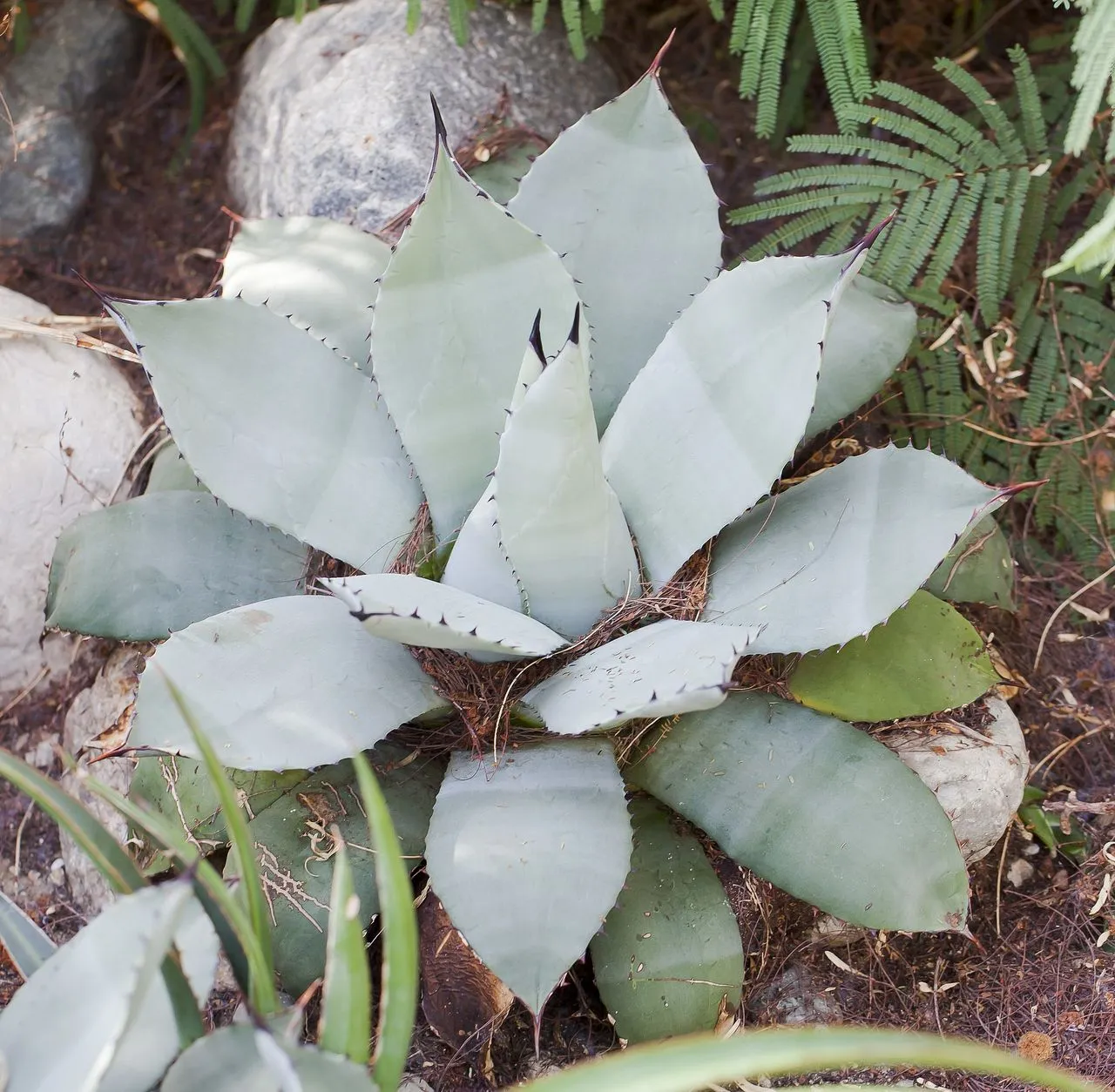
Brown tips on agaves are common because the leaf tip is the oldest, most exposed, and least forgiving part of each leaf. Wind, drought, salts, frost, and mechanical contact all register there first. Most dry brown tips are cosmetic. The plant is not dying because the last 5 mm of a rigid leaf has dried.
The serious cases are different: browning that spreads from the base, combines with yellow soft tissue, or follows a wet cold period. Diagnose before trimming. Part of the Complete Agave Guide.
Intermittent drought stress
Agaves tolerate drought by storing water in fibrous leaves, not by avoiding all water loss. During a long dry interval, the plant prioritises the crown and younger tissue. Leaf tips and outer margins may desiccate first, especially on container plants with restricted roots. The result is a dry brown point that may extend a few centimetres down the leaf.
This does not mean agaves want frequent sips. Light watering wets only the top of the pot and encourages shallow roots, while salts remain behind. The better correction is a thorough soak when the substrate is dry to the bottom, followed by complete drainage and another dry interval.
Salt accumulation and hard water
Container agaves can develop brown tips when dissolved salts accumulate in the potting mix. Fertiliser, hard tap water, and evaporative concentration all contribute. The highest salt concentration often occurs where roots are active and where water evaporates from the upper mix. Root tips are damaged, and leaf tips brown because water uptake becomes less efficient.
Salt stress is more likely when a plant is watered in small amounts, never flushed, or kept in a decorative outer pot where runoff is reabsorbed. White crust on the pot rim or substrate surface is a supporting clue. Agaves tolerate slightly alkaline conditions, but they do not benefit from a stagnant mineral load in a closed container.
Sun scorch on exposed tips
Agaves are full-sun plants once acclimated, but shaded leaves can scorch when moved abruptly into high summer light. The leaf tip and upper surface receive the strongest radiation. Damage begins as pale tan tissue, then dries to brown. It is fixed in place and does not move like rot.
This is common after buying greenhouse-grown plants and placing them immediately on a south-facing patio. The plant may ultimately need that exposure, but the existing leaves were built under lower light. Acclimation over 2 to 3 weeks prevents most tip scorch.
Frost and cold wind
Cold dry wind and frost can brown or blacken agave tips even when the centre survives. Tips lose heat quickly and freeze before thicker basal tissue. Hardy species show minor tip burn after unusual cold or wet snow; tender species can lose whole leaves. The distinction is whether the damage remains dry and terminal or progresses into the crown.
Do not cut frost-browned tips immediately. Wait until temperatures stabilise and tissue is dry. If the tip is only cosmetic, leave it. If a leaf has collapsed into wet brown tissue near the crown, remove it after the boundary between dead and live tissue is clear.
Root restriction and old substrate
A pot-bound agave with exhausted substrate may brown at the tips because roots cannot supply water evenly during heat or active growth. This is common in slow-growing species kept too long in nursery pots. The plant may look stable for years, then start browning tips whenever temperatures rise above 30 °C or the pot dries within a day.
Root restriction differs from simple drought because watering frequency increases but the plant still struggles. Slide the plant from the pot. If roots form a dense hard cylinder and the mix has collapsed into fine dust, repotting is the fix.
Mechanical damage and natural terminal spines
Many agaves naturally carry dark terminal spines. A brown or black point at the end of each leaf may be normal pigmentation, not damage. Separately, tips bruise when they strike walls, glass, paths, or neighbouring leaves. The injured point dries brown and remains sharp.
Mechanical browning is local and repeated in the direction of contact. If the same side of the plant faces a wall and every tip there is damaged, move the pot or give the landscape plant more clearance. Do not remove a terminal spine unless it is a safety hazard; cutting it changes the leaf permanently and leaves a blunt scar.
How to identify brown tip causes
| Pattern | Likely cause | Check |
|---|---|---|
| Dry brown points after long dry period | Drought stress | Pot weight, wrinkling, root depth |
| Brown tips plus white crust on mix | Salt buildup | Water source and fertiliser history |
| Tan-to-brown patches on sun-facing tips | Sun scorch | Recent move to stronger light |
| Brown or black tips after freezing weather | Frost injury | Species hardiness and crown firmness |
| Tip browning despite frequent watering | Root restriction | Dense circling roots |
| Uniform dark terminal points | Normal spine colour | Species character |
The safest dividing line is softness. Dry terminal browning is usually cosmetic. Soft browning connected to yellow leaves or wet bases needs root and crown inspection.
Risk and severity
Act immediately when brown tips are accompanied by soft yellow leaves, black basal tissue, sour smell, or a loose central spear. Those are not tip problems; they are rot or pest problems showing at the leaves.
Wait when the plant is firm and the browning is dry, terminal, and stable. A slow agave may carry the same scarred leaf for 5 to 15 years. Professional help is rarely needed for brown tips alone, but large sharp landscape plants may require careful pruning if tips project into paths.
Solutions
For drought-related tips
Water deeply only when the substrate is dry to the bottom. For containers, water until runoff exits the drainage hole, then empty any saucer. Outdoor plants in the ground should be watered at the root zone, not over the crown, and only during extended drought if the species and climate require it.
For salt buildup
Flush the pot with low-salt water during active growth, allowing several pot volumes to drain away. Do not do this in cold winter conditions. If the mix is old or crusted, repot into fresh mineral substrate. Feed lightly, if at all, and avoid high-nitrogen fertilisers.
For scorch or frost scars
Leave dry scars in place. Move recently scorched plants back to bright shade, then reintroduce sun gradually. Protect frost-sensitive species before the next cold event. Judge recovery by new central leaves.
For pruning hazardous tips
Use clean, sharp secateurs and cut only the dead dry point. Leave 2 mm to 5 mm of brown tissue between the cut and green leaf. Cutting into green tissue creates a fresh wound that often browns again along the cut edge.
Prevention
Use a free-draining mineral mix and water thoroughly rather than frequently. Let water leave the pot completely. If local water is hard, occasional rainwater or low-mineral water during active growth can reduce salt accumulation. Repot before the substrate compacts and before roots become a solid cylinder.
Acclimate agaves to sun and cold. A plant that spent winter under glass needs staged exposure in spring. Tender species need frost-free protection; hardy species need dry roots. Keep spiny rosettes away from walls, paths, and glass so the tips are not constantly broken.
See also
- Agave leaves yellowing — when tip browning is part of a broader root problem.
- Agave leaves turning black — how to separate dry scars from active rot.
- Agave victoriae-reginae — a compact species where tip and margin marks are visually obvious.
- Agave not growing — when tip damage coincides with root restriction or sustained poor light.
Frequently Asked Questions
Do brown agave tips turn green again?
No. Brown tip tissue is dead and remains as a scar until that leaf ages out. Recovery shows as clean new growth from the centre.
Can tap water cause brown tips on agaves?
Hard or salty water can contribute to brown margins in containers, especially when pots are watered lightly and salts accumulate near the root zone.
Should I cut brown tips off my agave?
Only trim dry dead points if they are a physical hazard. Leave a narrow brown margin and never cut into green tissue.
Are brown tips a sign of under-watering?
They can be, especially when leaves also wrinkle or fold. Brown tips alone are not enough; inspect roots, watering depth, and recent heat or frost exposure.