| Question | Short Answer |
|---|---|
| How big does Agave victoriae-reginae get? | Most mature rosettes reach 30 cm to 60 cm across and remain suited to long-term container cultivation. |
| What makes the white markings on Queen Victoria agave? | They are detached cuticle layers formed by bud imprints as leaves expand, not ordinary pigment. |
| How cold-hardy is Agave victoriae-reginae? | Dry plants survive about −9 °C to −12 °C, placing the species around USDA zone 8 in sheltered, drained sites. |
| How do you propagate Agave victoriae-reginae? | Seed is the usual route because the type form is often solitary. |
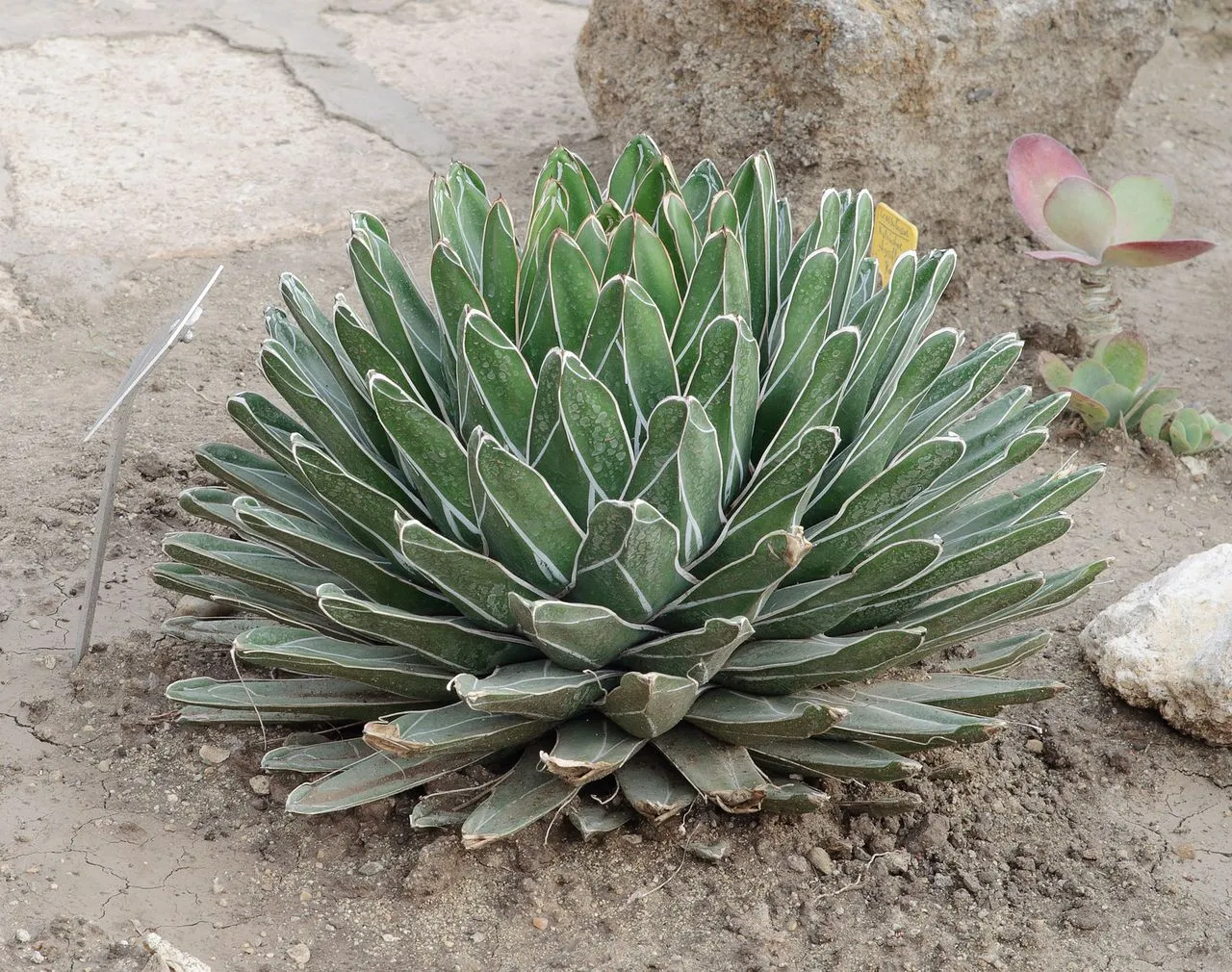
Agave victoriae-reginae T. Moore (Queen Victoria agave, royal agave) is one of the most collected small-to-medium agaves in ornamental horticulture, prized for the precise geometric rosette and the crisp white margin lines on each leaf. It is native to limestone cliffs and canyon slopes of the Chihuahuan Desert in the Mexican states of Coahuila, Nuevo León, and Durango, at elevations between 900 m and 1,700 m.
Taxonomically it belongs to the subgenus Littaea, group Marginatae, distinguished from the subgenus Agave by a simple spicate rather than paniculate inflorescence. Close relatives include A. nickelsiae (sometimes treated as a form of A. victoriae-reginae) and A. ferdinandi-regis.
Part of the Complete Agave Guide.
Identification
- Leaves. Short and thick, 15 cm to 30 cm long and 5 cm to 8 cm wide, dark green with striking white pencil-line markings along the margins and on both faces, tracing the bud imprints of adjacent leaves. Leaves are stiffly rigid and nearly triangular in cross-section.
- Rosette. Solitary in most forms, 30 cm to 60 cm across at maturity, perfectly hemispherical in profile. Offsets are rare in the type form, more common in some regional variants.
- Terminal spine. Black, 1 cm to 3 cm long, often with two or three smaller subsidiary spines at the leaf tip. Marginal teeth are absent or vestigial.
- Inflorescence. Spicate, 3 m to 5 m tall, densely flowered with cream to pale yellow flowers tinged purple.
The species is morphologically variable and several named forms exist in horticulture, including 'Compacta', 'Porcupine', and f. viridis (an all-green form without white markings). These are propagated from offsets where available and from careful selection of seed populations.
Cultivation
Cultivation differs from the pillar defaults principally in scale and tolerance:
- Cold tolerance. Moderate to good. Survives −9 °C to −12 °C when dry, placing it in USDA zone 8. In marginal zones it performs well under glass or in a sheltered raised bed.
- Light. Full sun in all climates, including hot desert sun. The densely arranged leaves protect the growth point from excessive heat.
- Water. Less water than the tropical agaves, reflecting its Chihuahuan Desert habitat. Water deeply, allow to dry fully, and repeat; in winter essentially withhold.
- Growth rate. Slow. A seed-grown plant takes 5 to 7 years to reach a presentable size and 20 to 40 years to flower.
The compact final size (rarely over 60 cm) makes this one of the few agaves genuinely suited to long-term container cultivation. A 20 cm pot will house a decade-old plant comfortably.
Container culture works best in a fully mineral, fast-draining substrate. A gritty mix such as Bonsai Jack succulent and cactus soil dries out quickly between waterings, which suits this species far better than peat-based potting soil. As an Amazon Associate, we earn from qualifying purchases, at no extra cost to you.
Propagation
Seed is the usual route, reflecting the solitary habit of the type form. Fresh seed germinates readily at 22 °C to 28 °C on a sterile pumice surface. Growth is slow but seedlings are unusually uniform and the species rewards patient seed-grown collections.
Where offsets do appear, typically in older specimens or in the offsetting forms, sever them as per the pillar and callus for at least 10 days before potting up. The thick basal tissue takes longer to seal than in thinner-leaved species.
Notes
A. victoriae-reginae has been overcollected from wild populations, and the species is listed as Near Threatened on the IUCN Red List. CITES Appendix II applies. Legal trade is confined to nursery-propagated plants with documented provenance. Any specimen offered cheaply as wild-collected is almost certainly trafficked and should be refused.
The white leaf markings result from detached cuticle layers formed by bud imprints as the leaves expand, not from pigmentation. The pattern is therefore as individual to each plant as a fingerprint, and the precise geometry of any given rosette cannot be replicated in a sibling.
If you are starting a serious agave collection and want one plant that will stay photogenic for three decades on a sunny patio, this is the species to pick. For winter container care that keeps slow-growing species like this one safe through cold months, see Agave winter damage.
See also: Agave parryi, Agave parviflora, Agave americana.
Quick answer: how do you care for Agave victoriae-reginae?
Give Agave victoriae-reginae bright light, sharp drainage, and long dry spells between watering. It is slow, compact, and much less forgiving of soggy soil than of missed watering. In cold or wet climates, grow it in a pot so you can move it under cover during winter rain or freezes.
Soil and pot choice
Use a gritty cactus mix and a pot with a real drainage hole. Heavy peat-based soil stays wet around the roots and can rot the plant before the leaves show trouble. A search for gritty cactus soil mix for agave is a practical starting point if your current mix feels spongy or slow to dry. As an Amazon Associate, we earn from qualifying purchases, at no extra cost to you.
Watering without rot
Water deeply, then wait until the mix is dry before watering again. In winter, especially indoors or under cover, that may mean watering rarely. Wrinkling can mean thirst, but yellowing, softness, or a sour smell usually points to too much moisture.
FAQ
How big does Agave victoriae-reginae get?
It stays fairly compact compared with many agaves. Many potted plants remain small for years, though mature rosettes can slowly reach about one to two feet wide in good conditions.
Can Queen Victoria agave grow indoors?
Yes, if it gets very bright light. A dim room will weaken the plant over time, even if it survives for a while.
Quick answer: how to care for Agave victoriae-reginae in a pot
Use a small, heavy pot with a gritty mineral mix and a drainage hole that never stays plugged. Give the plant as much sun as you can, water deeply in warm weather, and then wait until the pot is dry all the way down. In winter, dryness matters more than warmth.
As an Amazon Associate, we earn from qualifying purchases, at no extra cost to you. A gritty mix such as Bonsai Jack Succulent and Cactus Soil Gritty Mix #111 fits this plant better than peat-heavy cactus soil because it dries quickly around the roots.
Common container mistakes
- Potting it into a container that is too large. Extra wet soil around a small root ball increases rot risk.
- Keeping it in bright shade because the plant is expensive or slow. Low light stretches the rosette and weakens the markings.
- Watering by calendar in winter. Check the soil, not the date.
FAQ: why is my Queen Victoria agave turning soft at the base?
A soft base usually points to rot from cold wet soil or a mix that stayed damp too long. Stop watering, move the plant somewhere dry and bright, and inspect the roots. If the crown is already soft, recovery is unlikely.
Frequently Asked Questions
How big does Agave victoriae-reginae get?
Most mature rosettes reach 30 cm to 60 cm across and remain suited to long-term container cultivation.
What makes the white markings on Queen Victoria agave?
They are detached cuticle layers formed by bud imprints as leaves expand, not ordinary pigment.
How cold-hardy is Agave victoriae-reginae?
Dry plants survive about −9 °C to −12 °C, placing the species around USDA zone 8 in sheltered, drained sites.
How do you propagate Agave victoriae-reginae?
Seed is the usual route because the type form is often solitary. Offsets from older or offsetting forms should callus at least 10 days.
How often should you water Agave victoriae-reginae?
Water deeply and only once the mix has dried out completely. It needs less water than the tropical agaves, reflecting its Chihuahuan Desert habitat, and tolerates long dry spells in a container.