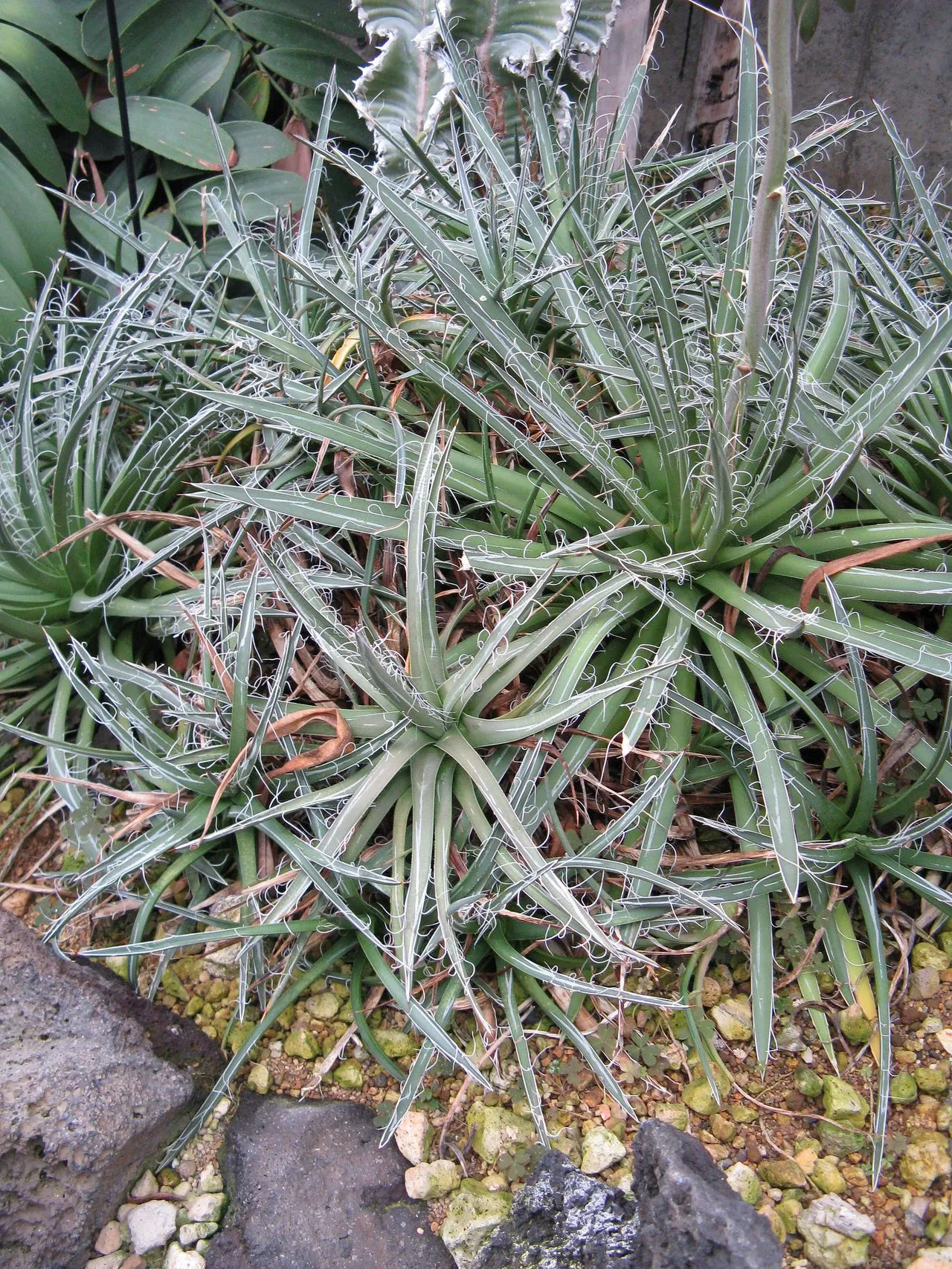
| Question | Short Answer |
|---|---|
| How small is Agave parviflora? | Mature rosettes are usually 10 cm to 20 cm across, making it one of the smallest agaves in cultivation. |
| How do you identify Agave parviflora? | Look for compact size, white bud-imprint stripes, curling white filiferous margins, and a short dark terminal spine. |
| Is Agave parviflora endangered? | Yes. |
| How do you propagate Agave parviflora? | Seed is the main route and germinates in 2 to 3 weeks on sterile pumice at 22 °C to 28 °C. |
Agave parviflora Torr. (Santa Cruz striped agave, small-flowered agave) is the smallest-flowered species in the genus and one of the most diminutive agaves in cultivation. Mature rosettes rarely exceed 20 cm across. It is native to the grassland-oak transition in southeastern Arizona and adjacent Sonora, at elevations between 1,000 m and 1,600 m, where it occupies rocky soils on open slopes.
Taxonomically it sits in the subgenus Littaea, group Parviflorae, alongside the closely related A. polianthiflora and A. toumeyana. The group is characterised by small stature, filiferous leaf margins, and dense spicate inflorescences.
Part of the Complete Agave Guide.
Identification
- Leaves. Short and narrow, 6 cm to 10 cm long and 1 cm to 1.5 cm wide, dark green with prominent white bud-imprint stripes on both surfaces, and conspicuously filiferous margins carrying curling white fibres that peel away as the leaf matures. The terminal spine is short, 5 mm to 10 mm, and dark.
- Rosette. Compact, 10 cm to 20 cm across at maturity, usually solitary but occasionally forming small clumps from basal offsets. Nearly spherical in profile in well-grown plants.
- Inflorescence. Spicate, 1.5 m to 2 m tall, with the smallest flowers in the genus, individual blooms only 10 mm to 15 mm long, pale yellow to cream. The inflorescence is disproportionately tall relative to the rosette and is the species's most striking feature in flower.
The combination of compact size, striking bud-imprint stripes, and filiferous margins makes mature A. parviflora unmistakable. Younger seedlings can be confused with A. toumeyana var. bella, but that species has longer leaves and a narrower inflorescence.
Cultivation
Cultivation diverges from the pillar defaults mainly in scale:
- Cold tolerance. Moderate. Survives −9 °C to −12 °C when dry, placing it in USDA zone 8. Winter wetness is more dangerous than cold.
- Light. Full sun in all climates, though the compact form is maintained best with some protection from the harshest afternoon sun in hot desert locations.
- Water. The small rosette holds limited water reserves and the species does need occasional summer watering in cultivation, more regularly than a large desert agave like A. parryi. Water deeply every 2 to 3 weeks in active growth, then allow to dry.
- Container choice. Perfectly suited to long-term pot culture. A 15 cm pot will house a mature plant.
The slow growth rate means seed-grown plants take 5 to 8 years to reach presentable size. Cultivated specimens worth buying are often well into their second decade.
Propagation
Seed is the primary route and germinates readily from fresh material. Sow on a sterile pumice surface at 22 °C to 28 °C; germination is typically within 2 to 3 weeks. Seedlings are small and slow but do not present unusual difficulty.
Offsets appear occasionally in mature specimens and propagate as per the pillar. Flowering is monocarpic and the parent rosette dies, but offsets produced before flowering carry the clone forward.
Notes
A. parviflora is listed as Endangered by the US Fish and Wildlife Service within its Arizona range, and US populations are federally protected. Wild collection is prohibited. Nursery-propagated plants are the only legal source.
The filiferous margins are a diagnostic character worth looking at closely. The white fibres are strips of detached epidermis that peel away from the leaf edge as the leaf expands, and their number and coarseness are distinctive between A. parviflora and the related A. filifera (which is larger, with more abundant and coarser fibres).
This is the agave for collectors who want a mature flowering specimen on a windowsill, something few other species can offer. For a comparable dwarf species with bold bud imprints rather than white stripes, compare Agave isthmensis.
See also: Agave victoriae-reginae, Agave parryi, Agave murpheyi.
Quick answer: how do you keep Agave parviflora healthy?
Give Agave parviflora strong light, a small pot with a drainage hole, and gritty soil that dries quickly. A cactus mix such as Miracle-Gro Cactus, Palm & Citrus Potting Mix can work better if you add extra pumice or perlite for a sharper-draining blend. As an Amazon Associate, we earn from qualifying purchases, at no extra cost to you.
The pot matters as much as the soil
This plant has a small root system and hates sitting wet. Do not move it into an oversized decorative pot just because the rosette looks valuable. A snug terracotta pot is usually safer than a deep glazed container.
Watering rhythm for small striped agaves
Water deeply, then wait until the mix is dry through most of the pot. In winter or low indoor light, that wait can be much longer than expected. If the lower leaves go soft near the crown, stop watering and check the roots before adding more.
Frequently Asked Questions
How big does Agave parviflora get?
It stays small for an agave, often around 6 to 10 inches tall with a compact rosette. Growth is slow, especially in containers.
Can Agave parviflora grow indoors?
It can grow indoors only in very bright light, such as a sunny south-facing window or under a strong grow light. Weak light causes stretched, softer growth.
What soil does Agave parviflora need?
Use a gritty cactus mix that drains fast. If the mix stays damp for days, add pumice, perlite, or coarse mineral grit and use a pot with a drainage hole.