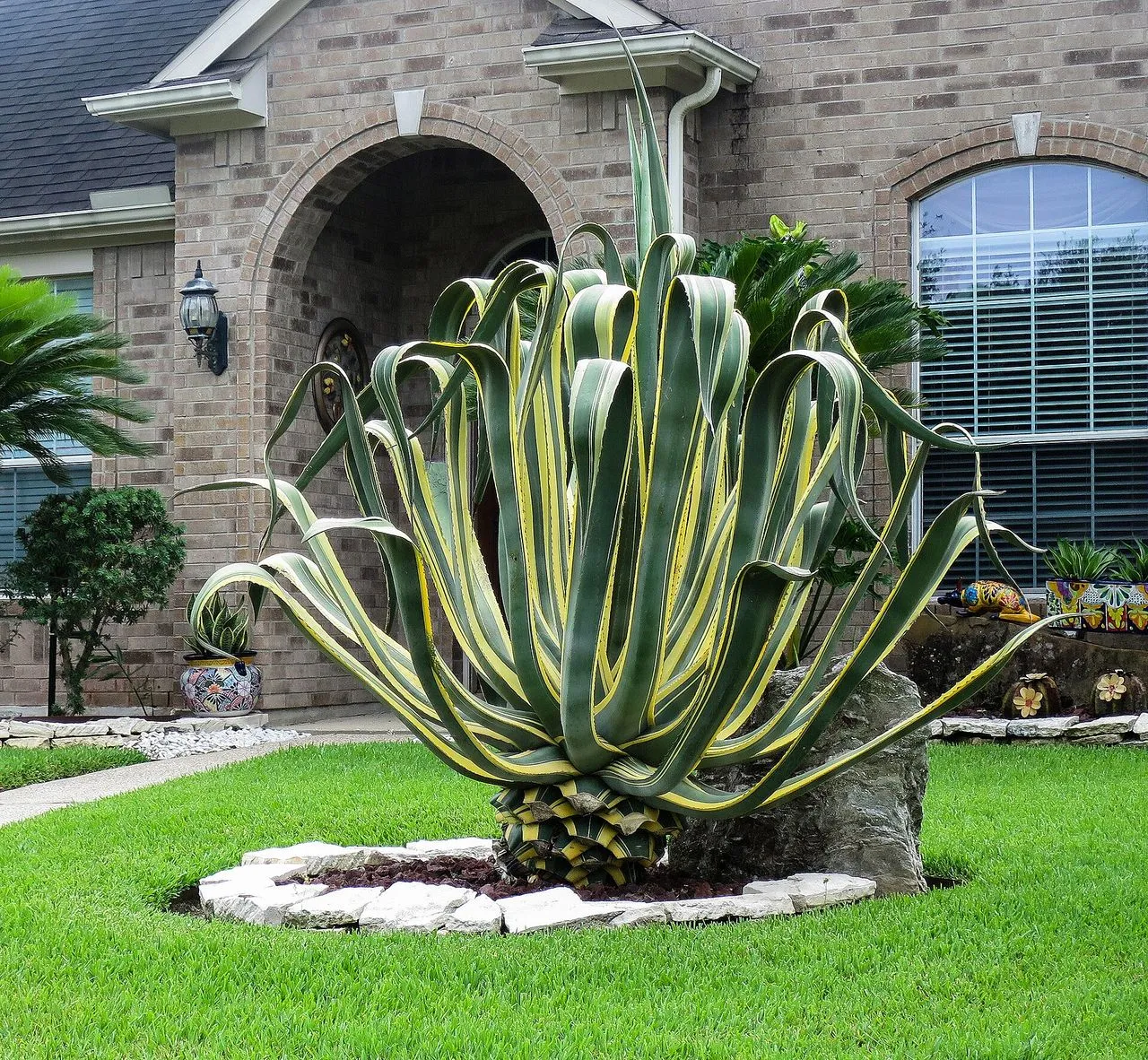
Dying bottom leaves are a near-universal feature of agave cultivation, and in most cases they require nothing more than removal once dry. The Agave rosette grows from the centre outward: each new leaf emerges at the heart, pushing the existing leaves outward and downward. The outermost leaves are the oldest; they have been through the most cycles of stress and recovery, and they eventually die. That is biology, not disease.
The diagnostic challenge is that root rot, which is a serious problem, also begins its visible effects at the bottom of the plant, producing outer leaf death that superficially resembles senescence. Reading the texture and colour of the dying leaves — not just their position — is the difference between doing nothing and performing an urgent root inspection.
Part of the Complete Agave Guide.
Normal basal senescence
A healthy Agave in active growth sheds outer leaves continuously. The rate depends on species, container size, season, and light. A fast-growing landscape species in full sun may lose several outer leaves per season. A compact slow-growing species may lose one per year. In all cases, the dying process follows a consistent pattern:
- The leaf tip browns and dries first, then the browning extends toward the base over weeks or months.
- The leaf body remains firm until most of it is dry.
- The final dried leaf is papery, straw-coloured or light brown, and pulls free from the stem with moderate tension once fully desiccated.
- The stem beneath the detached leaf is pale, dry, and clean.
This process is indistinguishable from drought tip damage in early stages, but senescent leaves do not require any care intervention. They will complete their cycle regardless of what watering changes are made. Cutting them off prematurely tears tissue from the stem and creates fresh wounds that invite secondary infection.
The correct approach is to allow senescent leaves to complete their drying cycle, then remove them by pulling parallel to the stem with a firm, steady motion. A fully dry leaf releases cleanly. A leaf that resists is not ready and should be left for another 2 to 4 weeks.
Root rot progressing upward
Root rot begins in the root system but eventually becomes visible in the leaves. As roots die and lose function, the oldest outer leaves — which receive the least hydraulic support from the reduced root system — begin to fail first. Early root-rot leaf death can mimic senescence for several weeks before distinguishing signs appear.
The signs that separate root rot from senescence are in the texture and colour of the dying leaf:
- Yellowing before browning. Senescent leaves typically brown directly. Root-rotted outer leaves often turn pale yellow or translucent first, then collapse, without progressing through a firm papery stage.
- Softness at the leaf base. A senescent leaf is firm until nearly fully dry. A root-rotted leaf may be soft, watery, or translucent at the base while still appearing semi-green elsewhere.
- Sour smell. Compress a suspected root-rot leaf at its base. A faintly sour or fermented smell indicates bacterial activity from root failure, not normal tissue drying.
- Rate of progression. Senescence is slow, measured in weeks. Root rot can produce visibly new outer leaf failure day by day in warm conditions.
If any of these signs are present, unpot the plant immediately. Do not wait for the leaves to complete their cycle. Root rot caught at the outer-leaf stage is still treatable; rot that reaches the crown is not, as described in Agave crown rot.
Pre-monocarpy accelerated shedding
In species approaching their reproductive phase — particularly those that flower on the younger end of their range, such as Agave americana in warm climates at 10 to 20 years — outer leaf attrition can accelerate before any inflorescence stalk appears. The plant is reorganising resources toward the inflorescence.
This is normal but worth recognising. Pre-monocarpic shedding is dry and proceeds faster than ordinary senescence but does not have the soft or yellow character of rot. The central growth point is firm and the centre of the rosette is beginning — slowly at first — to elongate upward rather than spreading outward in the flat pattern of a vegetative rosette. The full context for this process is covered in Agave monocarpy explained.
There is nothing to correct in pre-monocarpy. The outcome is predetermined. If offsets are present, they can be separated and grown on. The mother rosette will flower and die.
Physical damage and animal activity
Bottom leaves on outdoor landscape agaves can be damaged by ground contact, snail feeding, small mammal activity, or irrigation systems directing water at leaf bases. These causes produce localised damage that may look similar to senescence in early stages.
Physical damage is usually asymmetric. Senescence and root rot progress roughly uniformly around the rosette. A pattern where leaf damage is concentrated on one side or on specific leaves is more consistent with contact, abrasion, or animal feeding. Check for slime trails (snails), tooth marks, or areas of persistent rubbing contact from paths, furniture, or fencing.
Mechanical damage on a few leaves does not require any action beyond monitoring. If the contact source can be removed — moving the pot away from a wall, clearing mulch from the basal leaves — that prevents further damage.
How to identify the cause of bottom leaf death
| Leaf appearance | Likely cause | Action |
|---|---|---|
| Brown, dry, papery, firm to the base | Normal senescence | Remove when fully dry; no other intervention |
| Yellow, soft, translucent at base | Root rot progressing upward | Unpot and inspect roots immediately |
| Brown, dry, central growth elongating upward | Pre-monocarpy | Observe; separate offsets if desired |
| Soft, damaged, asymmetric pattern | Physical or animal damage | Inspect contact points; remove clean dry tissue |
Risk and severity
Act immediately when bottom leaves are soft, yellow, or translucent at the base; when the stem at the leaf attachment point is wet or dark; when the plant smells sour; or when new outer leaf failure is appearing faster than one leaf per week. These are root rot signs.
Wait when dying leaves are firm, browning from tip to base, and the rest of the rosette is rigid and showing normal central growth. Normal senescence requires patience, not intervention.
The risk in acting too early — cutting leaves that are only partially drying during normal senescence — is that stem wounds at the attachment point can introduce infection or weaken the structural base of the rosette. The plant marks the boundary of each leaf naturally and seals it cleanly when ready.
Solutions
Removing senescent leaves
Once a leaf is fully papery and the base feels dry and non-green, grasp it near the base and pull parallel to the stem with steady, increasing pressure. If it resists, leave it for another 2 to 4 weeks. Do not twist or use cutting tools unless the leaf is clearly dead but mechanically stuck, in which case cut only the leaf body and leave the base to dry and separate naturally.
Wear thick gloves when working around armed species. The terminal spines of dying leaves are no less dangerous than those of live ones.
For root rot
Unpot and inspect roots. Cut dead roots back to firm, pale tissue with a sterile blade. Allow bare-root drying for 5 to 10 days, then re-pot in a dry mineral mix. Withhold water for 7 days after potting. Resume normal care only after new central leaf growth confirms root function has returned. If the outer leaf damage has progressed to the stem, assess whether that damage is dry scar (survivable) or active wet rot.
For pre-monocarpy
No intervention is needed for the mother rosette. Separate and pot any offsets while they are at one-third to one-half the size of the parent, with a clean cut and 5 to 10 days of callusing time before potting. The flowering cycle from first stalk elongation to death of the rosette can last 1 to 3 months. The spent rosette should be removed with a saw or loppers after the inflorescence is fully dead.
Prevention
Water agaves into the root zone, not over the whole plant. Correct watering frequency prevents both the drought stress that can accelerate outer leaf death and the wet conditions that trigger root rot. Use a mineral substrate that dries predictably between waterings and does not hold residual moisture at the leaf bases.
Inspect the base of the rosette seasonally, particularly in spring and after wet winters, to catch soft or discoloured outer leaf bases before they reflect established root damage. Catching root rot while it affects only the outer two whorls of leaves is consistently more successful than addressing it after it has progressed to the stem. See also Agave not growing for the intersection of arrested growth and outer leaf failure.
See also
- Agave leaves yellowing — the earlier colour stage of root failure, before leaves die back fully.
- Agave brown tips — when tip browning accompanies outer leaf attrition from drought or root restriction.
- Agave monocarpy explained — the full lifecycle context for accelerated basal leaf shedding before flowering.
- Agave not growing — when outer leaf loss coincides with arrested central growth, signalling active root problems.
Frequently Asked Questions
Is it normal for agave leaves to die from the bottom?
Yes. Agaves add leaves from the centre and lose the oldest ones from the outer ring. Dry, papery, or dried-brown outer leaves are normal and require no action beyond removal once fully desiccated.
How many bottom leaves should an agave lose per year?
This varies by species and growth rate. A fast-growing large species may shed several outer leaves per growing season. A slow compact species like Agave victoriae-reginae may lose only one or two per year.
Can bottom leaf death signal that an agave is about to flower?
In older plants, accelerated outer leaf death can precede monocarpy, particularly in species that flower at a younger age. This should be accompanied by central elongation toward an inflorescence stalk to be meaningful.
Should I remove dead bottom leaves from my agave?
Remove leaves that have fully dried and detach with moderate pressure. Do not force green or partially green leaves. Leave dry attached leaves in place until they can be pulled free cleanly without disturbing the stem.