| Question | Short Answer |
|---|---|
| What does monocarpy mean in agaves? | It means a rosette reproduces once and then dies. |
| Can cutting an agave flower spike save the plant? | No. |
| How long does an agave death-bloom take? | From first spike emergence to full collapse usually takes 6 to 18 months, depending on species, temperature, and water. |
| Do any agaves flower more than once? | Yes. |
An Agave rosette flowers once, then dies. That single sentence covers the life history of most species in the genus and explains the popular name death-bloom for the spectacular flowering event. Here is the biology behind it, the timing, the warning signs, and the reason the plant in your garden is still alive even when the rosette in the middle has just collapsed.
Part of the Complete Agave Guide.
What monocarpy is biologically
Monocarpy, or semelparity in zoological language, describes a life history where an organism reproduces once and then dies. Bamboo flowering on a multi-decade clock, salmon returning to spawn, and the death-bloom of an agave all share this pattern. The opposite, polycarpy or iteroparity, covers most familiar perennials, including an apple tree that fruits every autumn or a Sempervivum whose mother rosette flowers and dies while the surrounding clonal mat persists.
The mechanism is energetic, not mystical. A monocarp accumulates resources over years and converts them all at once into reproduction. The flowering event is so costly that no reserves remain to rebuild leaves, repair roots, or hold structural tissue together. Once the carbohydrates, nitrogen, phosphorus, and stored water have moved out of the storage organs and into the inflorescence, the parent body cannot recover. Selection favours this approach when seed production scales steeply with reproductive size: one massive event makes more offspring than many smaller ones spread across a long life.
How it works in Agave
The genus is the textbook example. An Agave rosette behaves as a long-running carbohydrate bank. Crassulacean acid metabolism takes in CO2 at night and fixes it during the day, while sugars and starch accumulate in the thick leaves and the underground stem. For most species, that bank fills slowly over years.
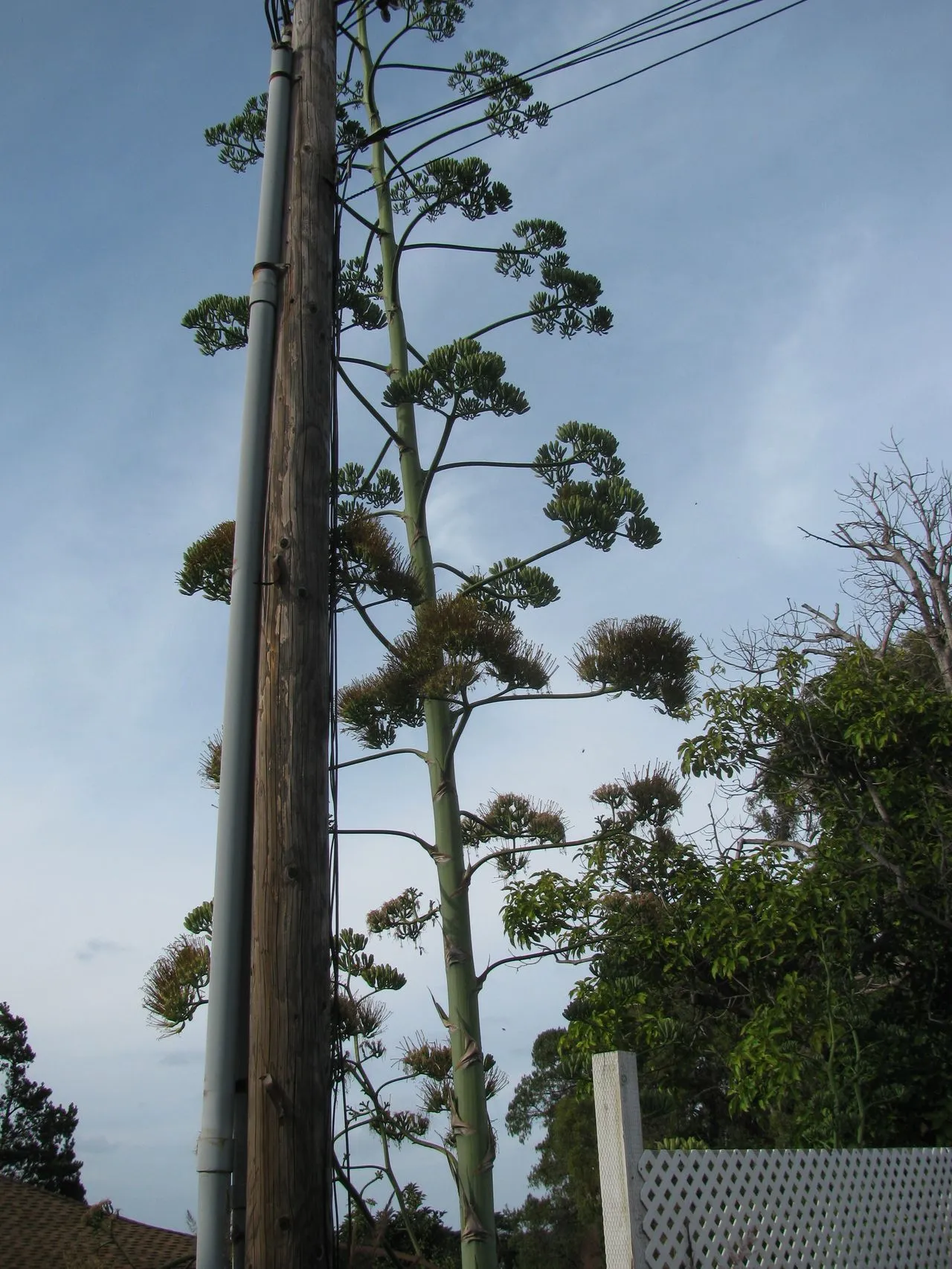
When the plant reaches reproductive size and the right environmental cues arrive, often a combination of crown maturity, rainfall, and temperature, the apical meristem switches from leaf production to inflorescence development. Within a few weeks the spike begins to extend, and the entire stored reserve mobilises into a single panicle. Most large species build inflorescences 4 to 12 m tall, with hundreds to thousands of flowers, and seed output runs into the hundreds of thousands. The rosette pays for that with everything it has.
Time to flowering scales with size. Dwarf species such as Agave parviflora and A. isthmensis often bloom at 5 to 10 years. Mid-sized species such as A. parryi and A. utahensis run 10 to 20 years. The largest, including A. americana and A. salmiana, take 20 to 50 years in habitat, with cultivated specimens often flowering closer to 25 to 30. The popular name "century plant" for A. americana is folklore. Real flowering ages average around 25 years, sometimes faster in warm climates under steady irrigation.
The signs your Agave is bolting
Bolting is the visible start of the death-bloom. Three changes appear, usually in this order, across a few weeks:
- The central spear elongates rapidly. A normal central leaf grows in millimetres per day. A bolting agave pushes a thick inflorescence stalk that gains 10 cm or more per week, and in large species 30 cm per week is common at peak. The growth is straight, not curled, and clearly different in texture and colour from the leaves around it.
- The outer leaves spread. To make space for the spike, the rosette opens. Leaves that previously stood upright drop outward, and the centre flattens. Some growers mistake this for stress or rot and try to correct it. It is a structural rearrangement, not a problem.
- Basal pups appear or accelerate. Many species produce offsets earlier than usual once the inflorescence is committed. The plant is investing in clonal continuity while it still has resources to do so.
Once these three signs are present, the plant has already mobilised its reserves. The inflorescence will appear above the rosette within weeks.
What happens during the bloom
A finished panicle in A. americana or A. salmiana can stand 6 to 9 m above the rosette and weigh tens of kilograms. The structure carries a candelabrum of branches in the larger panicle-flowering species, or a single tall spike in spike-flowering species like A. attenuata. Flowers open in waves, drawing in bats, hummingbirds, hawkmoths, and bees depending on the species and the region. Seed sets in capsules over the following months.
While the inflorescence develops, the rosette visibly thins. Leaves lose turgor, change from saturated blue-grey to dull olive, and droop progressively from the outside in. The basal stem softens as starch leaves it. By the time the seed has set, most of the rosette tissue has been emptied. From the first appearance of the spike to full collapse takes 6 to 18 months in most species, faster in warm wet conditions, slower under cold or drought.
What to do (or not do)
Once bolting starts, nothing reverses it. A common mistake is to cut the spike early in the hope of saving the rosette. The cut does not return the carbohydrates already mobilised, and the plant continues to decline; what you gain is months, not survival. The only legitimate reason to remove a developing spike is the deliberate practice of pulque cultivation, where the central bud is cored to redirect sap into a basin for harvest, and even that ends in a dead rosette.
Practical guidance:
- Plan logistics early. A 6 to 9 m flower stalk on a heavy rosette is a real hazard near paths, glasshouses, fences, and overhead wires. If you have an A. americana in open ground and the central spear is climbing 20 cm per week, work out who removes the dead inflorescence and how, before it falls on its own.
- Water normally during the bloom. The plant will not save itself, but adequate moisture supports seed maturation and pup establishment around the base.
- Let the pups stay until the parent is finished. Detaching offsets while the parent is still channelling resources into them is counterproductive. Wait until the rosette has clearly declined and the pups are at least 10 to 15 cm across with their own roots.
- Wear eye protection when the dead stalk comes down. Spent inflorescences are heavy and brittle and often drop without warning.
If you are new to the genus and want a wider frame, the Complete Agave Guide covers light, substrate, watering, and cold tolerance for the species you are most likely to grow. For broader succulent care, the beginner's guide to succulents is the right starting point.
Polycarpic exceptions
A handful of Agave species are technically polycarpic. They flower more than once, and the rosette survives the bloom. The list is short and worth knowing:
- Agave attenuata, the foxtail agave. The arching unbranched inflorescence emerges laterally from the rosette rather than terminally, and the parent rosette typically continues growing afterwards.
- Agave bracteosa, the squid agave. Lateral inflorescences from a soft, spineless rosette; survives flowering and can repeat.
- Agave celsii (synonym A. mitis). Polycarpic in cultivation and habitat, with a smaller inflorescence proportional to rosette size.
- Agave murpheyi, a culturally significant species of the US-Mexico borderlands, treated as polycarpic by several monographs and observed to flower more than once in cultivation.
These exceptions sit on a spectrum rather than a clean dichotomy. Some authors describe A. attenuata as weakly monocarpic because individual flowering rosettes occasionally do die, and a few accounts of A. bracteosa suggest that a particularly large inflorescence can exhaust the rosette. The pattern matters, but the rule for the genus remains: assume monocarpy unless the species is on this short list.
Death after offsetting (the rosette dies, the clone lives)
The death-bloom is final at the level of one rosette, not at the level of the plant. Most cultivated agaves produce basal offsets across their lifespan, and almost all accelerate offset production once flowering begins. By the time the parent has collapsed, a ring of healthy young rosettes typically sits where the old leaves used to fan out.
Those clones are genetically identical to the parent. They inherit not only species character but the specific selected traits of named clones; A. americana 'Marginata', A. attenuata 'Boutin Blue', and the variegated forms in trade are propagated this way for exactly this reason. The original mother dies, the line continues. From a gardener's perspective the plant has not vanished. The same individual, in clonal terms, has reorganised itself into several smaller bodies arranged around the burial site of the previous rosette.
The post-bloom job is therefore patient cleanup, not replacement. Cut the dead inflorescence at a safe height, remove the empty leaves once they detach easily, leave the stem stub to decay or extract it cleanly once the pups have rooted firmly. Allow another season before transplanting offsets, since young rosettes establish faster on the parent's residual root mass than they do in fresh substrate. Within two to three years, the circle of clones reads as a healthy clump rather than the aftermath of a death-bloom.
The death is real. The agave family in front of you is not over.
See also
- Complete Agave Guide - genus-level cultivation, flowering, hardiness, and propagation.
- Agave americana, the type species and the archetypal large landscape agave that gave rise to the "century plant" name.
- Agave tequilana, Weber's Blue agave, the cultivated source of tequila and a contrasting commercial-scale monocarp.
- Agave pups not producing — why offset production varies by species and how monocarpy timing affects it.
Frequently Asked Questions
What does monocarpy mean in agaves?
It means a rosette reproduces once and then dies. The plant converts stored carbohydrates, water, nitrogen, and phosphorus into one flowering event.
Can cutting an agave flower spike save the plant?
No. Once bolting starts, reserves have already mobilised. Cutting the spike may delay collapse but does not restore the rosette.
How long does an agave death-bloom take?
From first spike emergence to full collapse usually takes 6 to 18 months, depending on species, temperature, and water.
Do any agaves flower more than once?
Yes. Agave attenuata, A. bracteosa, A. celsii or A. mitis, and A. murpheyi are listed in the post as polycarpic exceptions.