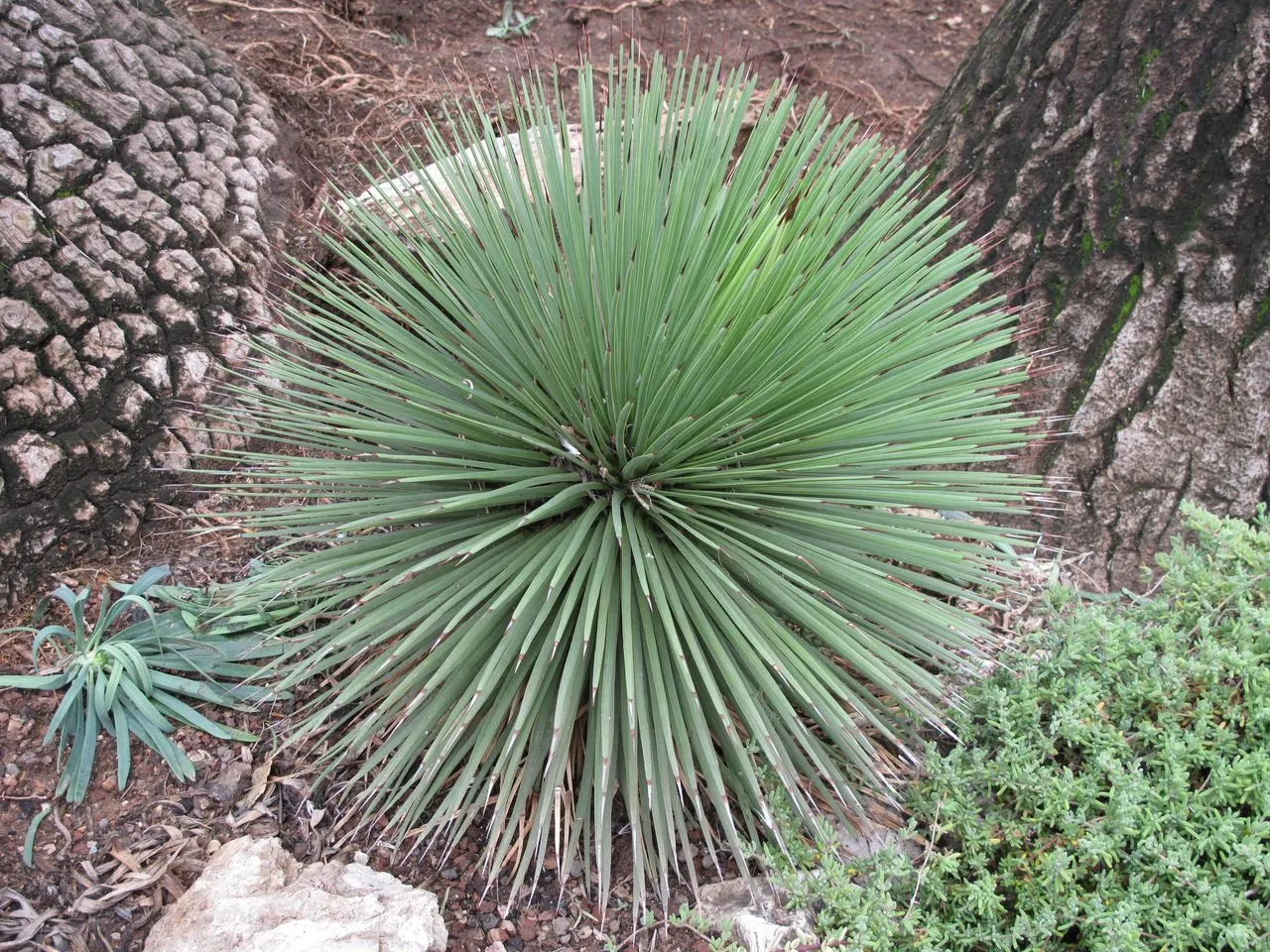
Yellowing leaves on an agave are not a diagnosis. They are a signal that stored tissue is being abandoned, damaged, or starved. The important distinction is whether the yellowing is restricted to the oldest outer leaves, where it can be normal, or spreading through younger leaves, where it usually means roots, light, temperature, or pests are failing the plant.
Do not respond to yellow leaves by watering automatically. In agaves, that mistake turns a dry stress problem into a wet rot problem. Part of the Complete Agave Guide.
Normal ageing of outer leaves
Every agave slowly retires its oldest leaves. The rosette grows from the centre, and the outermost leaves are the oldest tissue. When those leaves have done their work, the plant withdraws resources, the colour fades from blue-green or green to yellow-tan, and the leaf eventually dries to a rigid brown shell.
Normal ageing has a strict pattern. It affects the lowest one or two leaves, not the central spear. The leaf remains relatively firm while it yellows, then becomes dry rather than mushy. The rest of the rosette stays symmetrical and tight. A large Agave americana may carry several dry skirts of old leaves; a small A. victoriae-reginae may show only one ageing outer leaf at a time.
Over-watering and root rot
The most common harmful cause is excess water around the roots. Agaves are built to store water in fibrous leaves and tolerate long dry intervals. When substrate stays wet, oxygen disappears from the root zone, root tips die, and the plant can no longer regulate water uptake. Leaves turn yellow, then translucent, soft, or grey because the root system is failing beneath them.
Container plants are especially vulnerable in peat-heavy compost, decorative cachepots without drainage, and winter rooms below 10 °C. The symptom often starts at the lower leaves but spreads faster than normal ageing. If a yellow leaf base feels wet or the pot is still heavy several days after watering, assume root stress until proven otherwise.
Low light and inefficient growth
Agaves need high light to maintain compact, strongly coloured leaves. A plant kept in a north-facing window, under a deep porch, or behind tinted glass may not rot, but it can still yellow because photosynthesis cannot support the existing leaf mass. New leaves emerge narrower, paler, and more upright or stretched. Older leaves are sacrificed early.
This differs from over-watering by texture. Low-light yellowing is usually firm rather than mushy, and the centre may remain intact while the rosette becomes open and weak. The fix is gradual movement to stronger light. Do not place a shaded plant directly into full summer sun; acclimate over 2 to 3 weeks to avoid sun scorch.
Cold stress and wet winter soil
Cold tolerance is species-specific. Agave parryi and A. utahensis tolerate hard frost when dry, while A. attenuata, A. tequilana, and many lowland species are damaged near 0 °C. Yellowing after a cold night often appears where leaves were most exposed, especially on outer leaves and tips. If roots were wet during the cold event, the damage can progress into rot at the base.
Cold yellowing may not show fully for several days. Tissue that looked merely dull after frost can turn yellow, then tan or black as cells collapse. Keep the plant dry and above freezing while you wait. Cutting immediately into cold-damaged tissue exposes wet wounds before you know how far the damage extends.
Nutrient imbalance and exhausted substrate
Agaves are not heavy feeders, but long-term container plants can yellow when mineral substrate contains almost no available nutrients or when pH drifts far from neutral. General paling across older leaves, with otherwise firm tissue and healthy roots, can indicate exhaustion rather than rot. This is more likely in a plant that has not been repotted for 3 to 5 years and has roots circling the pot.
The solution is not high-nitrogen feeding. Excess nitrogen produces soft, over-expanded tissue. Repot into a fresh free-draining mix with a modest loam fraction, or feed at quarter to half strength during active growth only. Avoid feeding in winter, when low light and cool conditions make lush growth more vulnerable.
Pest damage at the crown or roots
Mealybugs, root mealybugs, scale insects, and agave snout weevil can all produce yellowing by interrupting water movement or damaging the crown. Above-ground mealybugs hide deep in leaf axils as white cottony deposits. Root mealybugs leave white wax on the root ball. Snout weevil is more serious: yellowing combines with a soft crown, sour smell, and loose central leaves.
Pest yellowing is often patchy. One side of the plant may decline faster, or the yellowing may cluster around leaf bases where insects feed. Use a torch to inspect between leaves and unpot the plant if symptoms do not match watering history.
How to identify the cause
| Pattern | Most likely cause | What to check |
|---|---|---|
| One or two outer leaves yellow, then dry | Normal ageing | Firm centre and dry leaf texture |
| Yellow, soft, translucent lower leaves | Over-watering or root rot | Wet mix, black roots, sour smell |
| Pale centre and stretched leaves | Low light | Distance from window, hours of direct sun |
| Yellow after frost or cold rain | Cold injury | Species hardiness and wet roots |
| General pale firm leaves | Exhausted mix or pH issue | Years since repotting, root congestion |
| Yellowing plus cottony deposits or collapse | Pests | Leaf axils, root ball, crown firmness |
Texture is more useful than colour. Dry yellow-brown is usually old tissue. Wet yellow-green is usually active damage.
Risk and severity
Act immediately when yellow leaves are soft at the base, the crown smells sour, the central spear loosens, or the pot remains wet for more than a week in mild conditions. Those signs can move from recoverable root stress to crown rot quickly.
Wait when only the lowest leaf is drying and the rosette is otherwise rigid. Normal leaf retirement can take 2 to 6 weeks. Professional help is needed for large in-ground plants with suspected snout weevil or crown rot because removal around rigid spines is hazardous.
Solutions
For normal ageing
Leave the leaf alone until it dries completely or detaches with light pressure. A dry skirt is not harmful outdoors and can even protect the stem, though it may shelter pests in humid climates. Remove dry leaves with gloves if they trap debris.
For over-watering
Unpot the agave. Remove wet substrate and inspect roots. Cut away black, hollow, or foul-smelling roots with a sterile blade. Let the plant dry bare-root in shade for 5 to 10 days, then repot into a mineral mix such as 60% pumice or lava grit, 25% coarse sand, and 15% loam-based compost. Do not water for another week.
For low light
Move the plant to brighter conditions in stages. Start with morning sun for a week, then add afternoon exposure. Indoors, a south-facing window or strong grow light is the minimum for compact growth. Distorted yellowed leaves will not turn perfect again; judge recovery by firm new leaves emerging from the centre.
For pests
Treat visible mealybugs with 70% isopropyl alcohol on a swab and repeat weekly for 4 weeks. For root mealybug, remove old substrate, rinse roots, and repot into fresh dry mix. For suspected snout weevil with crown collapse, discard the mother rosette and save only firm clean offsets.
Prevention
Water only when the substrate is dry to the bottom of the pot. Keep winter roots dry, especially below 5 °C. Use a pot with drainage and a mineral substrate rather than peat-heavy compost. Give agaves direct sun after acclimation, and rotate container plants every few weeks so one side does not weaken in shade.
Repot long-term container agaves before the mix collapses into fine particles. A 2 to 4 year interval suits many potted plants, while slow species in mineral mixes can go longer. Inspect leaf axils during every watering; early pest detection prevents yellow leaves from becoming a collapsed crown.
See also
- Agave snout weevil — the pest problem to rule out when yellowing includes crown softness.
- Agave victoriae-reginae — a compact species where abnormal yellowing is easy to spot.
- Beginner's guide to succulents — cross-genus basics for light, watering, and drainage.
- Agave leaves turning black — when yellowing advances to active black rot in the crown.
Frequently Asked Questions
Are yellow lower leaves normal on agaves?
One or two outer leaves yellowing and drying over several weeks is normal ageing. Yellowing across the centre or multiple leaf ranks is a stress signal.
Why are my agave leaves yellow and soft?
Soft yellow leaves usually mean roots are staying wet too long or the crown has begun to rot. Unpot container plants and check for black, hollow, or sour-smelling roots.
Can low light make agaves yellow?
Yes. Agaves kept below high-light conditions produce paler, weaker growth and may shed older leaves faster because the plant cannot support them efficiently.
Should yellow agave leaves be cut off?
Remove only leaves that are fully dry or rotten. Cutting partially yellow living leaves creates wounds and does not solve the underlying problem.