| Question | Short Answer |
|---|---|
| What light does this Crassula need? | Bright light is the default. |
| How should it be watered? | Water thoroughly, then allow the upper 3–4 cm of substrate to dry before watering again. |
| What substrate works best? | Use a free-draining mix with substantial pumice, grit, or perlite. |
| How is it propagated? | Stem cuttings are the most reliable method for most Crassula. |
Crassula alata (Viv.) A.Berger is a small winter-growing annual succulent widely distributed around the Mediterranean basin, the Canary Islands, and parts of southern Africa. It is one of a small group of annual species in a genus otherwise dominated by long-lived perennials.
Part of the Complete Crassula Guide.
Identification
Small size and annual habit make it the odd one out in the genus.
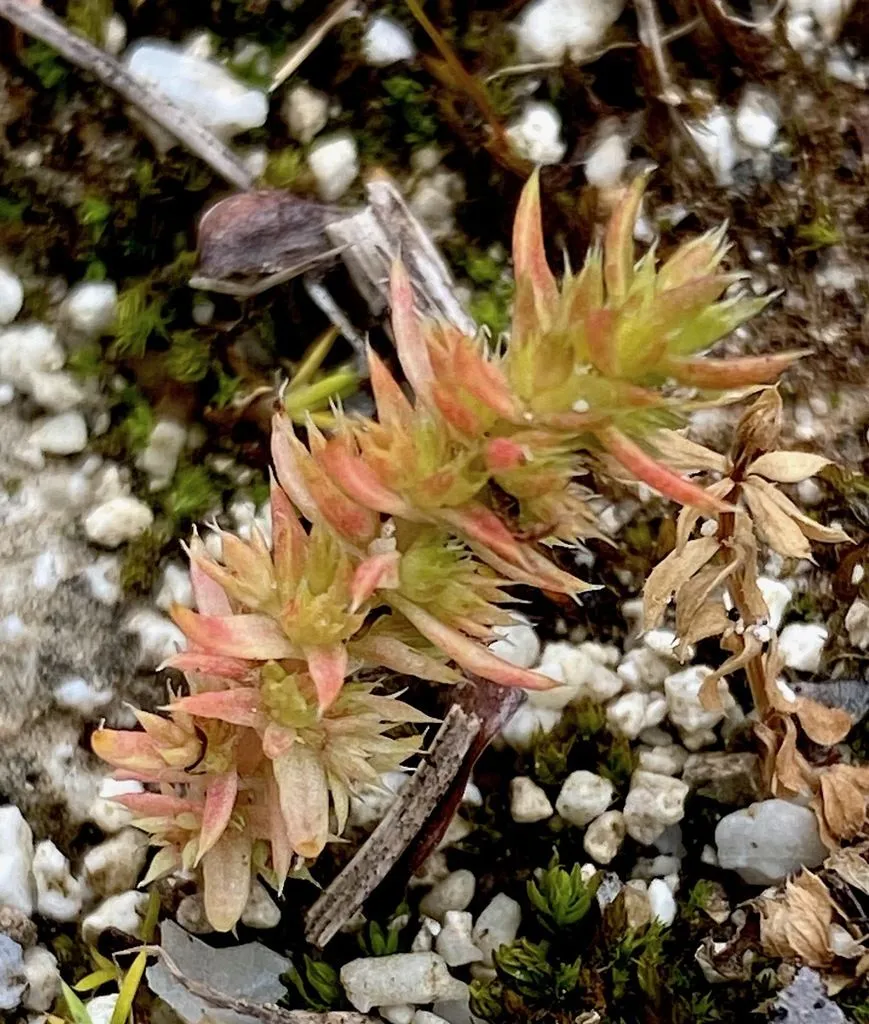
- Habit. A tiny upright or sprawling annual, rarely more than 5 cm tall and 8 cm across at maximum. Single plants die after flowering and seeding.
- Leaves. Narrowly oblong to linear, 2–6 mm long, arising in opposite decussate pairs along the slender reddish stem. Green to pink-flushed depending on exposure.
- Flowers. Very small (2–3 mm) white to pale pink stars, produced singly or in tiny clusters in the leaf axils and at stem tips. Flowering runs from late winter into spring.
- Life cycle. Germinates from seed in autumn with the first cooling rains, grows through winter, flowers and sets seed in spring, and dies back by early summer.
The plant is easy to miss in the wild. It looks at a glance like a moss or an odd-growing sedum, and you usually find it by recognising the decussate leaves on a stem no thicker than a pin.
Cultivation
Because this species is an annual, cultivation is best thought of as seed-to-seed management rather than long-term care of a single plant.
Sow seed on the surface of a gritty free-draining mix in early autumn, water in lightly, and keep cool (10–15 °C) and bright. Seedlings appear within two weeks. Water sparingly through winter; the plant runs its whole growth cycle on cool temperatures and moderate moisture that mirror its native winter-rainfall Mediterranean habitat. Allow it to dry out completely as flowering finishes, and collect seed from the ripe capsules for the next season.
Do not attempt to carry mature plants through summer. They are programmed to die after seeding, and prolonged watering into summer produces rot, not survival.
Propagation
Seed only. Cuttings of an annual species produce short-lived flowering shoots rather than independent perennial plants, and are not worth attempting. Ripe capsules split easily; sow the fine seed on the surface of moist gritty mix and do not cover.
Notes and Quirks
C. alata is one of four or five annual species in the genus, which also includes C. tillaea, C. vaillantii, and C. aquatica. All share the same Mediterranean-climate winter-growing habit and are ecologically interesting but horticulturally minor, valuable mostly as botanical curiosities and for rock-garden miniature collections.
In parts of its native range the plant is an ephemeral coloniser of burned ground and disturbed soil. Seed banks persist for years, and a population can reappear decades after apparent disappearance following fire or rain.
See also
- Crassula muscosa
- Crassula alpestris
- Crassula capitella
- Crassula umbella — another short-lived species with an unusual growth form, useful as a botanical companion.
Frequently Asked Questions
What light does this Crassula need?
Bright light is the default. Compact species and red-flushing cultivars need several hours of direct sun after gradual acclimation.
How should it be watered?
Water thoroughly, then allow the upper 3–4 cm of substrate to dry before watering again. In cool winter conditions, reduce watering sharply.
What substrate works best?
Use a free-draining mix with substantial pumice, grit, or perlite. Dense peat-heavy compost keeps the root zone wet too long.
How is it propagated?
Stem cuttings are the most reliable method for most Crassula. Leaf cuttings work on jade-type plants but are less useful for tight stacked miniatures.